Since the ‘70s, the American diet has gotten bigger, grain-ier, and more protein heavy. But in recent years, it’s also gotten more… purply.
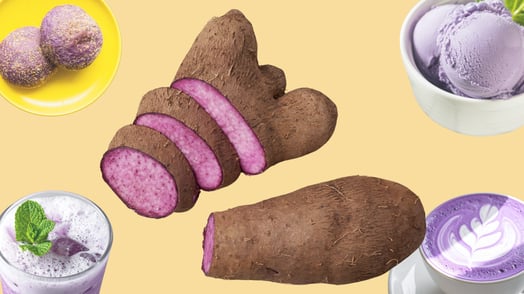
That would be due to foodies’ latest obsession: ube, a purple yam native to the Philippines, where it’s long been used to make sweets.
Now, its Instagrammable color and mild, nutty-vanilla flavor has made it an internet sensation that’s translated to high demand, particularly among American consumers, and an abundance of tasty new treats, per Bloomberg.
- The number of US restaurant menus featuring ube tripled between 2021 and 2025, per Datassential.
- Several brands have announced their own ube offerings, like Trader Joe’s, whose lineup includes regularly sold-out pancake mix and shortbread cookies, and Starbucks, which is introducing an iced ube coconut macchiato this month.
Supply chain woes take root
The ube craze might be a win for the businesses jumping on the trend, but it’s also led to a shortage of the climate-sensitive crop.
Exports from the Philippines, considered the world’s top producer, have quadrupled in recent years, with more than half of it bound for the US between 2019 and 2024, per The New York Times.
But ube is typically grown on small plots, mostly for local consumption, and yields have declined due to heavier-than-normal rainfall.
Consequently, local farmers are struggling to keep up with global demand and pushing for a geographical indication of ube, similar to Champagne, to protect production from moving abroad.
As for US ube purveyors, it’s driven up costs, which one San Francisco-based seller told Bloomberg have doubled since 2019, to $4.99 a pound.
If this all sounds familiar…
… that’s because matcha faced a similar shortage in 2025 after blowing up online, strained by surging demand and climate-related challenges, and made worse by people hoarding and scalping the green-tea powder.
But matcha and ube aren’t the only colorful foods feeding adventurous consumers’ growing appetites for Asian flavors:
- Ingredients like yuzu, miso, black sesame, and pandan are steadily entering the mainstream and expected to define 2026 food trends.
Plus, as quickly as purple has become the new green for American palates, the new purple might soon be… red? Animal blood, an ingredient used in cooking around the world, has been increasingly showing up on US menus and in cookbooks.
Food
-1.png)
%20copy%208.png)
%20copy%2011.png)
%20copy%206.png)
%20(1)%20(1)-1.png)
-1.png)