Lately, it feels like there’s always another headline about air travel gone wrong — door plugs blowing off mid-flight, planes nearly colliding, several fatal crashes — and naturally, it’s raised safety concerns around flying and put travelers on edge.
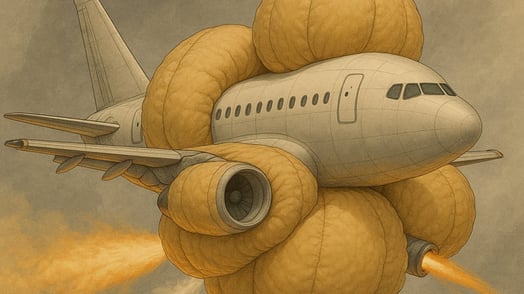
That’s why two engineers are proposing a bizarre solution: Project Rebirth, an “AI-powered crash survival system” that would prevent deadly crashes… by wrapping aircraft in giant inflatable airbags.
Sound (and look) cartoonishly simple? Yes. But the concept, which is all it is right now, is actually quite complicated.
How it works
The multilayered AI system would monitor altitude, speed, engine status, direction, temperature, and pilot activity.
- If it determines a crash is unavoidable below 3k feet, giant airbags would deploy from the nose, belly, and tail of the plane within two seconds (though the pilot would be able to override this).
- The airbags are made of layered fabrics (Kevlar, TPU, and Zylon) and non-Newtonian smart fluids that would absorb impact and protect the plane’s body.
- Then, assuming the engines are working, reverse thrusters would activate to slow the plane’s descent and reduce impact.
- After landing, infrared beacons, GPS, and flashing lights would help emergency responders locate the crash site.
Too farfetched?
Eshel Wasim and Dharsan Srinivasan — aviation engineers at Dubai’s Birla Institute of Technology and Science, who came up with the idea following the fatal Air India crash in June — say Rebirth can be installed on existing planes or built into new ones, and that simulations show a 60%+ reduction of impact force.
But an aviation safety expert told Popular Science that while the concept sounds promising, its viability hinges on several unknowns, particularly how much weight the enormous airbags and all its smart fluids would add to aircraft.
To figure that out…
… they’ll need to scale their testing beyond their current 1:12 scale prototype.
- The pair is looking to partner with aerospace labs, safety groups, and government orgs, with the goal to have Rebirth tested, approved, and used commercially by 2030.
But to get there, they’ll need funding — some of which they’re hoping to get through this year’s James Dyson Award.
The project is a nominee, and if it wins, the team will be $40k closer to making its lofty concept a reality.
technology
%20copy%202.png)

%20copy%204.png)