
There are, what feels like, a million wearables on the market that track everything from glucose levels to sleep. Yet, until recently, there was nothing to address the one bloody thing that half of the world’s population deals with on a monthly basis: periods.
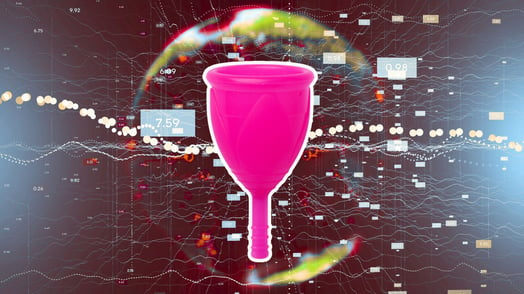
That's why Emm founder Jenny Button — who, in 2020, found herself wanting Oura ring-style insights about her menstrual cycle but found no products available to provide them — worked with engineers and biomedical scientists to make one.
Five years and thousands of prototypes later, she debuted the world’s first smart menstrual cup, which recently raised $9m and already has a 30k-person waitlist, per TechCrunch.
How it works
Like other menstrual cups, it’s designed to store blood, except it’s made from medical-grade silicone and embedded with ultrathin biosensors that collect data on the wearer’s menstrual cycle patterns, like:
- Daily flow rate
- Cup usage, so you know when to change it
- Period and cycle length, so users can track changes over time
That data — fully encrypted and anonymized — is sent to Emm’s app, where users receive personal insights about their menstrual health.
The cup offers 4x the capacity of a regular tampon and, when not in use, can be easily cleaned with soap and stored in its charging case for the month ahead.
The hope…
… is to “transform the research, diagnosis and treatment of menstrual and reproductive health conditions,” Button told TechCrunch.
- For example: endometriosis, a painful and often misdiagnosed reproductive condition that can take up to 10 years to diagnose, largely due to a lack of data.
Emm wants to accelerate those diagnoses and give women a better, data-backed understanding of their bodies.
The product launches in the UK next year, with a US expansion planned for 2027.
Period wearables…
… represent a new but burgeoning sector within femtech, an industry worth an estimated ~$40B in 2024 and expected to grow to $97B by 2030.
And while Emm is a pioneer in the field, it’s no longer the only one working on smart solutions to address that time of the month.
- In October, researchers at Canada’s McMaster University released a seaweed-powered menstrual cup that it hopes to eventually outfit with sensors to detect infections and blood-borne illnesses.
In June, scientists in Switzerland unveiled a pad-attachable device that can detect disease biomarkers in period blood.
health