“This is not a good thing. Other than opening jars, sperm is the only thing women need us for!!”
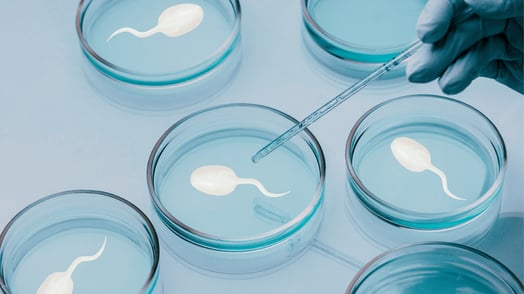
That was the reaction of one online user to the news that Utah-based Paterna Biosciences has successfully grown human sperm in a lab — a technique known as in vitro spermatogenesis — marking a breakthrough that’s been ~100 years in the making, per Wired.
- Others have tried: French biotech startup Kallistem claimed to have figured it out in 2015, but was unable to prove its sperm was capable of fertilizing eggs.
While Paterna’s findings have yet to be independently verified, its lab-grown sperm has already been used to create embryos in early testing, validating its viability.
So… she don’t need no man?
Well, to make a baby, she actually still do.
Sperm is produced from specific stem cells found in testicular tissue; IVS still requires those stem cells, meaning someone with balls is still part of the process.
But getting those stem cells into a petri dish is the easy part. The hard part that’s stifled past attempts is getting them to become sperm.
- Over ~65 days, sperm-producing stem cells journey through the testicles to eventually become the tailed swimmers you probably picture them as.
- But each step of that journey involves “very strict control mechanisms,” Paterna CEO and co-founder Alexander Pastuszak told Wired.
Using computational biology to determine the molecular signals involved and after testing several combinations, Paterna has figured out the “instructions that are needed to teach these stem cells to become mature, normal sperm.”
Why it is “a good thing”
Male factors account for ~50% of infertility cases, and ~10%-15% of infertile men produce no sperm at all. But they do still have the sperm-producing stem cells to create it, meaning the tech could help these men, who have few other options, become biological fathers.
One sperm retrieval specialist who spoke to Wired says it could also potentially help prepubescent cancer patients undergoing chemotherapy, since those stem cells are present at birth.
Plus, infertility care has largely focused on treatments for women, despite both genders being about equally affected by it. Advancements like this could lighten the physical and emotional load for women.
The company plans to conduct more testing to make sure it’s safe and effective before turning their science project into a human baby, but says trials for such sperm-derived pregnancies could begin as soon as next year.
%20copy%205.png)
%20copy%207-1.png)
%20copy%206-1.png)
%20copy-2.png)
%20copy%2017.png)
%20copy%2013.png)
%20copy-1.png)
%20(1)%20(1)-1.png)
-1.png)