We love an in-office perk, sure, but that typically means free pastries — not nicotine pouches.
Nicotine, most commonly associated with cigarettes, has long been available in a variety of alternative formats — e.g., vaping, patches, gums, etc. — as a cessation tool for smokers who’d like to quit.
However, non-smokers — especially tech workers in Silicon Valley — have begun using nicotine as a stimulant, per The Wall Street Journal. This has led some companies to offer it the way others provide protein bars and kombucha on tap.
Why? And also, how?
One study found that nicotine can have brain-boosting benefits, improving memory, attention, and cognitive processing. Alex Cohen, founder of an AI health-tech startup, told WSJ that, as someone with ADHD, it helps him focus.
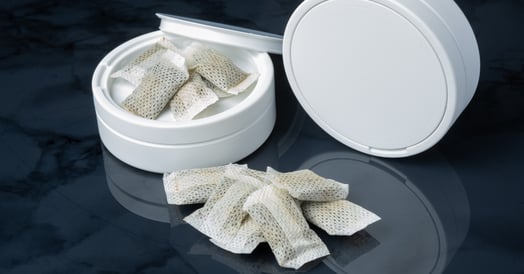
The preferred method of delivery is a flavored pouch, such as those produced by startups Lucy Nicotine and Sesh, that people tuck between their gums and teeth.
Palantir Technologies currently has a vending machine from each brand in its Washington, D.C., office, with pouches free for anyone 21 and up.
Is it dangerous?
Compared to smoking cigarettes — the leading risk factor for lung cancer — no.
But nicotine is still an addictive substance with potential negative health outcomes. A Swedish dentist told the BBC about some gnarly gum lesions he’d seen among pouch users that were so deep, the roots of nearby teeth were visible.
There’s also concern that pouch users might seek out nicotine in other more harmful forms, including cigarettes.
And perhaps it's mildly dystopian to think about companies supplying a habit-forming substance that makes workers more productive… until you remember that’s also coffee.
Speaking of coffee…
Forty-four percent of US companies offer free snacks, a key motivator for workers. Yet a tax law that allowed companies to deduct the cost of free food and beverages expired on Dec. 31, 2025. The change is expected to raise an additional $32B in taxes on employers through 2034.
It’s currently unclear if companies will pull back or not, per Bloomberg.
But it actually may not matter what perks employers provide. Forbes predicted that in 2026, one of the hottest office perks will be the ability to not go there thanks to the rise — and popularity — of remote and hybrid roles.
Those workers will have to provide their own bananas and nicotine fridges.
-2.png)
-1.png)