The act of turning water into wine may be divine. But at Credem Bank’s warehouse in northern Italy, which reportedly resembles a “cathedral of parmesan,” turning cheese into cash is just business.
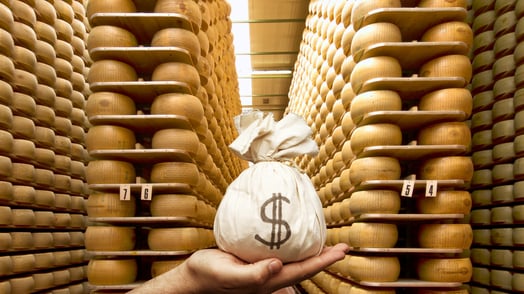
Since 1953, the regional bank has been wheeling and dealing in Parmesan Reggiano — one of the most strictly regulated foods in the world, produced by just 300 dairies — accepting the cheese from producers as collateral for loans.
And, according to CNN, it hasn’t lost a euro on it yet.
Why bank on cheese
The $4.7B industry relies on a delicate supply chain, tight regulations, and age-old methods.
- It can only be produced within a small geographic location using three ingredients — cow’s milk, salt, and rennet.
- After 12 months of aging, the Parmigiano Reggiano Consortium performs a tapping test to certify a wheel’s quality with its (literal) stamp of approval.
- Each wheel weighs 80+ pounds and can cost anywhere between $900 and $2.5k, depending on its age, with some maturing for up to 40 months.
For producers, that means revenue doesn’t arrive for at least a year. But farmers must be paid monthly, while other costs add up. Credem fills this gap.
While parm represents just 1% of the bank’s business, it’s a vital part of the overall industry.
“Without this system of leverage, the world of Parmigiano Reggiano cannot exist,” Italian dairy industry leader Paolo Ganzerli told CNN.
How it works
- Certified wheels are scanned and saved in a digital log detailing their production date, dairy or origin, and status.
- Then they’re stored on long wooden shelves in a climate-controlled vault, where they’re monitored daily for irregularities.
Producers receive 60%-80% of the wheel’s value upfront while saving on operational costs of aging the cheese, and banks hold onto an appreciating asset that it can sell if a producer defaults on a loan.
Blockchain technology has also recently doubled the bank’s lending capacity by allowing pledged wheels to be stored in producers’ own facilities.
BTW: Wine and whiskey are also commonly exchanged for financing, but food isn’t the strangest form of collateral out there. In 2011, a Spanish bank tried to offer Cristiano Ronaldo as collateral for a loan from the European Central Bank.
Food
%20copy%208.png)
%20copy%2011.png)
%20copy%206.png)
%20(1)%20(1)-1.png)
-1.png)