When people go to spas, it’s usually to unplug from technology and life’s stressors for a few relaxing hours. But soon, those looking to unwind might actually find it takes plugging in to unlock next-level relaxation.
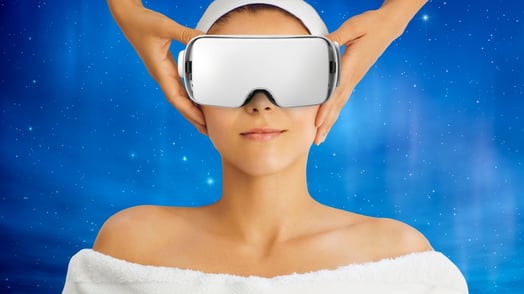
A growing number of spas and resorts around the world are beginning to offer “immersive digital wellness treatments,” the latest trend to hit the $6T global wellness scene.
What is it?
These treatments marry tech with traditional spa services to help relax the overstimulated. It’s aimed at people with anxiety or shrinking attention spans as a way to “soothe and engage the senses via video streams, synchronized light, music, vibrations and even scents,” per The Wall Street Journal.
One prominent player in the space is Submersive: the world’s first immersive art bathhouse, which is slated to open in Austin, Texas, next year. The 25k-square-foot, science-backed facility will feature trippy videos, lighting, and audio that change based on a user’s biometric data to inspire a sense of awe, transcendence, and deep relaxation.
Another is Senkiva, whose Vessel — a futuristic-looking pod available at the Four Seasons Oahu and coming to San Francisco next year — is said to have a “tremendous effect on physiology after just five minutes” (according to its CEO, anyway).
Some others:
- Jumeirah Burj Al Arab’s Talise Spa in Dubai offers a so-called “brain massage,” a 25-minute treatment involving beats and “3-D sound.”
- California’s StringTheory11 has The Harmonic Egg, a chamber with a zero-gravity seat that envelopes users with sound waves and light to enhance their mood.
- Golden Door offers The Circle, a multisensory outdoor healing experience where guests are surrounded by a huge 360-degree screen that plays dreamy videos of nature in tandem with live music. It debuted last year.
Do they work?
Depends on your goals. If you’re looking for a nice, relaxing time, yes; if you’re looking for a miracle, probably not.
Some wellness professionals are skeptical of the high-tech treatments and the promises they make. But while you shouldn’t expect long-lasting effects or for it to “cure” you (don’t quit therapy just yet), they can promote mindfulness and relaxation and help you feel grounded, even if only temporarily.
- WSJ’s Melinda Fulmer found her treatment at the very least helped keep her mind on the moment and not on a to-do list.
Ultimately, it’s too soon to really judge their effectiveness — but at a time marked by high anxiety and overstimulation, you can trust that they’ll do well enough for us to eventually find out.
%20copy%205.png)
%20copy%202.png)
%20copy%207-1.png)
%20copy%206-1.png)

%20copy%204.png)