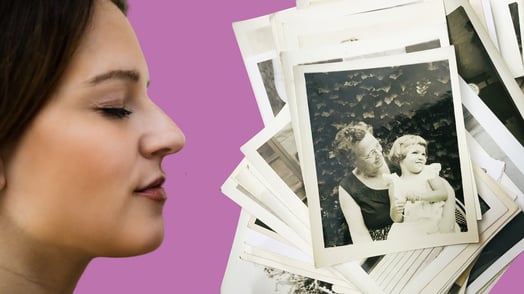
An old photo can transport you to a moment in time by allowing you to look at your memories. But what if you could smell your memories, too? Or even someone else’s?
MIT Media Labs researcher Cyrus Clarke is answering those questions with The Anemoia Device, a “scent-memory machine” that uses AI to turn physical photos into unique fragrances.
How it works
At the top of the three-tiered machine, a user inserts a physical photo. Then, an AI-powered computer in the middle section uses a visual-language model to interpret the image’s contents.
It generates a brief narrative, which the user can modify by adjusting three physical dials that inform perspective, time, and mood to determine the characteristics of the scent. For example:
- In a trial, a photo of either an apple or pear being eaten by a couple on stone steps was interpreted from the perspective of the apple, described as “in use” and “calm.”
- The result: a fragrance with notes of “spiced apple, pear, and earthy musk,” per Dezeen.
Finally, the AI system creates the scent based on a library of 50 fragrances, dispenses it from the bottom — and boom, you can now smell memories that might not be your own, or feel nostalgia for a time you never actually experienced — AKA “anemoia.”
Unlike sight and hearing…
… our sense of smell operates on hundreds of receptor types, per the World Economic Forum, which had made it too complex to digitize until recently, when AI made it possible.
Now, AI-powered olfactory intelligence is transforming industries — it’s already spurred innovations in fragrance production, product authentication, and health care diagnostics — as well as the human experience.
Which is what sets Clarke’s Anemoia Device (which he is contemplating turning into either an at-home machine or an online service) apart from other AI and tech: Instead of diminishing human connection and experiences, it grounds them in reflection and tangible memory.
"In today's reality, our memories are externalised, usually stored in digital infrastructure and retrieved through functions, files, and feeds," he told Dezeen. "They're accessible, but they're not truly with us, and I want to change that."
%20copy%2011.png)
%20copy%202.png)
.png)
%20copy%2010.png)
%20copy%209.png)
%20copy%208.png)
%20copy%204.png)
-1.png)