AI NPCs often flop in video games. But Arvore's "Fabula Rasa: Dead Man Talking" displays a clever use case.
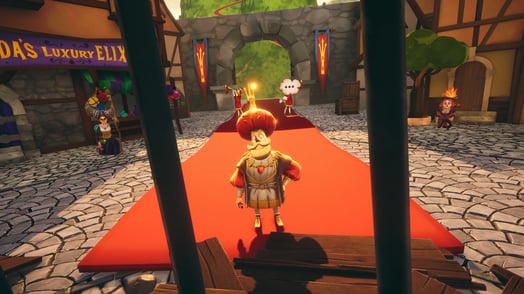
At SXSW, people tried to talk their way out of certain death. Few succeeded; the rest became lunch.
In “Fabula Rasa: Dead Man Talking,” a VR game developed by Brazil-based studio Arvore, you’re on trial in a medieval fantasy kingdom. You must convince the town you’re innocent or deserving of clemency, or the king will have you lowered into a pit with a voracious monster.
It’s fun, sure, but it’s also a rare example of AI-powered NPCs that actually work.
What do we mean by that?
NPCs, or non-playable characters, are game characters that the player doesn’t control — townsfolk, companions, etc. In most games, players speak to NPCs by choosing from a list of dialog options.
In theory, an AI-powered NPC could talk or chat with players in real time for a more immersive experience.
In practice? They often flop due to latency issues or because bots simply can’t deliver emotional impact talented voice actors can (it’s okay, we also cried during “Clair Obscur: Expedition 33”).
Why does “Fabula Rasa” work?
Arvore didn’t use AI to shorten production times or save money, “but as a storytelling medium… only possible because of AI,” Ricardo Justus, Arvore's CEO, told The Hustle.
“That was the challenge from the very beginning. In fact, we made a point of not using any gen AI art.”
The concept requires players to improvise — Arvore actually consulted with an improv comic during development — and thus can’t be pre-scripted.
Plus, the characters — which include a conniving witch and a helpful goblin — are actually enjoyable to talk to.
Making a model
Arvore built the characters, which Justus described as “a collection of contextual prompts that define who they are, their personality, [and] what they know,” with LLMs like Claude and ChatGPT, while their voices were crafted with ElevenLabs, an AI voice generator.
A second AI acts as a director. It keeps the story moving and chooses which NPCs show up based on what the player says.
The team spent a year fine-tuning the characters, creating guardrails, and making sure each felt distinct.
Luiza Justus, head of creative development, described it as “a lot of trial and error,” noting that the AI had to be reined in to make sure conversations didn’t become circular and that characters had context, not just about what was said to them, but about the world they lived in.
“We really wanted our story to evolve,” she said. “We didn't want it to feel like you're having one interaction with a character and then a separate interaction with another character — then it's just a string of a bunch of interactions. We wanted it to build on itself, and for you to feel like the thing you said back there matters over here.”
The end result is that every player has a unique experience based on the tactics they used to avoid — or not avoid — the monster, which makes it surprisingly social. At SXSW, players couldn’t wait to share their fate and attempted machinations with one another.
Is this the future of gaming?
It’s certainly a future, but don’t expect to see AI NPCs everywhere. The characters still pause to generate an answer, which works in a short experience but probably not in a 160-hour game. It also plays well in a comedic game like “Fabula Rasa” but would feel awkward in something more cinematic and serious.
“I think there is going to be room for games with very defined stories that are going to be handcrafted and with voice actors… and there’s going to be room for crazy games like this one that are only possible because of this medium,” Ricardo Justus said.
“Fabula Rasa” is currently playing at festivals with plans for a commercial release in the future.
%20copy%2011.png)
.png)
%20copy%2010.png)
%20copy%209.png)
%20copy%208.png)
-1.png)