

👋 Good morning. If you’re heading to a Fourth of July BBQ this weekend, maybe don’t ask what’s in the hot dogs. While 59% of Americans report eating hot dogs at least once a month, only 11% could name a specific health risk linked to processed meats, according to a survey from the Physicians Committee for Responsible Medicine. That’s despite the World Health Organization's recognition of processed meat as a Group 1 carcinogen. Maybe go for the corn on the cob?
P.S. Speaking of BBQs, we’re off tomorrow to host our own. See you back here Monday morning.
NEWS FLASH
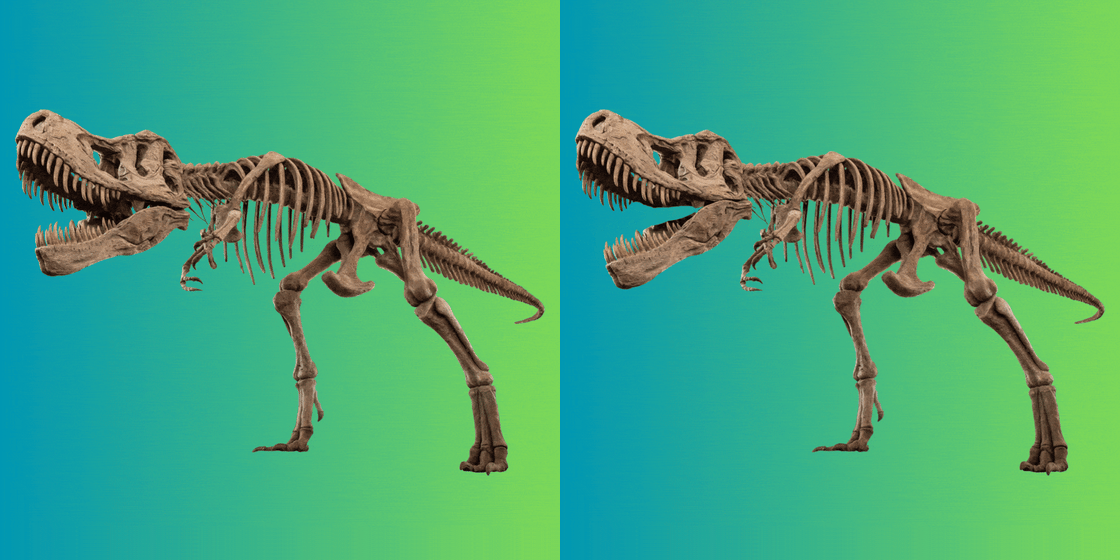
🦴 Jurassic jackpot: Sotheby’s is auctioning off Gus, a 67-million-year-old T. rex skeleton, this month. The 38-foot-long dino is one of the largest and most complete (61%) skeletons ever found, and is estimated to fetch a price of $20m-$30m. If you’re interested, grab your auction paddle (and your crypto, apparently, since it’s accepted as payment) on the 14th.
🎟️ The Netflix of Broadway: Startup prioriTIX is betting theatergoers will subscribe to Broadway shows the way they do to streaming services with monthly ticket packages starting at $90 a month. The platform tracks pricing to help members get better seats for less while giving show producers a steadier revenue stream.
🛰️ Space needs space: How many satellites can Earth’s orbit hold? No more than 100k, according to new research from the European Southern Observatory, which says anything more would have major impacts on astronomy. People who won’t like that news include Elon Musk, who plans to launch 1m satellites into orbit through SpaceX alone.
MORE NEWS TO KNOW
-
Still rolling: Uber-backed scooter-maker Lime raised $167m for its IPO, emerging as one of the sole survivors in the micromobility industry, which has burned an estimated $10B in investment since 2015 according to McKinsey.
- A unicorn is born: Venice AI raised $65m at a $1B valuation for its privacy-focused AI platform, which gives its 3m+ active users access to 200+ AI models without storing their data.
- Feature fail: More than half of social media child safety protections aren’t working as promised, according to a study from the Cybersafety Research Center, which tested 86 safety features across TikTok, Instagram, Snap, and YouTube.
- Everybody’s doin’ it: Honda will send batteries originally meant for its canceled US EVs to be used in energy storage systems for data centers.
PITCH LIKE A PRO

This is how you whip up a pitch
Shaan Puri, co-host of My First Million, has seen 1k+ pitch decks, funded 100+ startups, and launched them himself. Swipe his personal $20m pitch deck so you always have an airtight template for wooing new investors.
Sell like Shaan:
- Flex your credibility
- Tell your startup story
- Present some beautiful solution
- Explain how you take over the world
- Add some charts (“Investors dig charts” - Shaan)
- Reveal why this works now
- Blow their freakin’ minds
THE BIG IDEA
.png?width=600&height=293&name=Copy%20of%20Copy%20of%20Daily%20visual%20template%20-%202026-06-30T210837.035%20(1).png)
These startups are getting on our nerves
Put that avocado down.
Summer is the season of avocado hand, when roughly one in 50 knife injuries occurs while slicing that delicious green fruit. Hand surgeons kindly ask that you safely cut avocados on a cutting board, rather than wind up in the ER with severed nerves and tendons.
But if you happen to be an unlucky avocado victim — or one of ~500k Americans who suffer nerve injuries annually — startups are working to improve your chances of regaining feeling after an accident.
When peripheral nerves are severed, the two ends need to be held in place to allow the nerve to heal itself.
- Around 90% of nerve repair procedures rely on micro-sutures.
- But sutures can introduce tension, trigger inflammation and scarring, or limit the quality of regeneration.
- Only a 50-70% success rate for micro-sutures.
- Failure to heal properly can lead to numbness, tingling, pain, and loss of feeling.
Patch me up, doc
To improve outcomes and repair nerves in a more consistent, less traumatic way, French biotech startup Tissium developed a biodegradable liquid that attaches to tissue when exposed to light, per Wired.
- A biopolymer, made of fatty acid and glycerol, holds the nerve in place as it heals, before biodegrading.
- In one trial, 12/12 patients regained the ability to feel temperature, pain, texture, and light touch.
- Tissium raised $68m to expand commercialization and develop other applications, including hernia treatment and cardiovascular reconstruction.
Who else?
Other startups are also addressing nerve repair and pain in innovative ways, helping to propel the ~$9B market to an estimated $25B+ by 2032.
- Orthocell's Remplir is a collagen-based nerve wrap that mimics epineurium — the nerve's outer layer — for controlled healing without sutures. (It's currently used by soldiers in Ukraine.)
- Renerva's nerve cap aims to reduce chronic pain for amputees.
- Neuraptive Therapeutics’ NTX-001 kit fuses nerves together with a special solution that accelerates recovery and reduces pain.
- Epineuron's PeriPulse system uses bioelectronic therapy to stimulate nerve regeneration and healing.
- Researchers invented Nerve Tape, a device with microscopic hooks that creates a tube around nerve ends for more precise alignment and improved recovery.
- Myriagon developed a treatment for nerve pain caused by chemotherapy.
- Axogen's Avance Nerve Graft uses donor nerve tissue, rather than the patient's, reducing complications and speeding up recovery.
So, while there are plenty of promising nerve repair treatments out there, we still hope you avoid avocado hand this summer.
HIGHLY RECOMMENDED
Podcasting: It seems everybody’s doin’ it. But here’s how to reframe your strategy to do it right.
NEWSWORTHY NUMBER
%20(1).png?width=600&height=93&name=Noteworthy%20Number%20template%20(42)%20(1).png)
Square feet of sod — rolls of pre-grown grass that can weigh up to 2k pounds each and take about a year to grow — required for each World Cup stadium. For some stadiums, outfitting their fields requires outsourcing turf from as far as 1.2k miles away and 27-30 refrigerated trucks to keep it in pristine shape on the way there, per Business Insider.
While fans might not notice, the players certainly do: "So far this World Cup, we've been hearing people say that's the best surface they've ever played on,” John Sorochan, the World Cup’s turfgrass overseer, told CBC. “It gives me goosebumps.”
AROUND THE WEB
📅 On this day: In 1992, Stephen Hawking broke British publishing records when his book A Brief History of Time remained on the nonfiction bestseller list for three and a half years.
🤫 Shhh: Post a secret anonymously for 24 hours.
📖 That’s cool: Write a collaborative book with other internet strangers.
🐁 Game: Run, you little hamster.
🐶 Aww: When the before and after are both cute.
SHOWER THOUGHT
People probably read more now thanks to smartphones than before. SOURCE
Today's email was brought to you by Juliet Bennett Rylah, Danny Jensen, and Singdhi Sokpo.
Editing by: Sara "Getting up the nerve" Friedman.
Was this email forwarded to you? Sign up here.
Working on something big?
We've got a whole library of business-building resources for you.
Subscribe to our other newsletters
Grow your business: Starter Story | Stay up-to-date on AI: Mindstream
Expert insights: Marketing Against the Grain | Sell better: The Science of Scaling