

👋 Good morning. Hope you had a restful night, unless you were one of the mysterious people caught climbing in and out of New York City’s sewer system. Security cameras have documented three instances of groups climbing in and out of manholes in Brooklyn and Queens, some wearing headlamps or carrying shovels and other tools. Police conducted a sweep of the areas and reported no threat to public safety, though now we’re wondering if we’re missing out on a really cool speakeasy.
NEWS FLASH

⚽ Goldman’s World Cup bracket: Goldman Sachs is betting the reputation of its forecasting models that it knows who will win the World Cup. The investment bank released a report that says Spain has a 26% chance of winning, followed by France (19%) and Argentina (14%). Its prediction model analyzes historical performance, team momentum, geography, talent, and other factors, though the economists warned soccer has plenty of "inherent unpredictability” and Goldman's model missed in 2018 despite running 1m simulations.
☄️ Like in Alien? Japan’s Hayabusa2 spacecraft will reach 1998 KY26, a small asteroid, in 2031. Some think it’s a dark comet — an asteroid with comet qualities — but Harvard astronomer Avi Loeb posits that it could be an abandoned Soviet spacecraft — specifically, the Phobos 1 probe, which failed due to a typo after its launch in 1988. Loeb is also open to the idea that another dark comet was sent to us by extraterrestrials. Loeb’s paper hasn’t been peer-reviewed, but it’s fun to think about, isn’t it?
📚 A bundle for book lovers: Scribd’s Everand announced a combined subscription that lets users enjoy both the audio and ebook versions of its 1.5m+ titles, plus access to Fable, the social book club app it acquired last year. Plans start at ~$12 a month for one book, while ~$29 will get you five. Everand conducted a survey that found over half of respondents regularly both read and listen to books, while Fable appeals to those who like to discuss and track their latest reads.
MORE NEWS TO KNOW
-
Healthcare team-up: Microsoft is partnering with the Mayo Clinic to develop an AI model to “support earlier diagnoses, more personalized treatment decisions, and better patient outcomes,” per a release.
-
Got milk? Nestlé and startup Helaina are developing baby formula made with proteins identical to human breast milk. Nestlé’s namesake is Henri Nestlé, a 19th-century German-born Swiss pharmacist’s assistant who made infant formula.
-
Fintech tackles food stamps: Payments startup Forage raised $40m to help 100k+ stores and food-delivery companies process Electronic Benefits Transfer (EBT) cards so that consumers can use SNAP benefits to shop.
-
Iceman is still kickin’: Researchers found living bacteria and yeast inside Ötzi (AKA “the Iceman”), a 5.3k-year-old mummy, suggesting that microbes can survive and possibly remain active for thousands of years.
FROM OUR FRIENDS AT MINDSTREAM

Nvidia is coming for your laptop
The chip giant is bringing its AI to PCs with a new processor designed to power AI agents directly on your device.
Nvidia says the move could be as major as the shift from flip phones to smartphones.
It also puts the company in more direct competition with Apple, Intel, AMD, and Qualcomm.
THE BIG IDEA
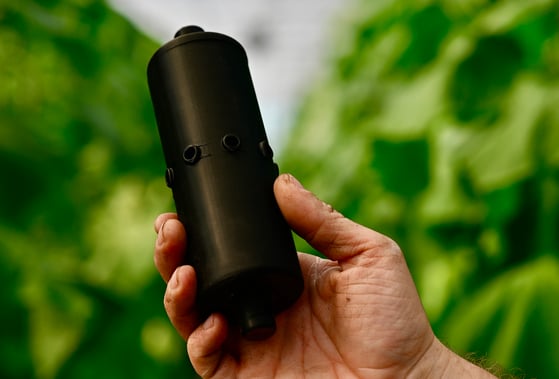
(Sonicflora)
This startup listens to plants
Wouldn’t it be weird if plants screamed when in pain, just like humans? Well, bad news for your nightmares: they kinda do, just not in frequencies humans can detect.
Sonicflora is a Swedish startup developing technology that “listens” to the ultrasonic sounds plants emit to determine what they need to thrive.
Quiet plants…
… are happy plants, Robin Jansson, CEO and co-founder of Sonicflora, told The Hustle. Stressed plants get louder the worse they feel.
For example, if a plant is dehydrated, it needs to prioritize where it stores water. What Jansson described as “negative pressure” builds, creating air bubbles that emerge and then burst, producing airborne signals, or an “ultrasonic melody.”
To train its models, Sonicflora put healthy plants in soundproof boxes, then introduced stress to capture the sounds and analyze that data. The startup is currently investigating drought, but there are other potential stressors it could explore — e.g., too much wind, too much or not enough sun, viruses, molds, or pests.
“We need to do a lot more data collection. That's farther down the road, but that's the goal,” he said.
What’s all this plant torture for?
With enough data, we’d know a plant was in trouble before visible signs of distress and could intervene.
Right now, Sonicflora’s main focus is on tomatoes grown indoors, where it’s easier to pick up sounds.
Some greenhouses are massive — think up to 10 hectares, holding 350k plants.
That’s impossible to monitor without being incredibly selective and employing a large staff, but Sonicflora uses triangulation to locate stressed plants, ideally reducing labor costs and, ultimately, waste.
Could this be used on other plants?
Sonicflora also listens to cucumbers, while one of its customers is a university researcher who uses the tech to listen to “screaming trees.”
But Jansson said Sonicflora’s “thesis” is that 80% of plants communicate, opening the door for many applications, from vineyards to something even the average plant enthusiast could use on their own houseplants or garden.
BTW: Sonicflora does not turn its data into music, but you can vibe with PlantWave, which converts the electrical conductivity of plants into sound.
HIGHLY RECOMMENDED
Lights, camera, budget? It doesn’t sound fun — but it can be. A video ad expert breaks down her “less is more” mentality for killer ads.
NEWSWORTHY NUMBER

How much one “unnamed and deeply unfortunate” company blew in a single month on Claude after failing to implement usage limits on licenses for employees, per Futurism.
Apparently, efficiency is worth thousands of layoffs but maybe not half a billion dollars — companies that once adamantly pushed for employees to use AI, like Microsoft and Uber (whose engineers reportedly maxed out their 2026 Claude Code budget by mid-March), are starting to rethink their strategies now that the tech is proving to be more expensive than the human labor they were so eager to trade for it.
AROUND THE WEB
📅 On this day: In 1876, an express train made it from NYC to San Francisco in 83 hours, an impressive feat for the time.
🥒 That’s interesting: An analysis of similes — “cool as a cucumber,” “eyes like daggers” — throughout literature.
🗞️ Newsletter: The Quartz Daily Brief delivers intriguing global business and economy news.
😱 Spooky: Watch the original Backrooms short from 2022 on YouTube. The idea, however, actually began on message boards.
😍 Aww: A baby groundhog.
SHOWER THOUGHT
We have a tendency to look down on people who didn’t have to work hard for what they have because their parents gave them everything. We then proceed to work hard so we can provide the same thing for our children. SOURCE
Today's email was brought to you by Juliet Bennett Rylah and Singdhi Sokpo.
Editing by: Sara "Plant whisperer" Friedman.
Was this email forwarded to you? Sign up here.
Working on something big?
We've got a whole library of business-building resources for you.
Subscribe to our other newsletters
Grow your business: Starter Story | Stay up-to-date on AI: Mindstream
Expert insights: Marketing Against the Grain | Sell better: The Science of Scaling