

👋 Good morning. Hope the birthday plans are coming together nicely for this weekend. No, we’re not psychic, it’s in the data: September is the most common birth month, according to FiveThirtyEight analysis. Sept. 9 claims the top spot as the most common birthday, with Sept. 19 coming in at No. 2 and September birthdays taking nine of the 10 top spots. If you’re born on July 7, you can feel special — but not too special — you’re in there, too.
NEWS FLASH
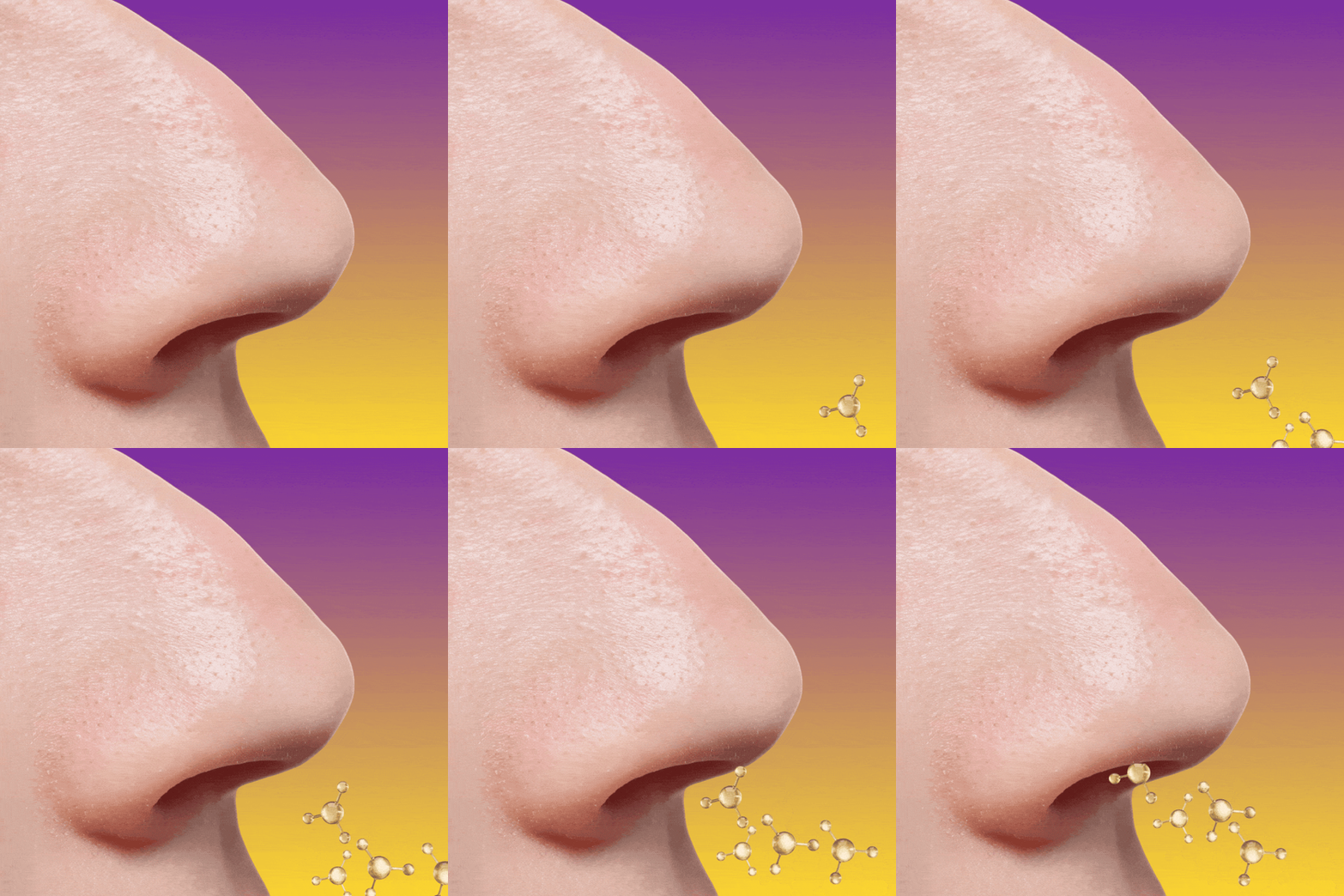
👃 Get a whiff of this: London startup Anemo Labs raised fresh funding to keep building its electronic nose. Yeah, you got that right, an electronic nose. The e-nose is an elaborate sensor tech that will feed AI smells in hopes that it’ll be able to detect disease-related compounds. Anemo expects it to classify up to 5k smells every day, a feat only matched by middle school gym teachers.
🦻 A good sign: Kenyan startup ZeroBionic developed a robotic hand that can translate a teacher’s voice into sign language to help deaf or hearing impaired children learn in the classroom. The hands are 3D-printed from recycled plastic, cost $350, and can run for three years without needing maintenance. The startup, which has already sold nearly 80 units, says its robot hands have a 92% speech-to-sign accuracy rating and could one day help ~300k hearing impaired children in Kenya access educational opportunities.
💪 One more body part: Tokyo startup MW Inc. is betting that ceiling-mounted robotic arms embedded into homes can outperform humanoid bots at household chores like folding laundry, sorting pantry and fridge items, and carrying groceries. The startup's homes, which will be available to retrofit with ceiling-mounted robot arms by 2028, will range from $1.3m-$2.6m with a $33-$66 monthly service charge. The startup hopes to sell 10k units a year by 2035, the equivalent of 5% of new homes built in Japan.
MORE NEWS TO KNOW
-
No business like show business: Later this month, fintech Ramp will put on quite an elaborate (and presumably stupid-expensive) marketing stunt: a one-night-only, bill pay-themed Broadway musical starring Billy Zane and Billy Porter.
-
Bravo: A Polish developer built an app that can scan for nearby smart glasses and alerts you if it thinks you’re being recorded without permission. The best part of the tool, which detects the Bluetooth signature of Meta’s AI specs, is its name: Zuckoff.
-
Not to be confused with NYC’s Battery Park: Swedish energy startup Tavion will construct its first three “battery parks” in Poland — imagine a storage facility but all the units are a connected web of large-scale batteries.
- “Google Maps for the battlefield”: Texas startup Tern scored a big new client — the US Army — for its alternative navigation tech, which taps into vehicular data to keep uninterrupted tabs in a world rife with GPS jammers.
CREATE MORE LUCK
How to go from zero to $1m
Starting from the bottom has its perks.
No one’s there to watch you swing and miss... You can take risks the bigwigs avoid… And it’s upon this reckless foundation where you will find your edge.
Money on your mind?
- Three phases for changing your trajectory
- The “loser’s advantage”
- Tips for picking projects
- How to create more luck
- The $1m service business blueprint
If interested in building wealth and legacy: Study this Shaan Puri playbook.
THE BIG IDEA
%20copy-2.png?width=600&height=293&name=SF%20TEMPLATES%20TO%20USE%20(2)%20copy-2.png)
This is your brain. This is your brain on ultrasound. Any questions?
If you dreamed of becoming a brain surgeon, but the idea of cutting open someone's noggin made you squeamish, there's still hope for you.
Focused ultrasound, a groundbreaking treatment, lets doctors perform brain surgery without a scalpel. The non-invasive procedure has been used to treat Parkinson's and other conditions, and now shows promise for treating drug addiction, per Wired.
A sorely needed solution
- Nearly 45m Americans met the criteria for a substance use disorder in 2025.
- While drug overdose deaths have declined for the past three years, there were nearly 70k deaths in 2025.
Neurosurgeon Ali Rezai, a pioneer of deep brain stimulation, saw an opportunity to develop new treatments for drug addiction at the epicenter of the opioid epidemic, West Virginia.
While deep brain stimulation — used to treat Parkinson’s, OCD, traumatic brain injury, and addiction — involves cutting into a patient's skull to implant electrodes, focused ultrasound targets the same area without the cutting. The outpatient procedure could take just 20 minutes.
To address addiction, Dr. Rezai and his team at West Virginia University focus on the behavioral regulation, anxiety, and craving portions of the brain.
Buckle up, future brain surgeons:
- Focused ultrasound machines emit dozens of beams through a helmet-like device into the skull.
- Waves are targeted with millimeter precision and converge on the nucleus accumbens, zapping the region of the brain that highly addictive drugs like opioids flood with dopamine.
- Patients view images of substances through special goggles, and the ultrasound resets the nucleus accumbens, breaking the connection the brain made with the drugs.
While the treatment is still in its infancy, many patients reported reduced cravings and sustained abstinence.
Dr. Rezai hopes to expand treatment access, and the team is testing a portable device that looks like a salon hair dryer. They're also testing the treatment for binge eating disorder and want to adapt it for dogs with anxiety.
Focused ultrasound in Silicon Valley
While still highly experimental, numerous tech companies are ultra-focused on focused ultrasound:
- Coinbase co-founder Fred Ehrsam’s Nudge
- Sam Altman’s Merge Labs
- Mary Lou Jepsen’s Openwater
- Sanmai Technologies, backed by LinkedIn co-founder Reid Hoffman
And they're not alone.
Maybe you could be a brain surgeon after all. Though there's still that whole medical school thing.
HIGHLY RECOMMENDED
Get hooked: A fishing store, aquarium, and gourmet restaurant under one roof? Bass Pro Shops uses a unique retail approach to hack your brain.
NEWSWORTHY NUMBER
-1.png?width=600&height=93&name=Noteworthy%20Number%20template%20(53)-1.png)
Days a week that some Australians could be legally entitled to work from home for. While countries like the UK, New Zealand, and Canada have passed laws that establish workers’ rights to request remote work, lawmakers in the Australian state of Victoria are considering a proposal that, if passed, would put the onus on employers to justify why an employee can’t WFH — turning remote work from a perk to a guaranteed right, per Fast Company.
For any Americans thinking, “Maybe that could be us next” — yeah, probably not. Legal expert Rachel Arnow-Richman says that the US, where paid sick leave is still not a guarantee, has “bigger fish to fry.”
AROUND THE WEB
📅 On this day: In 1814, Francis Scott Key wrote the poem which was later set to music, becoming “The Star-Spangled Banner,” America’s national anthem.
🌱 Game: Mow the lawn in the most efficient way possible.
🎙️ Your next listen: Subscribe to "This Is The Point," our new weekly show featuring founder/VC Sheel Mohnot and journalist Alex Kantrowitz as they break down the biggest stories in business and tech.
🧮 That’s fun: The internet’s weirdest calculators.
🐕 Aww: A tiny tail.
SHOWER THOUGHT
With the advent of A.I. in a ransom situation, there is zero way to provide proof of life without seeing the person with your own eyes. SOURCE
Today's email was brought to you by Ben Berkley, Singdhi Sokpo, and Danny Jensen.
Editing by: Sara "Can I pick your brain?" Friedman.
Was this email forwarded to you? Sign up here.
Working on something big?
We've got a whole library of business-building resources for you.
Subscribe to our other newsletters
Grow your business: Starter Story
Stay up-to-date on AI: Mindstream
How to use top AI tools: Futurepedia
Expert insights: Marketing Against the Grain
Sell better: The Science of Scaling