

👋 Good morning. Did you forget to grab a 66m-year-old triceratops fossil at the store yesterday? You’re in luck: A triceratops skeleton that’s been on display at the Wyoming Dinosaur Center for nearly 30 years just hit the auction block through Pharrell’s Joopiter platform. Nicknamed Trey, the fossil is expected to bring in $4.5m-$5.5m. A pretty fair price for blowing your neighbor’s 12-foot Home Depot skeleton out of the water.
STARTING UP
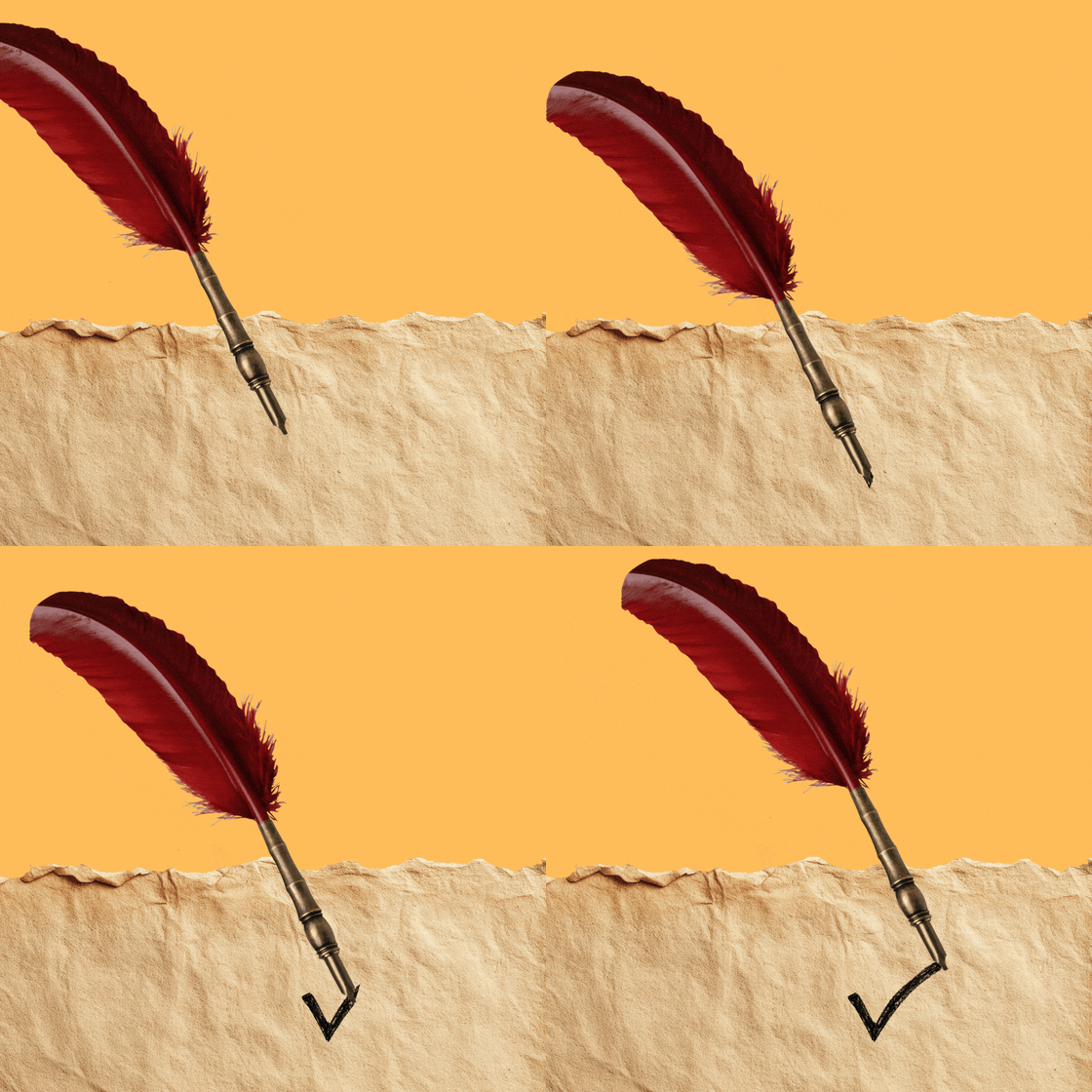
Can AI help archivists bring history into the future?
❌ The problem: Archives across the US are buried under massive backlogs — the National Archives has a 30-year pileup — with records staying piled in boxes because cataloguing is still a mostly manual and time-intensive process.
💡 The pitch: Historiq is building an AI-powered platform that lets archivists describe items out loud while the system records and organizes them. The tool will eventually support image scanning and digitization, making it easier to preserve and access historical materials.
🚀 The outlook: Historiq is partnering with Fort Ticonderoga in New York to test its tech on the fort’s extensive archives of thousands of unprocessed books.
NEWS FLASH
-
Perfect strangers: AI companions may be a hot topic, but researchers from the University of British Columbia found that college freshmen who texted other random freshmen daily for two weeks were 9% less lonely, compared to 2% for those who chatted with a bot.
-
Even the dictionary now? Numerous publications have already filed lawsuits against OpenAI. Now, Merriam-Webster and its owner, Encyclopedia Britannica, are piling on, accusing it of scraping online articles without permission and threatening public access to quality education due to ChatGPT’s hallucinations.
-
Do you want to meet a snowman? Disneyland visitors in Paris and Hong Kong will be able to “meet” Olaf, the snowman from Frozen, this year. Olaf is a robot, trained by Disney animators to move like the character. It’s not powered by AI. Operators control the bot remotely via a Steam Deck, and also choose which lines, pre-recorded by actor Josh Gad, it says.
-
Mobility breakthrough: A 7-year-old boy with cerebral palsy became the first person in the UK to trial a ~$96k bionic exoskeleton at home, helping him walk independently. While the tech could be life-changing, the cost likely means widespread use is still years away.
YOUR MOST PRODUCTIVE YOU

How to be insanely productive
There are times for dillying and dallying, and other times for coming up clutch.
When you need yet another game winner, lock in on work with this free productivity kit by ClickUp and HubSpot. It’s filled with frameworks, templates, and tips to make you way more efficient.
Amplify your output:
- Respectably work from home
- Maintain flow-state efficiency
- Visualize goals and progress (two templates)
- Calculate labor hours for long projects
- Prioritize with a PIE scoring chart
Stop slackin’. Get crackin’.
THE BIG IDEA

Paper cranes to pioneering products
The intricate, beautiful designs of origami are amazing — especially if paper airplanes are the extent of your folding skills.
Startups and researchers are now utilizing techniques from the centuries-old art form to innovate everything from furniture and vehicle parts, to medical devices and spacecraft, per BBC.
Even if you can fold a paper crane (congrats, BTW), you're bound to be impressed.
Welcome to the fold
Dating back to at least the 17th century, origami still inspires designers and engineers to rethink an array of products, cleverly transforming flat materials into three-dimensional shapes.
- Swedish startup Stilfold reduces weight, waste, and emissions by transforming sheet metal into durable origami-inspired designs for electric motorcycles, vehicle parts, and bridges.
- Ninth-grader Miles Wu designed an emergency shelter using the Miura-ori pattern — developed by astrophysicist Koryo Miura for solar panels on a satellite — that's sturdy and easy to deploy. What was I doing in ninth grade?
- Sick of uncooperative umbrellas flapping in the wind? The origami-inspired Ori umbrella ($249) employs a frameless design with a single continuous surface.
- MIT students used kirigami — like origami but with cutting — to turn a flat rectangle into a chair with the pull of a string. The team intends to expand the technology for targeted drug delivery within the body.
- Finnish researchers built a machine to fold cardboard into lightweight, flexible, and biodegradable packaging.
- The foldable Oru Lake origami kayak ($500) really does look as cool as it is bonkers.
- And pandemic-inspired origami face masks? Yep.
Below the fold and beyond
While many origami designs revolve around everyday objects, scientists and mathematicians have used intricate folds in everything from biomedical engineering to aerospace.
- MIT researchers developed a patch that folds around surgical tools and seals internal injuries.
- Researchers have explored origami's "egg box" design for expandable spinal fusion implants.
- A Northeastern University professor and PhD student received a patent for foldable yet strong wings that "morph."
- The James Webb Space Telescope, the largest in space, uses origami-like folds for its mirror and sunshield.
From DNA gene therapy to space exploration, origami's uses are unfolding everywhere.
Meanwhile, I'm here figuring out the meaning behind the origami in Blade Runner and practicing paper cranes.
HIGHLY RECOMMENDED
Can community members own their neighborhoods? Maybe. One grassroots group in Philadelphia is attempting to decommodify real estate.
NEWSWORTHY NUMBER

Increase in after-hours meetings among US-based knowledge workers in 2025, up from 23% the year prior, based on a survey by AI workspace provider Miro. What’s worse: These meetings aren’t one-off occurrences — Miro’s Dom Katz told Fast Company that six in 10 people attend a meeting after regular work hours at least once a month, and not just in the US, but globally.
What's to blame? Tech, like video-conferencing and digital collaboration tools, which have made it easier to schedule and take meetings from pretty much anywhere in the world, and that much harder to disconnect.
AROUND THE WEB
📅 On this day: In 1965, Soviet cosmonaut Alexei Leonov performed the first spacewalk, lasting 12 minutes.
💻 That’s cool: A website you can change in real time.
🌍 Chill out: with this calming footage from space.
🪺 That’s interesting: How hummingbird feeders have changed the way the species evolved.
🐕 Aww: May we all find as much joy as this dog playing in a fountain.
SHOWER THOUGHT
People probably faked illness to get out of work even in the hunter-gatherer era. SOURCE
Today's email was brought to you by Juliet Bennett Rylah, Danny Jensen, and Singdhi Sokpo.
Editing by: Sara "Trying not to fold" Friedman.
Was this email forwarded to you? Sign up here.
Working on something big?
We've got a whole library of business-building resources for you.
Subscribe to our other newsletters
Grow your business: Starter Story | Stay up-to-date on AI: Mindstream
Expert insights: Marketing Against the Grain | Sell better: The Science of Scaling