

👋 Good morning. It’s officially back-to-school season, and even the crayfish are getting backpacks. Biologists at the US Fish and Wildlife Service are supergluing tiny microchip backpacks onto Big Sandy crayfish, a freshwater crustacean in Appalachia that’s considered a federally threatened species. The chips will let scientists track whether hatchery-raised critters survive after being released in the wild. Like your elementary schooler, the crayfish do eventually lose the backpacks.
NEWS FLASH

🌋 Want your startup to sound badass? Say you’re harnessing the power of underwater volcanoes. When Endurance Energy makes that claim, it’s not just for show: The company uses underwater geothermal generators to tap hydrothermal fluids that can reach 750 degrees Fahrenheit. Hot fluid flows into a generator and heats a refrigerant until it boils, spinning a turbine, and seawater cools it down so the cycle can repeat. The startup plans to deploy its fifth prototype next month, which could alone power a small neighborhood.
🚢 The little e-tug that could: Los Angeles startup Arc, known for its $300k luxury e-boats, is pursuing a less sexy but no less useful product — a $20m battery-powered tug boat. The startup’s tugs, backed by a $160m deal with Curtin Maritime, pack batteries equivalent to 75 Tesla Model Ys and could pull cargo loads of up to 100 tons. Arc wants to one day electrify heavy-duty marine transportation, from ferries and barges to military vessels.
👓 Finally, a chance to relive every moment of an awful dinner party: The next evolution of Meta’s AI smartglasses could turn your life into “SportsCenter”-esque highlight reels? The company filed a patent for its facial recognition tech that automatically picks up who it is seeing, stashes videos of that person, and presents the smartglass wearer with a highlight video at the end of the day.
MORE NEWS TO KNOW
-
Billion-dollar babies: July produced 40 new unicorns, per Crunchbase data, the most prolific month in more than four years. The first half of 2026 saw more unicorns join the club than all of 2025.
-
Gen Z and Big Tech don’t mix: The generation came out strong against tech CEOs in a new CNBC Generation Lab poll — Microsoft’s Satya Nadella was Gen Z’s most trusted exec and still 65% of them distrust him.
-
Who the kids do like: One generation down in Gen Alpha, the brands that ranked highest in favorability are aggressively mainstream: Amazon, Nike, McDonald's, and Walmart, per data from HarrisX and Allison Worldwide.
-
Five finger discount: The first flight of startup Heart Aerospace’s X1 last week made aviation history as the largest electric aircraft to ever go skyward. But the most gobsmacking tidbit about the half-hour flight: it used just $5 of electricity.
YOUR SECOND BRAIN
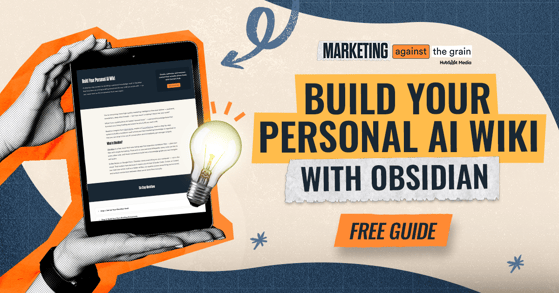
Why does one need an AI wiki?
So that every LLM you prompt has the same layer of context. And you save yourself from typing out the same spiels, day after day.
This is how you build a second brain in Obsidian, a free/local note-taking app. AI educator Matt Wolfe published his silo-busting system for:
- Setting up your Obsidian vault files
- Writing core brief documents
- Configure cross-linking
- Install a one-click capture extension
- Link with your AI tool of choice
- Install a weekly checkup workflow
Made for marketers. Useful for anyone.
THE BIG IDEA
%20copy%207.png?width=600&height=293&name=SF%20TEMPLATES%20TO%20USE%20(2)%20copy%207.png)
Getting paid to care for your family
An estimated 63m Americans are caregivers — to a spouse, child, aging parent, or other loved one — and most do the work for free.
Most also probably wouldn’t expect to be paid to look after their loved ones, but maybe they should be.
You could call it a labor of love, but time is money, and when you’re busy spending most of it looking after someone else, it can be hard to make ends meet. According to AARP:
- A quarter of caregivers take on debt due to caregiving.
- Half report negative financial impact due to caregiving.
- One in five can’t afford basic needs like food.
And as America ages, demand for caregiving is only growing.
Entrepreneur Havi Nguyen thinks that family caregivers don’t just deserve to be compensated for their work, but that doing so could also provide a solution to the home-care market’s supply problem, per Forbes.
How?
The 26-year-old founded Abby Care, a 5-year-old startup that provides formal training to family members of people who require long-term care (e.g., people with autism or the elderly) so that they can become state-certified professional caregivers and be paid for their services through Medicaid.
- After training — which might involve in-person lessons on techniques like CPR and the Heimlich maneuver, or online courses on food hygiene and first aid — caregivers work with Abby Care nurses to create personalized care plans.
- Using the company's app, they can manage medical documentation, track hours, and access AI-powered clinical support.
- Hourly wages range from $15 to $27, depending on the type of certification.
The company currently operates in just eight states, but the ultimate goal is to build out a home-care marketplace — or, essentially, Uber for caregiving.
The program has its challenges…
For one, its reliance on Medicaid makes it vulnerable to policy changes and budget cuts that could disrupt its business model.
Scammers have also exploited Medicaid-funded home-care programs by inflating or fabricating hours of care that were never provided.
Even so, Abby Care has received $45m in backing from VC firms like Sequoia Capital and Khosla Ventures, thanks in part to its use of AI, which one investor says allows it to “operate at a new level.”
Forbes is even betting on the company, currently valued at ~$225m, to hit unicorn status.
HIGHLY RECOMMENDED
A cat on a chair that helps you focus… and an app that makes its founder $18k a month.
NEWSWORTHY NUMBER
%20copy%205.png?width=600&height=93&name=Noteworthy%20Number%20template%20(52)%20copy%205.png)
Share of AI interviews taking place between 10pm and 2am local time, according to data from Ribbon, a startup that provides voice-AI recruitment software to 500+ companies. Bot-conducted interviews are becoming more commonplace — roughly 66% of US job applicants said they’d had one in a recent survey — and while most people aren’t exactly thrilled about them, they’ve made scheduling more flexible and late-night job interviews an option that many are taking, per Wired.
It’s been a win for those with obligations during normal waking hours, like parents and anyone with a job, but maybe an L for your sleep? Having to explain your worth to a machine right before bed sounds like enough of a nightmare for one night.
AROUND THE WEB
📅 On this day: In 1992, Boston Celtics forward Larry Bird retired at 35.
🐈 That’s fun: Bouncing cats.
🎤 Game: Competitive video dubbing.
📚 That’s fun: An endless stream of book samples.
🐶 Aww: A tiny floof.
SHOWER THOUGHT
Automatic folding side mirrors make it easy to find unlocked cars. SOURCE
Today's email was brought to you by Singdhi Sokpo and Ben Berkley.
Editing by: Sara "Take care" Friedman.
Was this email forwarded to you? Sign up here.
Working on something big?
We've got a whole library of business-building resources for you.
Subscribe to our other newsletters
Grow your business: Starter Story
Stay up-to-date on AI: Mindstream
How to use top AI tools: Futurepedia
Expert insights: Marketing Against the Grain
Sell better: The Science of Scaling