

👋 Good morning. Congratulations to Spain, which won the 2026 World Cup last night (and to the team's fans, who are likely nursing hangovers this morning). The iconic FIFA World Cup trophy, created by Italian sculptor Silvio Gazzaniga after Brazil permanently claimed the original in 1970, is one of sports' most recognizable prizes 50+ years later. While winning captains get to lift the solid 18-carat gold trophy on the field, FIFA reclaims it after the game and the champs go home with a gold-plated replica instead.
NEWS FLASH
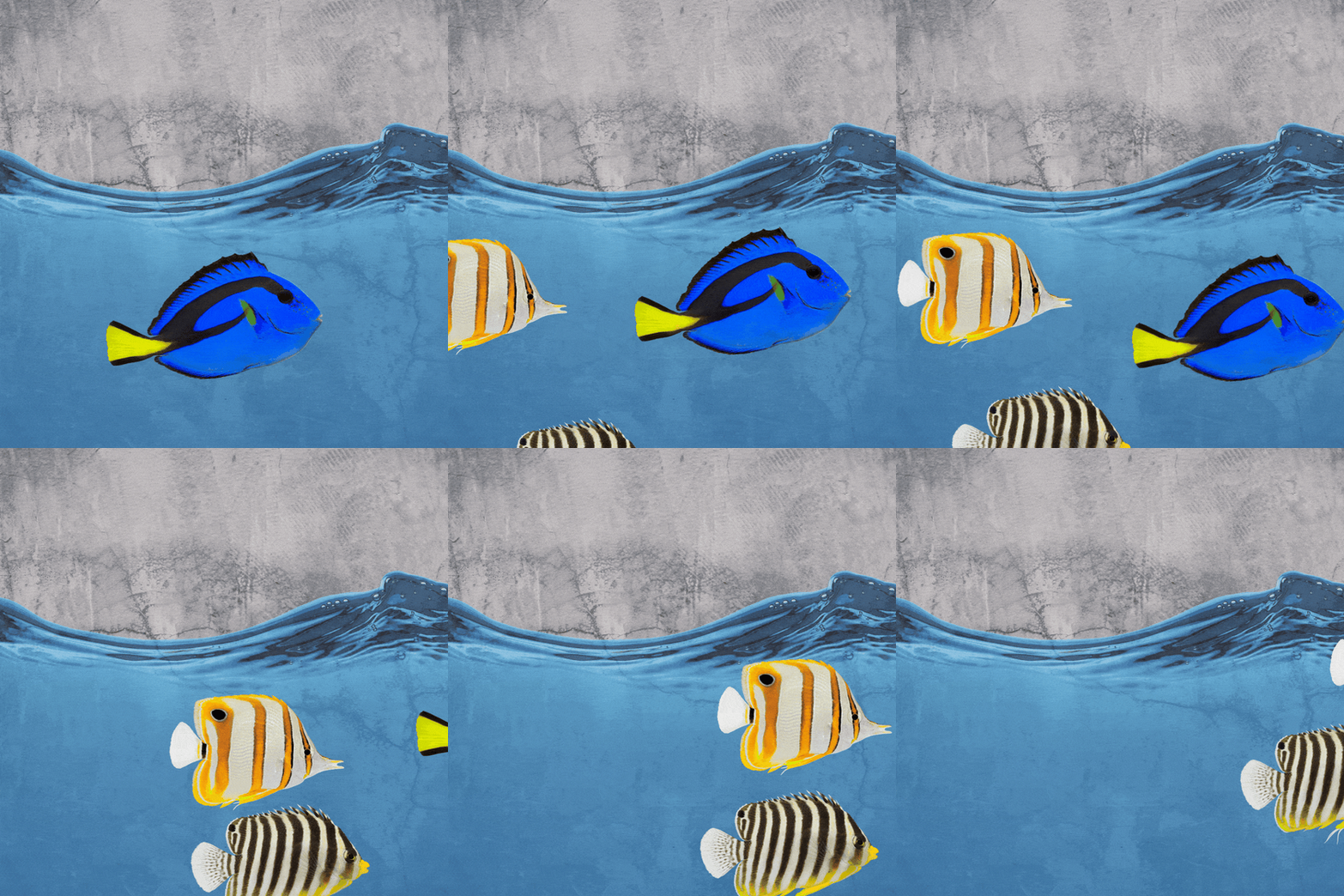
🏠 Home is where the fish are: Miami startup Kind Designs is 3D-printing concrete seawalls that will protect oceanfront human homes while doubling as a home for marine life. The company’s concrete seawall panels are inspired by mangrove roots with grooves and crannies perfect for protecting fish, oysters, and algae. The custom panels can be printed in 60-90 minutes and the startup already has a $175m project pipeline, total funding of $21.5m, and a $2m US Navy contract.
🤖 Silicon Valley’s big bosses had a squirmy weekend: Beijing’s Moonshot AI ended last week with the seismic unveiling of its new Kimi K3 model, which outperformed top Anthropic and OpenAI models in independent evaluations. Oh, and Kimi performed better while also costing 40% less. Kimi instantly upped hand-wringing over US labs’ outsized valuations, the billions of dollars being spent on data centers, and America’s previously perceived edge in the AI race. Oh look, now you’re squirming, too.
📸 Less scrolling, more remembering: Instead of using AI to generate new images, London startup Popsa is focusing on the photos you already have. The company says people take an average of 551 photos per month — 6.6k+ per year — but 70% never get looked at again. Popsa built hundreds of AI models to analyze your photo library, organizing memories, writing captions, and removing duplicates. Let’s hope the AI is ready for the 2k photos of your dog from slightly different angles.
MORE NEWS TO KNOW
-
Smoked out: Zoox recalled the software in its fleet of 105 robotaxis after one got confused by heavy smoke and had to be remotely removed from the fire scene to make room for first responders.
- There’s a new king of American business …and it looks a lot like the old king, as Apple reclaimed its perch atop most-valuable-company mountain. Its $4.9T market cap has edged out AI darling Nvidia — for now.
- On repeat: Netflix’s KPop Demon Hunters is still one of the streaming platform’s biggest hits, racking up 648.7m total views and holding its top-five spot this year, with a sequel on the way.
- Break out the jewel cases: Compact disc sales surged in the first half of the year (up 16%). Sure, one BTS album skewed the numbers a bit, but even taking that outlier away, CDs still grew nearly 3x faster than vinyl.
WINNING FRAMEWORKS

Your competitors are guessing. You shouldn't be
Here's a fun fact: most businesses enter markets without actually understanding them. They just kind of... vibe their way in. Bold strategy.
Wait, what? This free kit gives you a structured way to stop guessing and start knowing:
- Trends: Learn to read industry signals before the herd notices them
- Rivals: Dissect what competitors are doing right (and where they're exposed)
- White space: Identify the gaps no one's plugging yet
- Playbook: Turn raw research into an actual go-to-market angle
Five frameworks. Zero vibe-based decisions.
THE BIG IDEA
%20(1)%20(1).png?width=600&height=293&name=UPDATED%20template%20(1650%20x%20864%20px)%20(1)%20(1).png)
Making protein out of thin air
From Pop-Tarts to an Espresso Proteini, they're jamming protein into everything these days.
Protein-maxxing — the trend of maximizing protein intake, fueled in part by widespread use of GLP-1 drugs and TikTok — is clearing shelves of cottage cheese, causing a whey shortage, and has farmers going wild for peas.
To meet demand, a new crop of biotech startups is pulling protein out of thin air — using microbes and air to create nutrient-rich protein powders that could be infinitely renewable, per Green Queen.
Is air protein the future of food or just a lot of hot air?
Producing food from air first took shape decades ago when NASA researchers explored the concept for long-haul space missions. (It probably couldn't compete with astronaut ice cream and Tang!)
Inspired by NASA's efforts, Dr. Lisa Dyson and Dr. John Reed launched Air Protein, a protein-rich powder made from air, water, and energy.
- Naturally occurring bacteria that metabolize carbon dioxide are added to tanks with water, nitrogen, oxygen, and carbon dioxide in fermentation vats.
- Using renewable energy, the bacteria — which act like a culture for making yogurt — reproduce, quickly filling the vats.
- The bacterial biomass is then dehydrated, leaving a protein powder rich in vitamins, minerals, and all 20 amino acids.
With a neutral flavor, Air Protein can be added to a wide variety of foods and serve as a protein alternative that uses much less land and water than most.
Who else?
A surprising number of other startups are also using microbes and air to create protein:
- Finnish startup Solar Foods just launched a delicious-sounding salted caramel cold brew-flavored powder with 20 grams of air protein.
- Biosphere received $9m to produce gas-fermented proteins for military rations.
- Danish startup Unibio is building the "world's largest" gas protein factory in Saudi Arabia.
- New Zealand-based Jooules is turning CO2 and microbes into feed for aquaculture.
Air protein may sound a bit too good to be true, and it remains to be seen how scalable it is, but it does seem like a more sustainable approach to keep up with all our protein-maxxing.
HIGHLY RECOMMENDED
A $400 pink pineapple? It exists. But it’s illegal to buy, sell, or even grow in the country that produces it. Here’s the wild story.
NEWSWORTHY NUMBER
%20(1).png?width=600&height=93&name=Noteworthy%20Number%20template%20(45)%20(1).png)
Months that hundreds of grape seeds will spend at the International Space Station before returning to Earth, as part of a mission by Texas A&M AgriLife to test how cosmic radiation affects their growth and genetic expression, per Food & Wine. Researchers, who say the findings could potentially lead to the development of new grape varieties, plan to plant the seeds at a Texas ranch and eventually make wine from the resulting grapes. How will they taste? We’re guessing out of this world.
AROUND THE WEB
📅 On this day: In 1969, Neil Armstrong and Buzz Aldrin became the first humans to walk on the moon — or on a soundstage approximation of the moon, if that’s the kind of person you are.
📝 That’s interesting: Remembering the man behind the Spell Check squiggles.
🐋 Whoa: How to transport a 4k-pound-plus beluga whale.
🎥 That’s cool: An oral history behind the movie Labyrinth a whole 40 years later (sorry to make you feel old).
🦝 Aww: An overdramatic wrestling match.
SHOWER THOUGHT
Prior to recorded sound, no one ever realized how weird their voice probably sounded to their own ears… SOURCE
Today's email was brought to you by Singdhi Sokpo and Danny Jensen.
Editing by: Sara "Whey ahead of ya" Friedman.
Was this email forwarded to you? Sign up here.
Working on something big?
We've got a whole library of business-building resources for you.
Subscribe to our other newsletters
Grow your business: Starter Story | Stay up-to-date on AI: Mindstream
Expert insights: Marketing Against the Grain | Sell better: The Science of Scaling