

👋 Good morning. If you’re reading this while pulled over at a rest stop, we have some good news. Chinese carmaker Seres patented an “in-vehicle toilet” that tucks under a passenger’s seat to “satisfy users” during long rides without bathroom access and slides out with voice-activated commands. Our command: please, no.
NEWS FLASH

🏃 On the run: Chinese smartphone manufacturer Honor won the half-marathon race for robots in Beijing, with its bot wrapping the 13 miles in 50 minutes and 26 seconds. That’s faster than Jacob Kiplimo, who holds the world record for finishing in ~57 minutes, and faster than last year’s winning bot, which finished in 2 hours, 40 minutes, and 42 seconds. That’s a marked improvement, but besting a human is perhaps not that impressive when you consider that machines don’t get tired. Also, one bot began the race by falling on its face.
🍎 End of an era: Apple announced that CEO Tim Cook will step down on Sept. 1 after 15 years and transition into an executive chairman role — the first CEO transition for the company since Steve Jobs. Cook will be succeeded by John Ternus, senior VP of hardware engineering who’s been with the company 25+ years. Ternus will have big sneakers to fill: Apple’s market cap increased 1,000% under Cook’s leadership, surpassing $4T and making it the third most valuable public company in the world.
🚀 Oops: Blue Origin reused one of its New Glenn rockets to put an AST SpaceMobile satellite into orbit. Unfortunately, it was a "lower than planned orbit," meaning the sat must be de-orbited and will ultimately burn up in Earth’s atmosphere. AST SpaceMobile’s loss is covered by its insurance policy and the company still plans to launch 45 additional satellites by year’s end. TechCrunch notes it’s Blue Origin’s first big screwup — but only its third launch of a New Glenn rocket.
MORE NEWS TO KNOW
-
App-solutely back: Rather than killing apps, AI has actually fueled a new wave of them, with worldwide app releases up 60% YoY in the first quarter of 2026, per Appfigures.
-
Subs for all: Jersey Mike’s filed for its IPO. It has 3k+ locations across the US, where it's the second-largest hoagie chain, behind Subway. In 2025, it reported $309.8m in revenue, up 10.6% YoY.
-
Never mind: Rumors suggested American Airlines and United Airlines might attempt a megamerger, but American shot it down, saying it would be "negative for competition and for customers."
-
Pondering the orb: Tinder users can now get a verified badge proving they’re human if they let one of World’s Orbs scan their eyeballs. That’s the biometric verification company co-founded by Sam Altman, which has apparently verified 18m people thus far.
19 FREE CANVA TEMPLATES
.png?width=600&height=293&name=On-Brand-Social-Media_1200x628_Opt7A%20(1).png)
Make on-brand bangers in minutes
World domination begins with a damn good color scheme.
We can’t pick your colors and icons, but we can airdrop 19 Canva templates and reference tools for publishing.
Sparkle across socials:
- Comprehensive social media audit
- Snazzy Canva templates for a variety of posts
- Platform specs for sizing/processing images
Customize and ship within minutes. Maybe don’t pick orange, unless you want to step onto our turf.
THE BIG IDEA
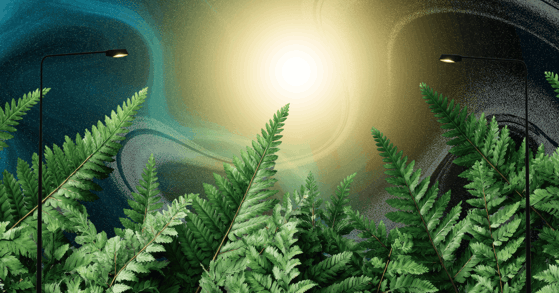
Could glow-in-the-dark plants replace street lamps?
Avatar fans, good news — we are another step closer to turning Earth into Pandora.
Chinese biotech startup Magicpen Bio has created plants that glow in the dark, per EuroNews.
By splicing genes from fireflies and bioluminescent mushrooms, they genetically engineered some 20 plant species, including lilies, orchids, and roses, to emit visible light, a technical feat that reportedly took ~532 rounds of iterations to achieve.
Amid climate change and rising demand for energy, Magicpen founder Li Renhan says glowing plants could one day provide an electricity-free, cost-efficient way to illuminate cities around the world.
Plant-based lighting
Magicpen isn’t the first to engineer luminous plants, or the only startup working to improve the tech.
The first was created in 1986, when US researchers injected firefly genes into tobacco plants. In 2020, another team did the same using genes of glowing fungi.
But buzz around bioluminescent plants really picked up in 2024, when Light Bio started selling $40 glow-in-the-dark petunias (also made using mushrooms) as household plants, which the USDA deemed safe to grow and breed.
A year later, Chinese scientists created multicolored succulents that “recharge” in the sun by injecting them with strontium aluminate, a material often used in glow-in-the-dark toys and watch dials.
So, bye-bye, streetlights?
Not quite yet. For now, they’re better suited to replace nightlights, to beautify gardens, or as a fun novelty gift.
While each iteration has produced brighter plants, these alien-like floras are still too dim to replace nighttime urban lighting, though that’s certainly the goal and, as long as scientists keep tinkering, a potentially not-too-distant reality.
Practical applications aside, it’s just downright magical — which seems to be at least one motivation for people working in the space:
- Almost every team has made some mention of realizing “our solarpunk dreams” by “bringing the 'Avatar' world to Earth.”
Need science always be more than that?
HIGHLY RECOMMENDED
Can’t find customers? Borrow someone else’s. That’s how this entrepreneur built a SaaS business that brings in $10k a month.
NEWSWORTHY NUMBER

How many hours people are waiting for a chance to eat and drink in the back of one Minneapolis-area Amoco gas station, per The Wall Street Journal. The draw isn’t ready-made corn dogs and slushies, but $18 craft cocktails and elevated bites, like a $45 espresso-dusted ribeye, at Farmer’s Cellar — a speakeasy located behind one of the store's cooler doors, converted from a vacant repair shop by fuel man and owner Tony Donatell.
Since opening last April, the bar has become one of the town’s hottest tables, with first-year sales expected to hit $1.5m.
AROUND THE WEB
📅 On this day: In 1962, the Seattle World’s Fair opened, the first in the US post-WWII.
🛰️ That’s interesting: How GPS works.
🪦 Tech: Learn about the 299 products Google has shipped and killed since 2006.
🖼️ Art: A discovery engine for art from 22 museums.
😴 Aww: So sleepy.
SHOWER THOUGHT
New houses are huge, yet families aren't bigger, and technology has reduced our space needs. SOURCE
Today's email was brought to you by Juliet Bennett Rylah and Singdhi Sokpo.
Editing by: Sara "Making light work of it" Friedman.
Was this email forwarded to you? Sign up here.
Working on something big?
We've got a whole library of business-building resources for you.
Subscribe to our other newsletters
Grow your business: Starter Story | Stay up-to-date on AI: Mindstream
Expert insights: Marketing Against the Grain | Sell better: The Science of Scaling