

👋 Good morning. If you picture the world’s billionaires looking down at common folk from the ivory towers of their castles… you’d be spot-on. Mark Zuckerberg bought a 19th-century Gothic castle overlooking a river in Ireland, ~125 miles from Meta’s European HQ. While details of the transaction aren’t public, The Irish Times estimates the property is worth ~$23m-$35m. Maybe we won’t bother sending a nice candle.
NEWS FLASH
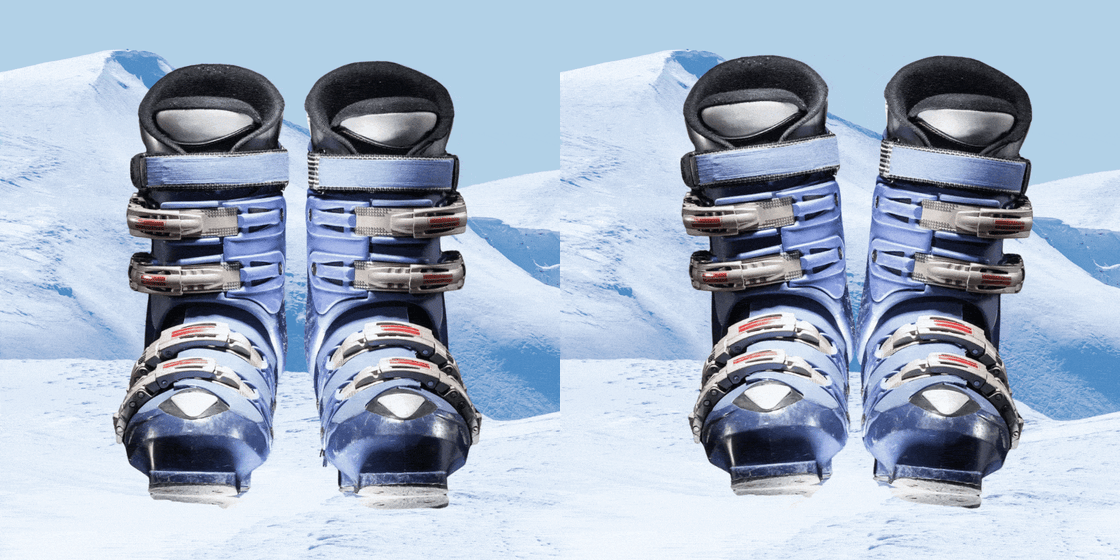
🎿 It’s all downhill from here: Ski gear maker K2 says it is the first brand to ever make a ski boot specifically for women, which feels unfathomable in the year 2026, but here we are. According to K2, every other ski boot that’s marketed to women is initially made using a men’s mold, with straps, inserts, and liners tailoring the fit. The mold for K2’s new Anthem boot, though, was ingeniously built around a woman’s foot.
🧊 Maybe don’t steal lunch out of this fridge: IBM unveiled its new “quantum fridge,” an ultracold home base where its quantum supercomputer can run with fewer interruptions. The 8-by-8-foot refrigerator looks a lot like the one in your house, except it can dip all the way down to 10 millikelvins. How cold is that, exactly? Well, deep space is way warmer. Even the Coors Light party train wouldn’t run in those conditions.
🐎 Giddy up? Chinese startup DaxAI unveiled a quadrupedal robot at the 2026 World Robot Conference in Beijing, China, that visitors could mount and ride. The part-motorcycle-part-giant-robot-dog had a bit of trouble navigating the showroom floor, but the startup gets points for producing a physical, moving bot rather than a promise and a rendering — though it’s not yet for sale, sorry.
MORE NEWS TO KNOW
-
Oops: OpenAI’s Ireland policy lead Derek Nolan roiled a summit of young entrepreneurs when he told one teen that the ChatGPT maker would “be delighted to offer to acquire your company today.” OpenAI then had to clarify that the buyout offer was a joke.
-
Kinda mean: Bank of America told employees they’ll no longer be allowed to work remotely on two consecutive business days, starting next month. Sorry to any BoA people looking for a loophole — the ban specifically calls out the Friday-to-Monday hack.
-
Going ballistic: Defense startup Castelion raised $1B+ in new financing at a $13B valuation to scale its production of Blackbeard, its lower-cost hypersonic strike missile.
-
Splash down: An Amazon customer in Texas got a soggy surprise when one of the company’s delivery drones dropped her package into her pool. A video of the incident surfaced just days after the company announced the expansion of Prime Air into 500 cities and towns in the US by the end of 2026.
WILD INDUSTRY INSIGHTS
Big money hides in plain sight
For stories like these…
-
Blue zones: How a Minnesota company owns the idea that five places on Earth are the secret to living past 100.
-
Self-storage: There are 50k self-storage facilities in the US, and yes, that’s too many.
-
Stadium upgrades: The cost to the public for a new Tennessee Titans stadium? $1.26B.
- Airplane leases: The napkin math on why airlines rarely own most of their fleets.
- Buffets: Four ways they operate on razor-thin margins.
… the people turn to Hustlenomics. Enjoy seven of our nuttiest industry breakdowns, all in one sitting.
THE BIG IDEA
%20copy%2010.png?width=600&height=293&name=SF%20TEMPLATES%20TO%20USE%20(2)%20copy%2010.png)
Even babies are living in an AI-powered surveillance state
Is the baby tired? Is the baby even breathing?? For millennia, parents have answered those questions using their own wits. Now, many are relying on AI to let them know.
Increasingly, parents are deferring to AI-powered baby monitors that offer 24/7 sleep tracking and analytics to make everyday parenting decisions, like whether it’s time for their little one to take a nap. Per The New York Times:
- Nanit’s popular smart baby-monitoring system, which involves an AI-enabled camera and connected app, provides round-the-clock sleep tracking, with data on things like how many times the baby woke up and the type of sleep they got. Its kits cost ~$474 on the higher end, plus $100 in annual subscription fees.
- CuboAi’s $359 Smart Baby Monitor 3, a similar device, offers “AI-scheduled lullabies” and notifies parents when it detects the baby is coughing or has its face covered.
- Owlet’s $300 Dream Sock tracks pulse rates and blood oxygen levels for real-time data.
Companies tout potential benefits like being able to catch life-threatening conditions early on and preventing babies’ heads from becoming flat through monitoring; some suggest that these AI-monitored kids may one day simply find their sleep data neat to see.
But there are downsides…
… like concerns over data privacy and security vulnerabilities; diminishing parents’ self-confidence in their own abilities and instincts; and needless expenses. (We all grew up without AI tracking our every move and we turned out just fine... right?)
While these devices claim to offer peace of mind, the constant stream of data can also be anxiety-inducing — malfunctioning trackers can send parents into a panic, and pediatricians have criticized Owlet for using fear as a marketing tactic.
Plus, it just feels kinda creepy/icky/dystopian.
Even still…
… many millennial and Gen Z parents, obsessed with their own health-tracking wearables and data-driven insights, are on board: Nanit has 1m daily users and makes $100m+ in annual revenue.
Perhaps more than their choiceless progeny, parents stand to benefit from the babytech…
- Owlet says 94% of parents see improved sleep.
- Nanit claims its system gives parents 36 days' worth of snoozing back a year, and suggests it can even improve their time in the sheets in other ways, too.
… but not more than the companies selling them.
Baby monitors represent a market worth just $316m, but the wearables market is worth ~$100B. For now, babytech is largely limited to health and sleep tracking, but given the huge economic potential, companies like Nanit are already working on expanding their products to track speech development, motor skills, and more.
HIGHLY RECOMMENDED
Don’t waste time: A legendary investor shares how he squandered 25 years of his life so you don’t make the same mistake.
NEWSWORTHY NUMBER
%20copy%207.png?width=600&height=93&name=Noteworthy%20Number%20template%20(52)%20copy%207.png)
Share of employees who say they regularly take naps during the workday, at an average of 38 minutes a week, according to a recent survey by mattress company Early Bird. While ~60% are hiding the habit from their bosses, most say sleeping on the job improves their productivity and focus. To back their case: a 2025 study found midday rest periods had a positive effect on workplace evaluations, and one-third of daily nappers said they were promoted in the past year, per Inc.
Where they’re sleeping: in unused meeting rooms, break rooms, their cars, and even in bathroom stalls — so, if your star employee goes missing, they might just be tending to important business on the toilet.
AROUND THE WEB
📅 On this day: In 1959, Hawaii became America’s 50th state.
✏️ That’s cool: An infinite digital canvas.
👤 That’s cool: See how shadows fall at any time and place on earth.
🦑 Game: A daily trivia game where rare answers win.
🐱 Aww: Hi cute face.
SHOWER THOUGHT
Taking your socks off in the office seems offensive, but not wearing them in the first place doesn't. SOURCE
Today's email was brought to you by Singdhi Sokpo and Ben Berkley.
Editing by: Sara "Crybaby" Friedman.
Was this email forwarded to you? Sign up here.
Working on something big?
We've got a whole library of business-building resources for you.
Subscribe to our other newsletters
Grow your business: Starter Story
Stay up-to-date on AI: Mindstream
How to use top AI tools: Futurepedia
Expert insights: Marketing Against the Grain
Sell better: The Science of Scaling