
Michael Jarman froze. In his first five minutes at the HyperX Esports Arena in Las Vegas, he forgot everything he knew about Microsoft Excel.

This was problematic, because Jarman was participating in the 2023 Microsoft Excel World Championship (MEWC). The arena was packed with hundreds of fans (with millions watching the YouTube stream), all screaming their favorite competitor’s name, egging them on to solve the creative puzzle — known as a case — broadcast on the big screen. Every five minutes, the last ranked competitor would be eliminated, until only one remained.
As things stood at the outset of the event, it was Jarman, feeling pressured by the big stage and making silly mistakes, who was ready to be axed.
“When your spreadsheet isn’t working, that’s when it gets very stressful that thousands of people are watching you," he told The Hustle.

Semi-finalists focus on their cases at last year’s championships. (Courtesy of the Microsoft Excel World Championship)
Competitive Excel is like Formula One: Top athletes keep it light off the circuit, often sharing learnings and grabbing dinner when in town. But this camaraderie doesn’t prevent a burning desire to drive each other off the track when a golden belt is at stake.
Luckily for Jarman, he wasn’t the only one who froze. He settled down and finished second at the competition. Over the next few months, hunched at a laptop even while on holiday, he prepared for the 2024 world championship. He wanted that darn belt.
This year, with the 2025 Microsoft Excel World Championships set to take place in December, Jarman has to worry about more than Excel guys. A new contender threatens to spell the end for not just professional Excel competitors but also office workers who specialize in Excel in millions of offices across the world.
It’s AI. And, unlike Jarman, it doesn’t tend to freeze.
The weird and wonderful world of competitive Excel
Elite athletes hate losing. The world of competitive Microsoft Excel is no different. Just ask Jarman’s wife.
On their second date, at a boardgame cafe, Jarman told her that “he wouldn’t just let her win to be nice.” And he didn’t.
It was at university where Jarman, who’s now 30 and lives in Toronto, first developed a reputation as an Excel savant. Then, while working as an analyst at the project finance firm Operis, his daily life revolved around the software. He accumulated thousands of hours tinkering with spreadsheets, climbing to a director position at Operis.
One of his bosses suggested he check out the competitive Microsoft Excel space, a deeply niche set of tournaments focused on solving real-life financial modeling cases, such as forecasting the amount of money fans might spend at a tournament or building a three-statement model for a manufacturing company. Jarman would have some initial success, winning ModelOff in 2018.

Michael Jarman strolls through the hype tunnel in seasonally appropriate Excel attire. (Courtesy of the Microsoft Excel World Championship)
Over time, the contests would evolve into a full-blown eSport: The Microsoft Excel World Championship, launched in 2021, focuses on solving cases that are “sexier” than, say, modeling debt.
Sample cases at the MEWC include ones like “Lana banana,” where one must write formulas to help an ice-skating monkey named Lana collect as many bananas as possible, beginning on the starting cell. Because Lana is said to be standing on a steep hill, she can only move down, diagonally left-down and diagonally right-down.
Jarman has competed in every MEWC. After back-to-back podium finishes in 2022 and 2023, he got an early lead in 2024, racking up 100 points for modeling the stats of World of Warcraft-themed characters to help them progress through different levels. Three-time consecutive world champion Andrew Ngai was following closely behind.
Halfway through, the two were tied at 705 points. “This is crazy, this is crazy,” the commentators exclaimed.
Curiously, between rounds, Microsoft showed off Copilot, its AI companion for Excel. The contestants found this funny because Copilot only seemed to be answering the easy questions.
But was this really a laughing matter?
Sufficient seniority
One of the biggest differences between a Formula One driver and an Excel World Champion, outside of the relative risks involved in both professions (though many will attest that a debt model can get quite dangerous), is that the latter still has a day job.
The day job, of course, is where one’s Excel apprenticeship begins.
.png?width=1198&height=1183&name=Excel1-v1%20(1).png) Olivia Heller/The Hustle
Olivia Heller/The Hustle
For the longest time, listing Excel on your resumé meant strong job prospects. As the world’s most popular piece of white-collar software, going strong for over 40 years, its dominance has never been disputed.
This has meant that the Excel guy has always commanded the respect of his peers.
Diarmuid Early, dubbed the “Lebron James” of competitive Excel, remembers it well. When he worked at the Boston Consulting Group in 2008, he’d have a steady stream of people by his desk every Friday waiting to ask him questions about Excel and peek at any custom formulas he might have handy.
Now, things appear to be changing.
Major Wall Street banks are expected to slash up to 200k jobs over the next three to five years due to AI adoption. And recent research, utilizing payroll data, estimates there has been a 13% decline in entry-level jobs in the most AI-exposed fields.
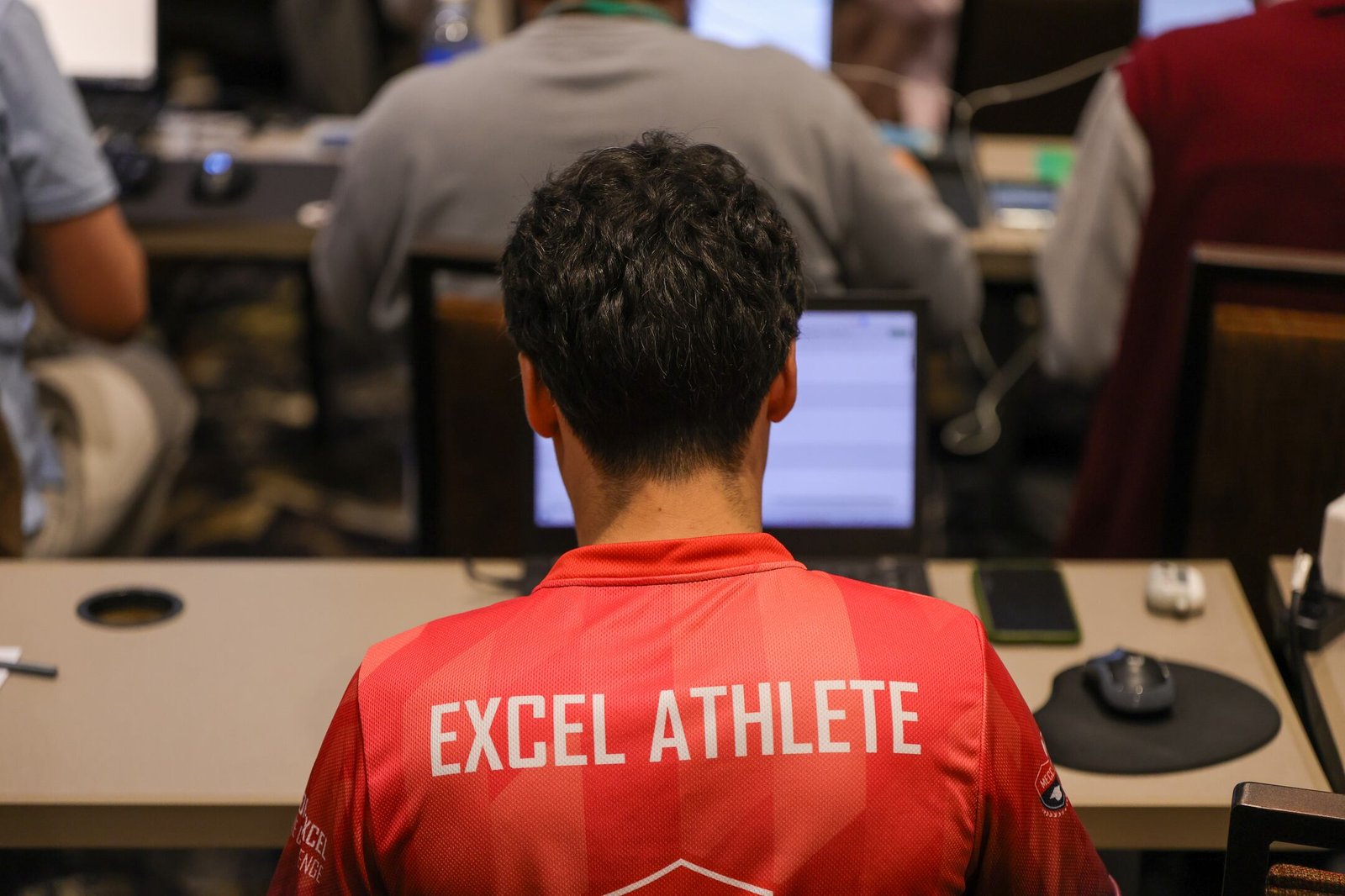
Excel Athletes will descend on Vegas Dec. 1 for this year’s world championship. (Courtesy of the Microsoft Excel World Championship)
It seems like this surge in AI adoption might threaten the advantage of knowing so much about Excel — why bother walking over to someone’s desk when you can simply ask ChatGPT?
Early believes he’ll still have value, most importantly in bringing “clarity on what model we should be building,” rather than “building the model itself.”
He considers himself to be “sufficiently senior” to charge roughly the same in a world with AI.
Jarman’s unconvinced, too. “It's not just about being good at Excel. It’s about a combination of being good at Excel but also being able to look at the spreadsheet, spot where things are wrong, and be able to stitch different pieces together.”
“I don’t think an AI will ever be as good as me or another director here [at Operus] who’s competent at Excel with 10-15 years of experience,” he adds.
But the same might not be true for everyone.
Excel monkeys
Earlier this year, the team behind the startup Shortcut AI, dubbed as a “superhuman Excel agent,” said its agent could outperform a McKinsey or Goldman Sachs analyst 89.1% of the time, and do it 10x faster.
This was no Microsoft Copilot. This was a tool that could do real damage. News spread, along with fears that tools like Shortcut AI could replace young analysts who lacked the skill of Excel world champions.
Jarman, though, doesn't think that it’s prudent to fire your first-year analyst class.
“If we sacked all the analysts tomorrow, the company would immediately be more profitable,” he says. “But that would be dumb, because who would then check the work of the AI in five to ten years time?”

Competitors ham it up off-screen. (Courtesy of the Microsoft Excel World Championship)
Indeed, even though AI might be an upgrade on a junior analyst, there are longer term implications to getting rid of newer talent. The entry-level roles aren’t just about immediate gains; they're about identifying and developing future leaders.
Further, it’s only by doing the “monkey work” to build something that one can truly understand it.
“Until you have built a three-statement model for the first time, you don’t intuitively understand the point of what you’re trying to do,” Jarman says.
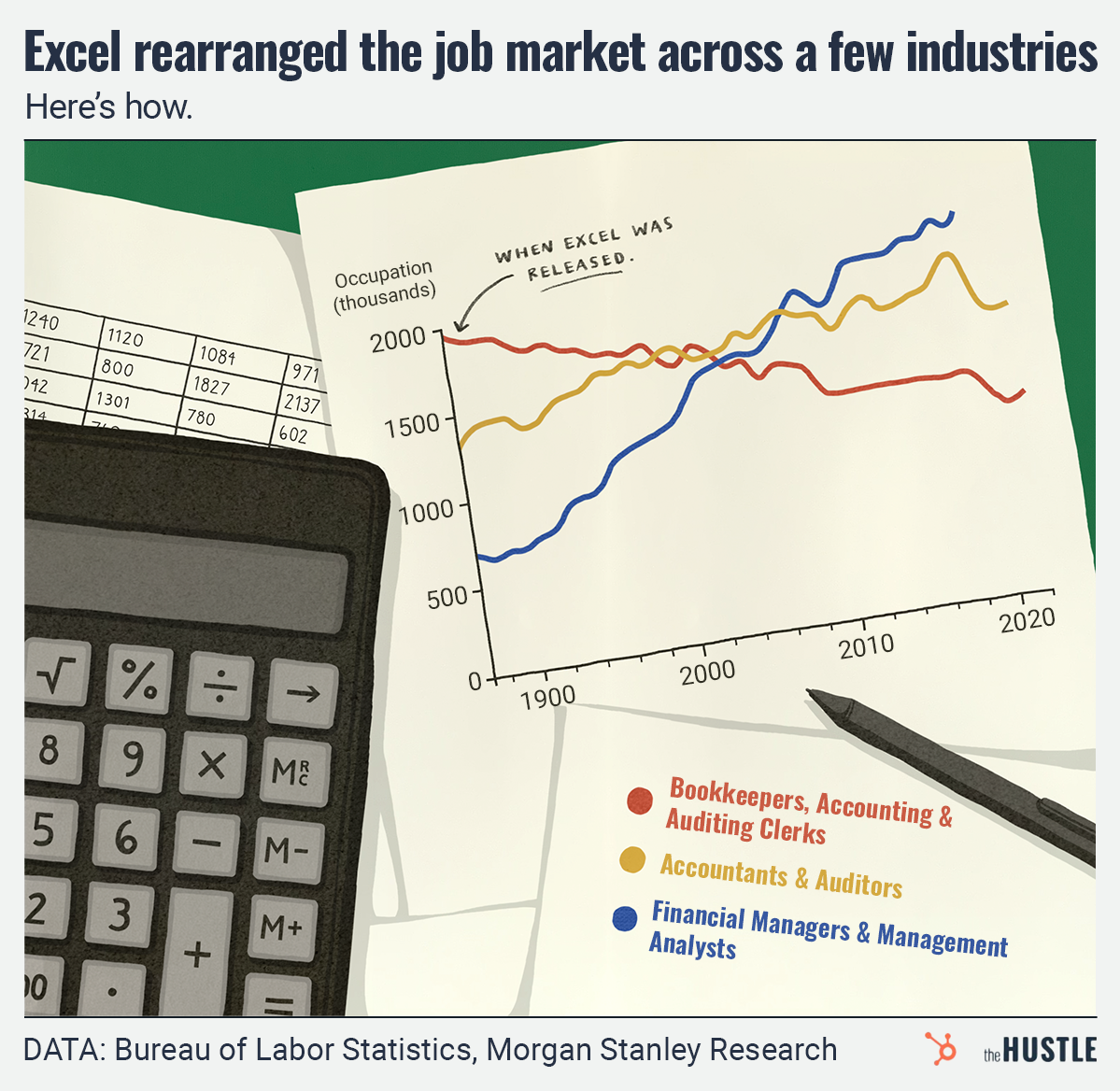
But we don’t have to look too far to find an example of technology replacing workers: When Excel first came out in the 1980s, a Morgan Stanley analysis using BLS data found that the number of Americans employed as bookkeepers and accounting clerks fell from about 2m to 1.5m between 1987 and 2002.
However, more analytical roles like those of financial managers and management analysts went up (from 600k to 1.5m) over that same time period.
In other words, Excel didn’t eliminate jobs so much as create demand for new ones.
 Olivia Heller/The Hustle
Under this view, a leap in AI might just raise the bar: clients will expect more complex models, longer decks, and deeper analysis.
“There are probably more people working on analyzing data now than there were 40 years ago, even though one person can do what a team of 50 could do back then,” Early says.
In a similar scenario, AI might augment rather than automate. But there’s no guarantee that it doesn’t get worse before it gets better.
The next formula
As the 2024 Excel championship neared its end, Jarman anxiously watched the countdown timer on a big screen. With about 15 seconds to go, his opponent, Ngai, threw a hail mary, using the RANDBETWEEN function to attempt an educated guess that could score the 50 points he needed to catch up to Jarman.
It didn’t work. The belt went from Australia to Canada, from Ngai to Jarman.
When the clock reached zero seconds, Jarman leaped out of his chair. You could hear his huge sigh of relief, immediately followed by a triumphant “COME ON!”
The belt was finally his.
The same tournament where Microsoft had shown off its AI assistant was still, ultimately, a contest of human instinct and nerve. But the tide had turned.

Michael Jarman takes home last year’s championship belt. (Courtesy of the Microsoft Excel World Championship)
In the months since, AI tools have advanced so rapidly that the MEWC has banned their use entirely. Until recently, competitors were allowed to use whatever software they liked — including AI — because it simply wasn’t fast or accurate enough to compete with humans.
That’s no longer true. Shortcut recently put out more evidence showcasing that its agent scored over 80% on cases presented at the Microsoft Excel World Championship in around 10 minutes. These problems usually take a trained human an hour or more.
Confident as Jarman is about his Excel skills, he still jokes that in the future his day job might be typing in six-digit authentication codes to let different AIs talk to each other.
For now, though, he’s set to keep doing what he loves in Vegas. That is, of course, if future Excel championships can still find enough competitors in a world where their day jobs may no longer involve much traditional Excel usage at all.
But as the MEWC’s LinkedIn account recently put it:
“Just because humans invented the car doesn’t make it less fun to run a marathon.”
microsoft