A demographic cliff is threatening hundreds of universities. They’re relying on niche sports to stay open.
For a certain type of college in the United States, the news is rarely uplifting.
These aren’t the state universities with huge research budgets and perks like Bama Rush and lazy river pools. And they aren’t the elite “Ivy Plus” private colleges with miniscule acceptance rates and greased pipelines to McKinsey.
They’re the majority of four-year nonprofit colleges and universities in the US, a mix of small private and regional public institutions whose problems are existential. Dozens have closed in the last three years, felled by:
- Financial struggles dating back to the Great Recession.
- A steep decline in available students (AKA the demographic cliff).
- A perceived decline in the importance of higher education that’s led fewer Americans, especially young men, to consider college.
“There’s only a finite number of 18-year-olds out there,” says Laurel Bongiorno, the incoming president of Hartwick College, a private liberal arts school of ~1.1k in Oneonta, New York. “So the question is, how do we get them to choose [us]?”
Hartwick has slashed tuition and added new majors to punch up an enrollment base that’s declined ~30% since the early 2010s. This year, it launched a secret weapon: a men’s volleyball team.
Yes, men’s volleyball.
Crazy as it sounds, sports are one of the strongest bulwarks standing between solvency and financial collapse for small colleges. Lacking the prestige and resources of larger competitors, they’ve introduced lesser-known sports like men’s volleyball and women’s flag football to give them niche market advantages.
The only catch? An optimal number of athletes can save a college. Too many can send it hurtling over the edge.
A growing sport and business opportunity
Last fall, my friend and colleague Zachary Crockett emailed me a screenshot with a stunning data point.
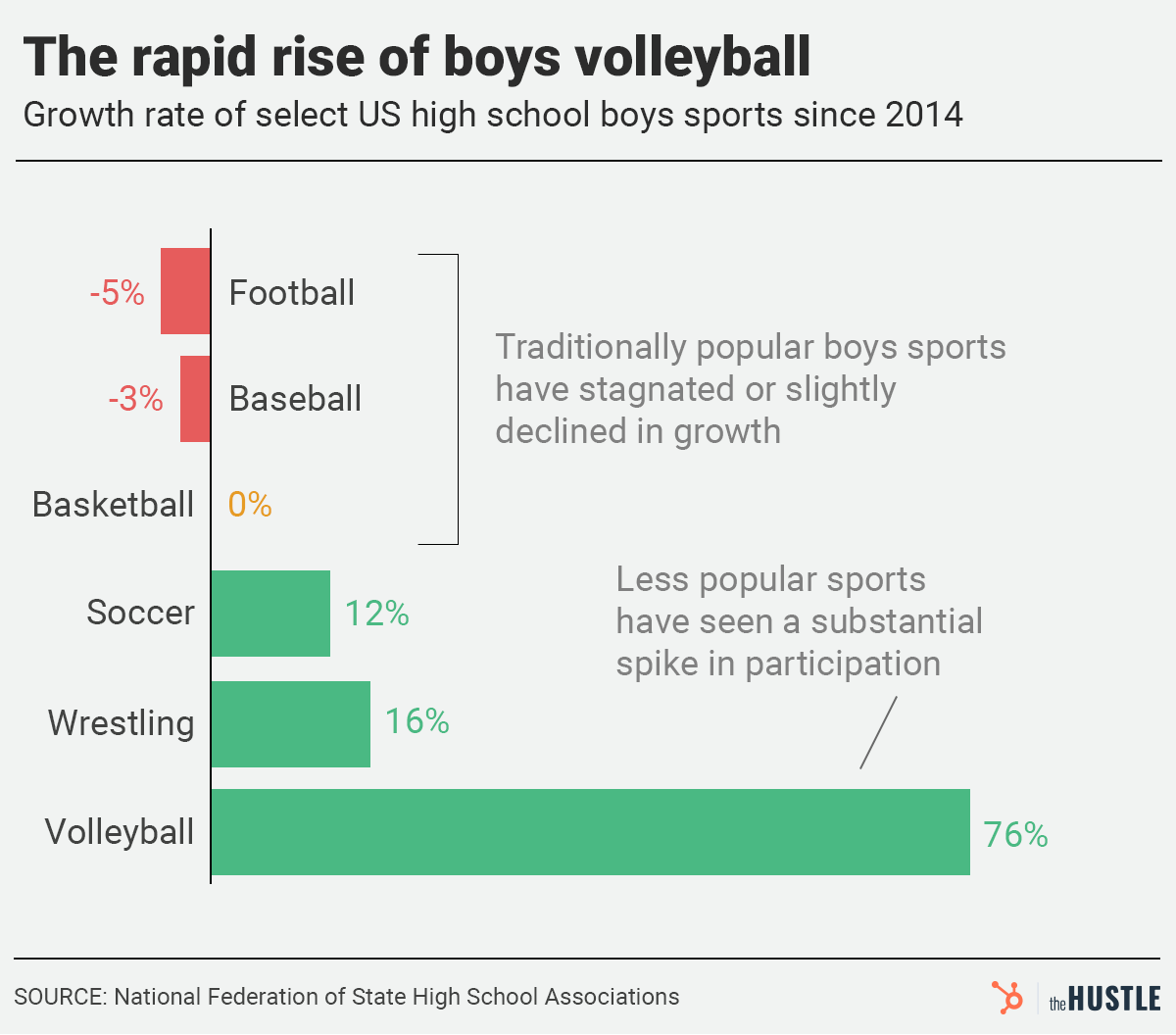
It was a list comparing the change in participation rates for boys' high school sports over the last 10 years.
- Football had declined by ~5%.
- Basketball and baseball were flat.
- Soccer went up ~12%.
And then there was volleyball. Participation among high school boys had skyrocketed by 76%. Talk about an absurd outlier.
 The Hustle
With just under 96k participants, boys’ volleyball has a long way to go to catch up to boys’ soccer (~485k) or football (1m+). But after decades of being confined to the coasts and random Rust Belt locales, it was sanctioned as an official high school sport by 29 states as of last fall.
Joshua Bigford, the Hartwick College men’s coach, grew up playing at makeshift beach courts in bars in Syracuse, New York, often against older men. He says the fast-paced nature of the game, coupled with increased opportunities at camps and junior leagues, helped cause an organic spread at the youth level.
Money has also been a factor. A nonprofit associated with USA Volleyball, First Point Volleyball, has contributed ~$3m to high school and college volleyball programs since 2017, according to IRS records.
The uptick in collegiate teams has fueled demand among high school and middle school boys.
“People are now finding out ‘I could play [volleyball] in college,’ so they're growing the sport at the youth levels,” says Paul Vecchio, Hartwick College’s executive director of athletics.
And, notably, the growth in men’s volleyball programs is concentrated at smaller colleges and universities.
- This year there were 31 Division I men’s volleyball teams, up from 22 in 2018. (Division I encompasses elite private universities, like Harvard and Princeton, and huge state schools, like Penn State University and the University of California, Los Angeles.)
- There were 45 men’s volleyball teams at the Division II level and 144 at the Division III level this year, up from 24 and 77 in 2018, respectively.
These Division II and Division III schools, which tend to be small private or regional public schools, are most threatened by enrollment woes. As their traditional enrollment bases dry up, sports have become a life raft.
“Athletics is charged with helping the institution reach their goals in terms of enrollment, recruitment, revenue generation,” says Sean Johnson, vice president for athletics at Division II Newberry College in South Carolina.
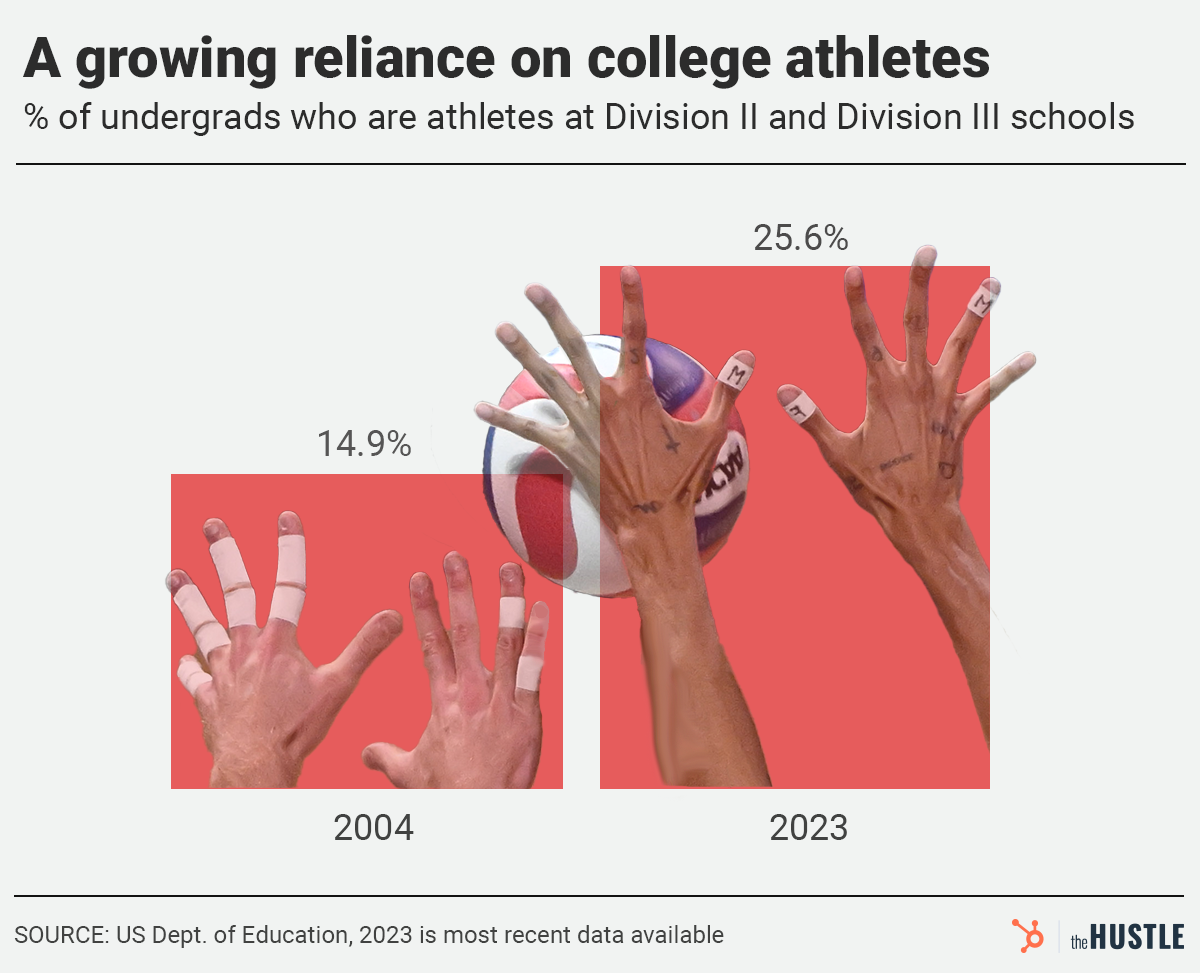
In 2004, according to Department of Education data, ~15% of all students were athletes at Division II and Division III schools. The number is now ~25%. (At the Division I level, it’s only ~7%.)
 The Hustle
The economics make sense.
Unlike Big-time Division I schools, which pour tens of millions into athletic scholarships and direct NIL (name, image, likeness) payments to athletes, Division II schools offer partial scholarships and Division III schools don’t offer athletic scholarships at all. NIL payments are basically nonexistent.
Even with eye-popping TV revenues, Division I universities struggle to stay in the black and are more likely to cut sports than add them. The opposite is true at Division II and Division III: more teams and players tend to lead to more tuition payments — and opportunities to recruit students who otherwise wouldn’t consider them.
“I’d never heard of Hartwick,” says Nate Roorbach.
As a high school senior in the Buffalo-area, Roorbach applied to five colleges, including two state universities where he’d just be a student. But midway through the year Bigford, the Hartwick coach, sent him an email and sold him on the Hartwick program. Roorbach became the team’s first commit.
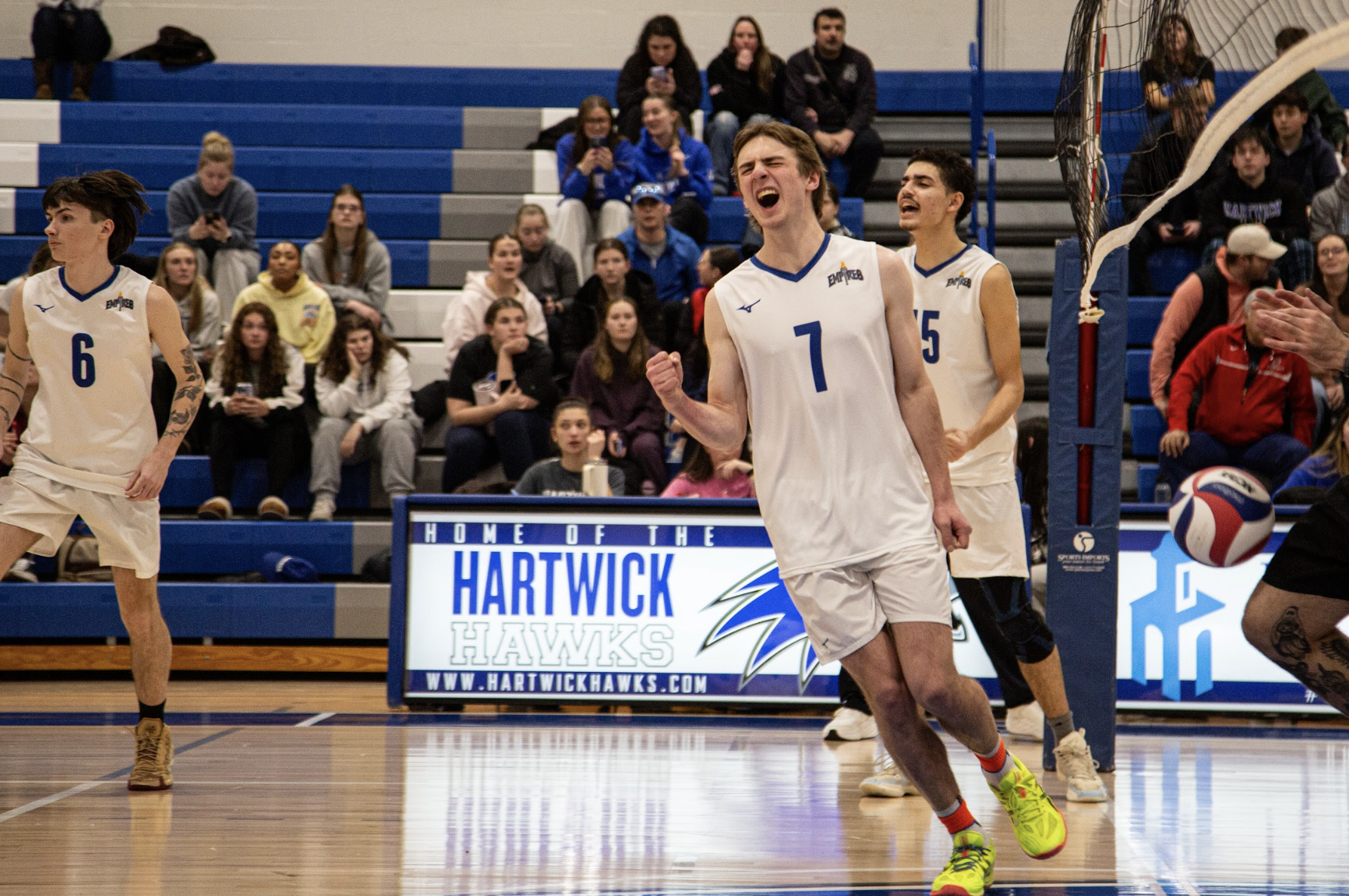 Nate Roorbach hadn’t heard of Hartwick College until he was recruited by its volleyball coach. (Courtesy of Hartwick College)
Hartwick, which has added three sports since 2024, features a student body in which ~40% of students are athletes. It’s a number the school is wary of increasing by too much — for one major reason.
The 44% theory
Steve Dittmore admits that his research interest, the relationship of athletics and enrollment at small colleges, falls pretty far outside of the mainstream, even in the already-niche world of sports and higher ed. At an industry conference this spring, there was only one panel devoted to Division II and Division III athletics. He was on it.
A couple years ago, Dittmore, a dean at the University of North Florida, got curious about whether athletes — “a way to ensure tuition dollars are coming in” during turbulent times — could be too much of a good thing.
He identified 44% as a key threshold after noticing that colleges like Birmingham-Southern, Finlandia, Clarks Summit, and Wells had student bodies with around that percentage of athletes and were shutting down.
Why did 44% make a difference?
“You're going to wind up with a campus climate that looks very different than perhaps what your institution was founded upon, if it was founded upon academics,” Dittmore says. That type of culture “may create antipathy for non-athletes to come to a campus with a dominant athletic culture,” adds Karen Weaver, a University of Pennsylvania professor who studies college athletics.
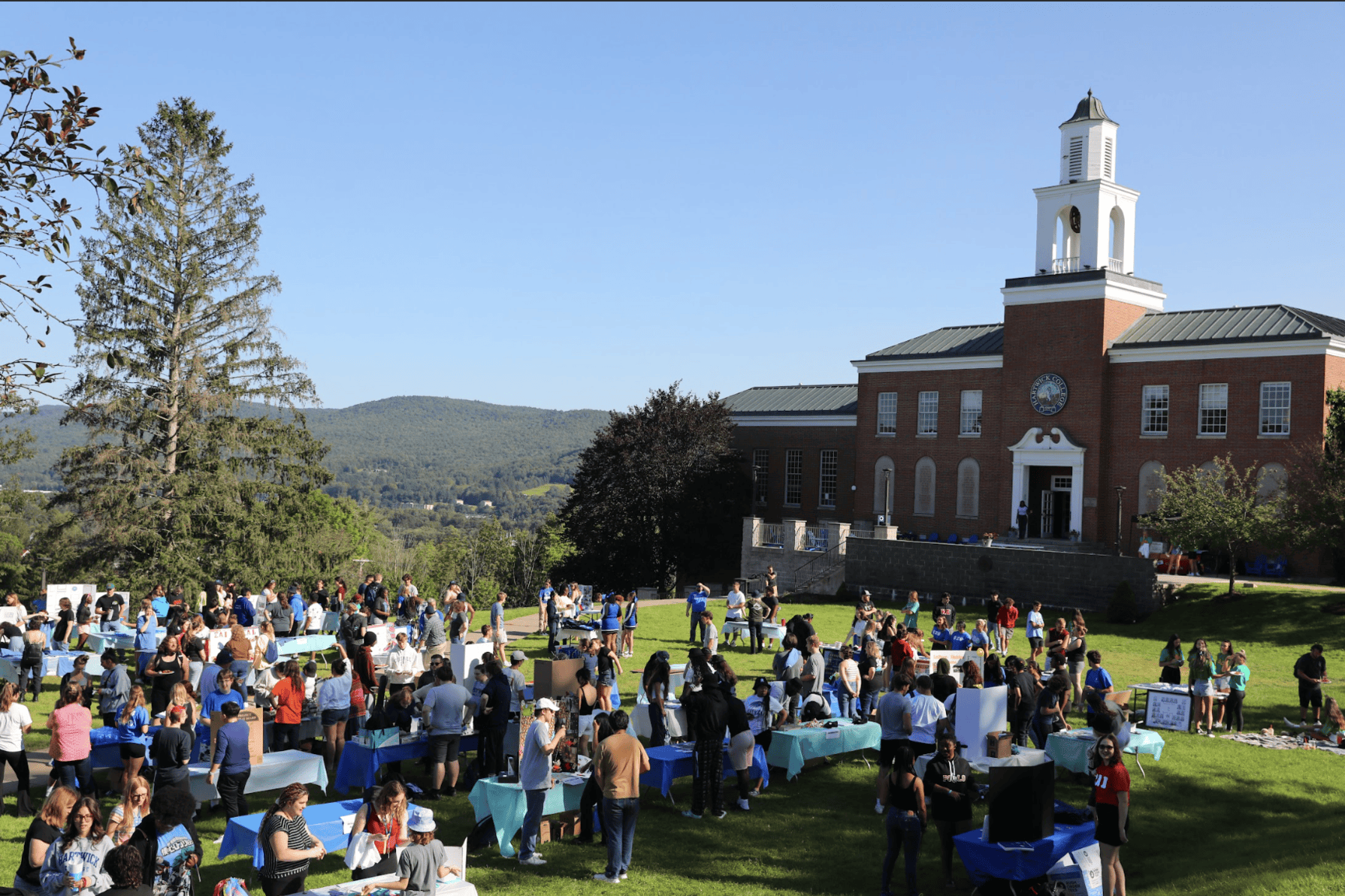
Hartwick College in Oneonta, New York. (Courtesy of Hartwick College)
Athletes are also more expensive than regular students due to costs associated with their sports. And if you rely too much on athletes, you might see comically large teams.
At Division II Erskine University in South Carolina, athletes make up ~80% of the student body, according to the most recent enrollment numbers it disclosed to the federal government. Erskine’s men’s basketball roster last season featured 44 players — 39 more than can be on the court at a time. (An Erskine spokesperson didn’t respond to a request for interviews.)
Players who can’t get off the bench seek new opportunities, lowering retention and graduation rates, and putting universities in the same financial troubles they face from declining enrollments.
I checked on the 44% threshold for every nonprofit four-year college that offered sports and closed for financial reasons in 2023 and 2024. It held up: Of the 14 for which enrollment and athlete numbers were available, eight surpassed the 44% athlete mark. The share at the University of Saint Katherine, an Orthodox Christian school in Southern California, was ~85%.
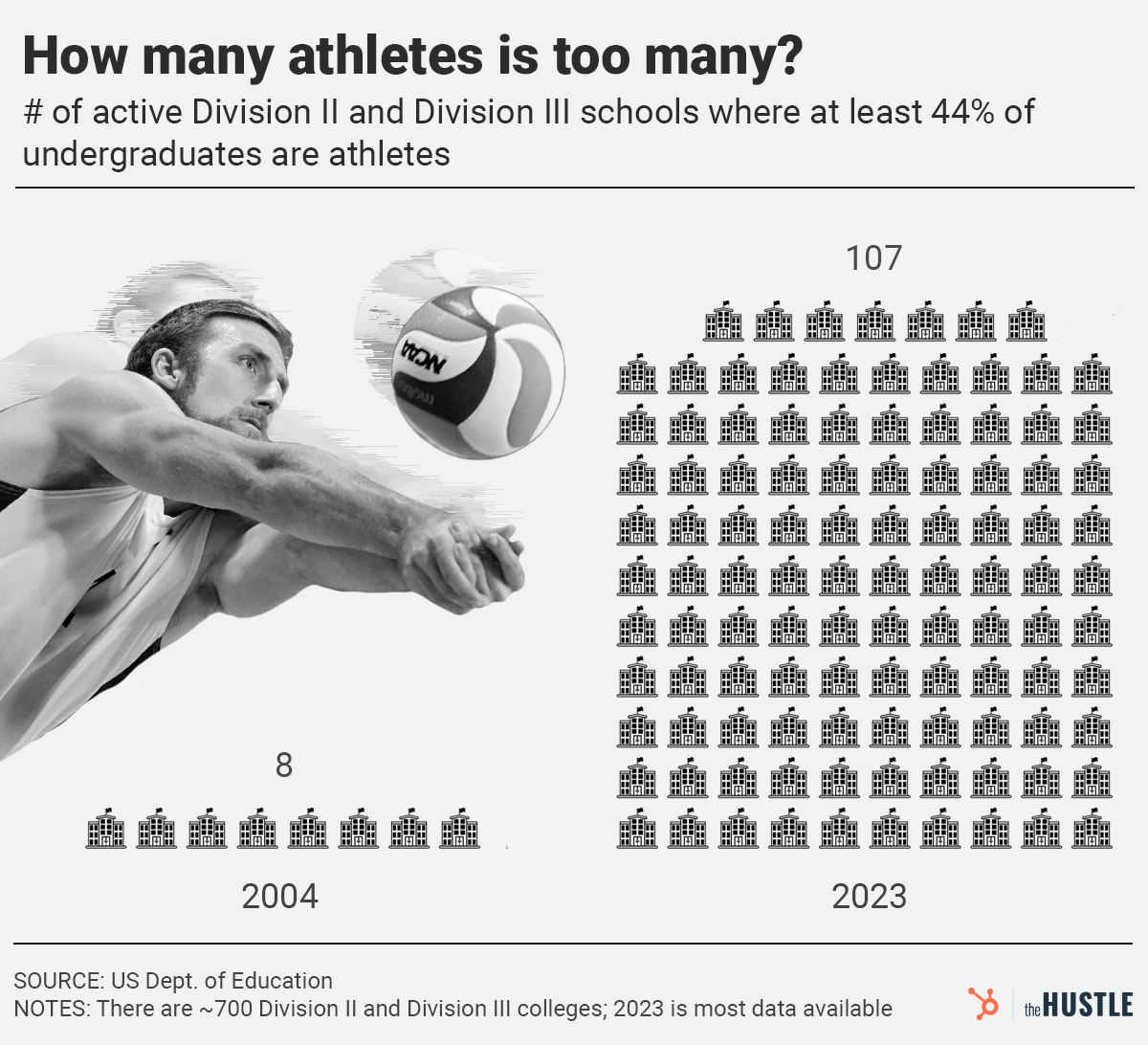
Altogether at the Division II and Division III levels, according to the most recent federal data, 107 out of ~700 colleges feature student bodies where at least 44% of undergraduates are athletes. (A number that doesn’t include some recently-closed colleges.) In 2004, just eight schools that are still open today reached that threshold.
“The problem that you run into, if you're too dependent on student-athletes, is you keep growing the size of your rosters,” says Johnson, the athletic director at Newberry College. “And at some point it just becomes unmanageable.”
 The Hustle
Located in the booming Sunbelt, Newberry has fared better than many liberal arts colleges, with its enrollment roughly doubling since the early 2000s. Still, when Johnson took over as athletic director in 2022, he started paring down rosters in traditional sports like football while adding newly-popular sports like men’s volleyball and women’s wrestling.
Since then, he says Newberry’s share of athletes as part of the overall student body has declined from ~60% to ~50%.
Kiko Santos, the Newberry men’s volleyball coach, intends to have no more than 15 or 20 players. He doesn’t want the program to turn into “a revolving door.”
A bright volleyball future
Next month, the best Division I and Division II men’s volleyball teams will face off in the NCAA championship in Los Angeles. Newberry College won’t be there. It finished its inaugural season with a losing record.
For Carson Kramer, there were plenty of highlights: the first win, new friendships, and growing as a person away from his home in Florida. If not for the partial scholarship he received at Newberry for men’s volleyball, he wouldn’t have attended college. He’s now aiming to become a physical therapist.
Kramer also liked what Santos preached to his players throughout the year. The coach told them they weren’t just playing for themselves, that they were pioneers for the college and the sport, leading future generations.
Newberry, and dozens of other schools, can only hope that it’s for many generations to come.