One grassroots group in Philadelphia is trying
Thirty years ago, in search of a better life for herself and her four kids, Darlene Burton moved to Kensington, a neighborhood northeast of downtown Philadelphia. Back then, the working class community was thriving, home to clothing stores, a five-and-dime, and a Murry’s grocery store. “It was beautiful,” she said. “I was proud to say I lived there.”
But the drug trade was beginning to spread throughout the area, and eventually Kensington became known as a notorious opioid hot spot, home to crime, rampant homelessness, and the largest open-air drug market on the east coast.
Along Kensington Avenue, the area’s main drag, pawn shops and check cashing services mixed with boarded-up storefronts. The drug use was so overt that Burton’s son, once he became a father himself, eventually refused to bring his kids there to visit their grandmother.
Now it’s changing again. Gentrification has come for Kensington.
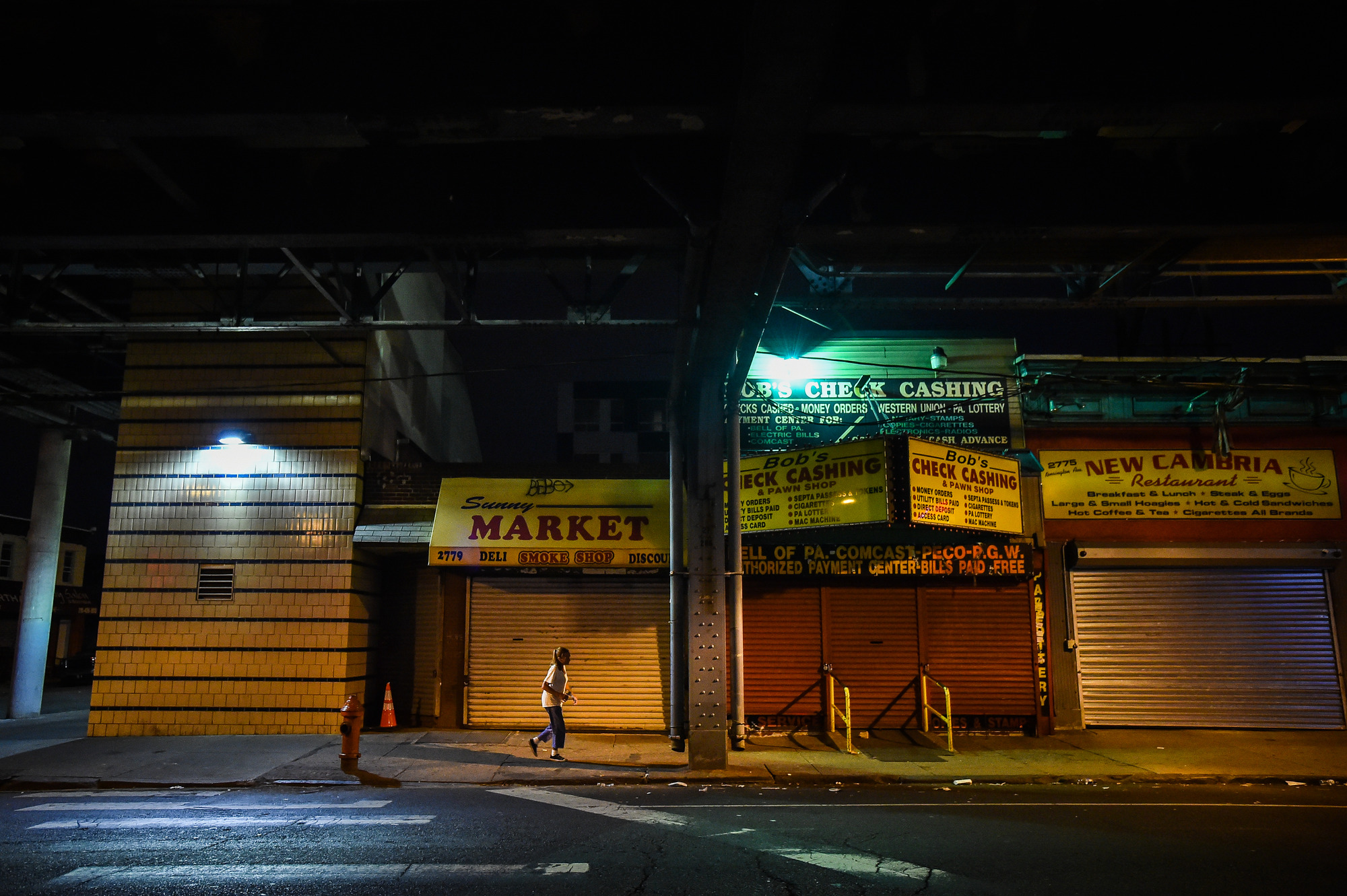 Kensington’s boarded-up storefronts at night. (Photo by Salwan Georges/The Washington Post via Getty Images)
Burton and her neighbors are worried. They’ve observed the process in nearby communities, as longtime residents who stuck it out through the bad years were unable to enjoy the improvements as rising taxes and rents forced them out.
“It’s very unfair,” she says. “First nobody wants to live there, and now your neighborhood becomes a place where you can no longer live.”
But one organization is pushing back. Since 2019, the Kensington Corridor Trust has been buying up buildings and land along a stretch of Kensington Avenue, and now owns 31 properties. Led by community residents, the nonprofit rents commercial spaces and apartments at reduced prices, keeping residents in the community even as property values rise.
The Kensington group is expanding quickly, but hundreds of organizations across the country are also experimenting with ways to put residential and commercial real estate in the hands of community members, not distant LLCs. They’re removing land from the speculative market — decommodifying it, if you will.
Sounds great. But will it work?
‘Sounded like a zealot’
Community-owned real estate isn’t a new idea. A century ago, cooperative housing programs thrived in cities around the US. The first land trust was created in Lee County, Georgia, in 1969, to help Black farmers — often targets of predatory lending — own land. Co-ops still hold thousands of housing units in New York City.
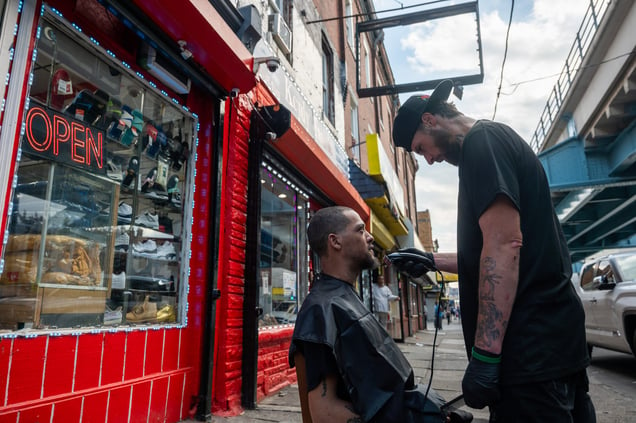 A man gets a haircut outside a barber shop off Kensington Avenue. (Photo by Spencer Platt/Getty Images)
But the most recent iteration of the movement got its start around 2004 with Market Creek Plaza, a community-owned shopping center in San Diego that brought a supermarket, bank and family-owned restaurants to a neighborhood that had once been a retail desert. Over the next 15 years, other initiatives sprang up, like the East Portland Community Investment Trust and the East Bay Permanent Real Estate Cooperative. After the Covid pandemic, property values spiked nationally, which reignited the conversation.
“Anyone talking about community-owned real estate [fifteen years ago] sounded like a zealot,” says Saul Ettlin, formerly of Community Vision CA, a community lender. “I think around the time of Covid, the conversation really changed.”
The idea of decommodifying real estate has been bandied about in recent years as a potential solution to private equity and other investors’ growing domination of the real estate market. In reality, it’s less an overarching policy and more a series of small, bottom-up experiments. Sometimes, it means trying to beat private equity at its own game.
 Olivia Heller/The Hustle
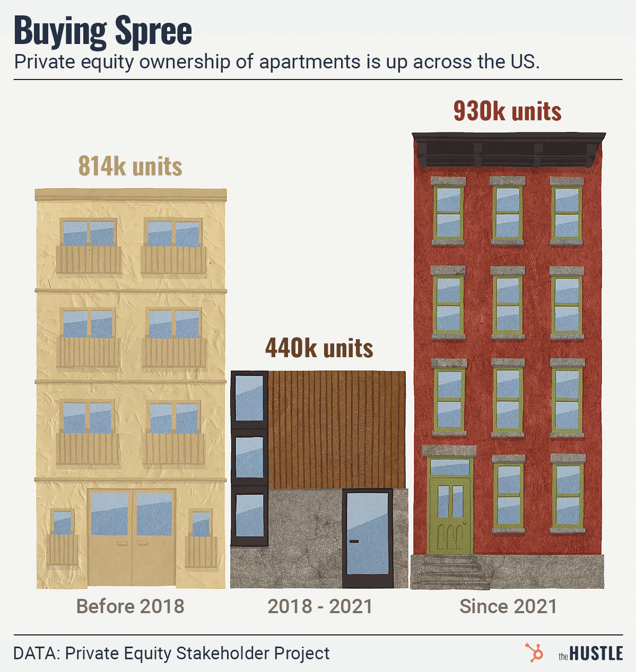
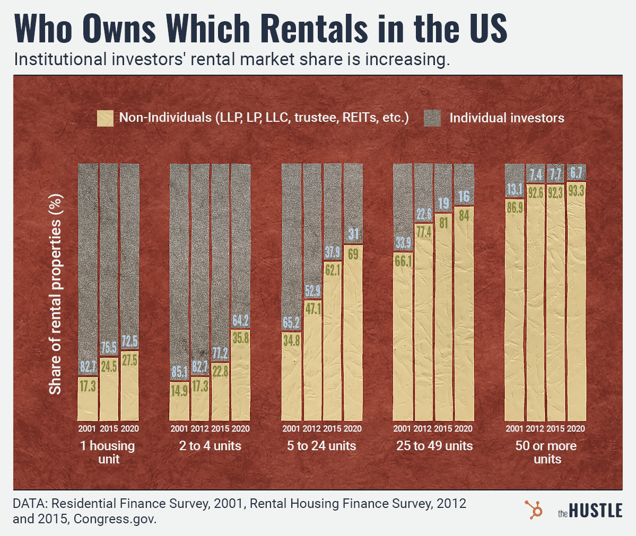
Today, ~10% of apartments nationally are owned by private equity firms; almost half were bought after 2021. That figure doesn’t include institutional investors like pension funds and REITs, or other large investors — the proportion of rental units owned by outside investors is likely significantly larger.
No more liquor stores
In Kensington, the Corridor Trust project started when several local companies and nonprofits joined forces to create an entity that would buy local properties and keep them in the hands of the community indefinitely. They weren’t necessarily envisioning that community members themselves would run the project, but once a board was formed and an executive director hired, the organization elected to become wholly neighborhood-run.
KCT is governed by a legal framework called a perpetual purpose trust, which mandates that all of the organization’s real estate purchases adhere to a single goal — in this case, preserving culture and affordability in Kensington — and are approved by a board of local residents and businesspeople.
“For small business entrepreneurs [who we rent to], we vet them and make sure their financials are sustainable and introduce them to the larger community,” says Jasmin Velez, development and communications manager at KCT.
“We don’t want any more liquor stores or check cashing places — the neighborhood is already saturated with them.”
 Olivia Heller/The Hustle
Two elements have been crucial to the organization’s initial success: speed and low-interest loans.
KCT’s strategy is to buy real estate now, while prices in the neighborhood are still low, and to move quickly when properties come on the market — techniques employed by big-dollar investors all the time.
And it’s the $16m the group has managed to raise in investments and grants that makes the purchases possible. Most of that has come in the form of investments with interest rates of ~2% from the Philadelphia-based Barra Foundation and the Kataly Foundation in San Francisco, as well as mission-driven investors like Community Impact Investments and Chordata Capital.
KCT then rents the properties out — to people like Crystal Ortiz, who owns the Waxery, a make-your-own candle business on Kensington Avenue. There’s also a hair-braiding business, an art gallery, and a youth-focused nonprofit, plus a waiting list of prospective businesses. Ortiz was KCT’s first commercial tenant, and has been on the strip for almost four years now.
“There are people who are addicted to drugs that are still lingering around the neighborhood, but they’re not where I am,” said Ortiz. “[The trust] has people coming out and cleaning the corridor to make it more eye-catching.”
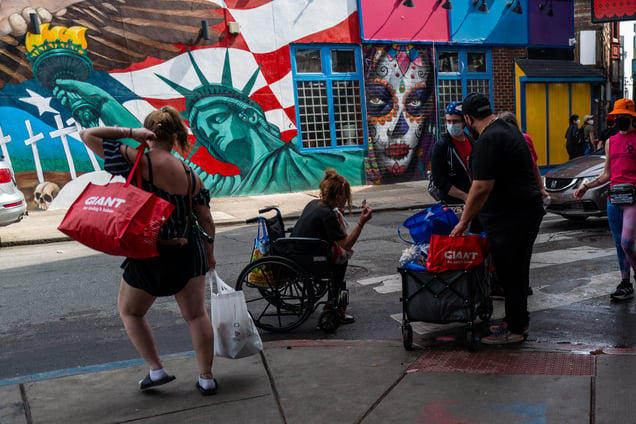 Kensington residents move their belongings during a crackdown on a homeless encampment two years ago. (Photo by Spencer Platt/Getty Images)
Despite the community’s deep pride in the neighborhood, it’s a tough life: 33% of residents live below the poverty line. The neighborhood’s median income is ~$24k, less than half of the median income in the greater Philly area.
Despite that, rents in the area are rising. Average rent in the neighborhood is ~$1650, higher than the city’s median of $1600. KCT is working on that, too. Its ground-floor retail spaces are affordable to people earning between 25% and 50% of the Philadelphia area’s median income of $62k, which includes most Kensington residents. They’re charging between $500 and $1500, depending on apartment size.
Eventually, the organization plans to double its inventory to 60 properties along a one-and-a-half mile stretch of Kensington Avenue.
No cookie-cutter approach
The perpetual purpose trust model has more often been used by businesses — the outdoor apparel company Patagonia put one in place in 2022 — but KCT married it with a nonprofit and adapted it to fit real estate.
Around the country, other shared ownership projects do things a little differently:
- Community land trusts, which exist in every state in the US, acquire and sell houses to low- and middle-income people while maintaining ownership of the land underneath. That keeps prices low and ensures that the properties stay in the organization’s portfolio.
- Community investment trusts like the East Bay Permanent Real Estate Cooperative allow local residents to buy shares in the properties, sometimes for as little as $10 each. The money becomes capital for the organizations and earns locals a modest return.
- Mixed-income neighborhood trusts, which exist in five cities around the country, including Kansas City and Tulsa, purchase and rent out market rate and affordable buildings in gentrifying neighborhoods. As the value of the buildings increases over time, market-rate units in the portfolio subsidize affordable ones.
“I’d wanted to taxonomize the field, but abandoned it because every example is different,” says Gretchen Beesing, a senior fellow at the Center of Community Investment who focuses on community wealth building and has mapped out community-owned real estate projects in the US.
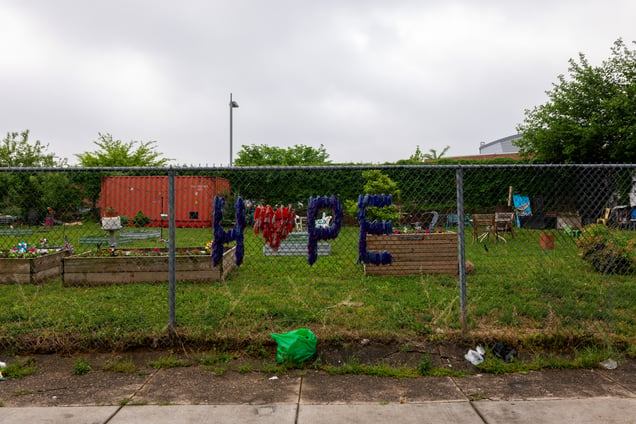 A community garden grows in Kensington. (Photo by Spencer Platt/Getty Images)
That makes growing the model a challenge, she says. “The potential is there — but so are real barriers,” she says. “Scaling them will require policy changes and sustained local organizing, not to mention capital and subsidy.” Still, Beesing considers KCT one of the country’s most successful examples of community-owned real estate today.
A solution to gentrification and displacement?
Some groups are thinking even bigger. In 2024, a national group called Grounded Solutions Network launched a fund to raise money from investors to buy single-family homes in large batches, much like Blackstone and other private equity firms have been doing for the last decade. Last year, Grounded Solutions helped to buy ~300 occupied single-family homes in the Twin Cities. As the homes become vacant, the group gives local land trusts the chance to buy them. It’s now working on a portfolio of 40 units in Atlanta.
Meanwhile, in Kensington, where luxury condos listed at ~$500k are under construction less than a mile away, KCT is coming off a busy couple of years. The organization bought eight commercial properties in 2024 and is now working on something the area has long been without: a grocery store. At only 800 square feet, it’s not the Murry’s of years past, but the operator is from the neighborhood and the store will carry fresh produce and other items residents have been clamoring for. It’s slated to open later this year.
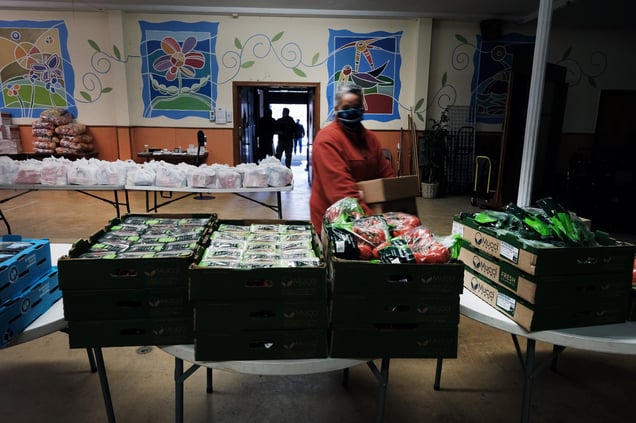 A grocery store is slated to open in Kensington this year. In the meantime, residents stock a food pantry. (Photo by Spencer Platt/Getty Images)
KCT board member Tayyib Smith, a local entrepreneur and real estate developer, has been part of the group since its start and is a cheerleader for its model.
For years, he’s been watching the same process play out that Darlene Burton is concerned about: deep-pocketed investors from elsewhere targeting a low-income community, bringing growth, higher property values, and returns, and inevitably pushing existing residents out. While advocates, policymakers and philanthropists wring their hands about it, he says, no one ever suggests an alternative.
“Where is the vision?” Smith asks.
KCT and its like-minded organizations, he believes, might offer an answer to that question.
housing and real estate