
US parents toilet train their kids much later than they used to. And that trend is a sales bonanza for Pampers and Huggies.
In the first few weeks with a newborn, time bends in every direction. Did the baby doze off for 20 minutes or was it an hour? Is it Saturday or Tuesday?
It was during this stretch that I stumbled on forgotten data regarding the ultimate question of timing for new parents: when to toilet train.
A small mention in a popular parenting book led me to an academic study from the ‘80s, which led me to a 1947 newspaper article, which led me, finally, to a journal article titled “Some Statistics on Rochester Babies Born in 1944.” The secret was buried deep in the Minnesota snow.
That year, doctors affiliated with the Mayo Clinic enrolled 336 local babies in a pioneering program that taught parents to follow a child’s behavior and cues instead of just sticking to regimented schedules.
The doctors tracked all kinds of baby stuff: breast feeding, sleeping, crying, and, yes, toilet training. Acting on advice from the physicians, some 80% of the parents achieved full or partial success toilet training their child by his or her first birthday.
I thought I might be hallucinating. That’s extremely fast!
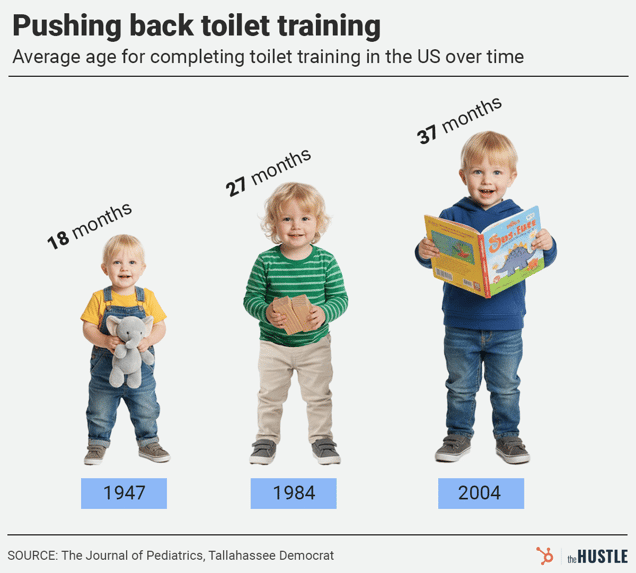
- More recent studies and surveys, tell us that the average age for starting toilet training is ~21 months. Nearly half of children haven’t finished by 36 months; many haven’t even started by then.
- The American Academy of Family Physicians advises training children when they reach specific developmental milestones, which is often anywhere from 18-24 months, while noting that the guidance is based on expert opinion rather than clinical studies and that parents in many non-Western countries successfully train their children earlier.
What changed in the last 80 years? The answer has a lot to do with the rise of the multi-billion dollar modern diaper industry.
The birth of the modern diaper industry
This saga begins — where else — in a bathroom. In the mid-1940s, a mother named Marion Donovan stared at her shower curtain and saw the future of infant care.
Donovan, a Connecticut resident and former beauty editor of Vogue, had recently given birth to her second child and couldn’t stomach the idea of using traditional cloth diapers, combined with the stifling latex of rubber pants, to keep her baby dry.

She snipped a section of the curtain. And then another. Donovan also experimented with nylon from parachute cloth and came up with a leakproof cover that could be folded over a baby and snapped on with fasteners. She called it the Boater.
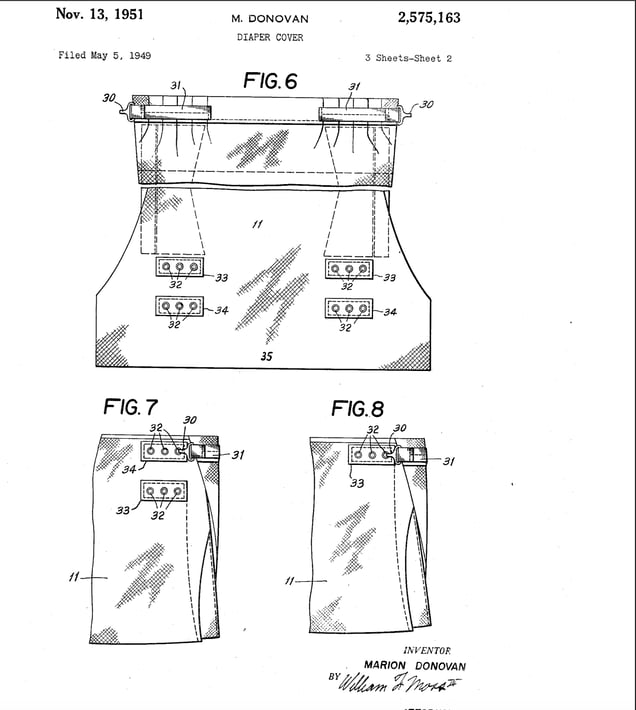
The patent for Donovan’s waterproof and leakproof diaper cover. (USPTO)
Manufacturers turned her down. Neighbors objected to her use of her home as a business. But Donovan financed and produced her own invention, first selling the Boater at Saks in 1949.
It was an instant success, leading her to sell the patent and her company for $1m (~$13m today) to the Ohio-based Kennedy Company. Her work provided a blueprint for the disposable diaper industry.
Although established companies may not have wanted to work with Donovan, they were eager to produce their own diaper innovations.
- In the late 1950s in Dallas, Procter & Gamble researcher Victor Mills started testing the first mass-produced disposable diapers.
- They were too expensive for average parents, as were modified disposable diapers that P&G tested in Peoria, Illinois, in 1961, sold at 10 cents each.
P&G tweaked its manufacturing process for the next few years, getting the price down to a reasonable six cents. It released the diapers nationwide in 1966, under the brand name Pampers.
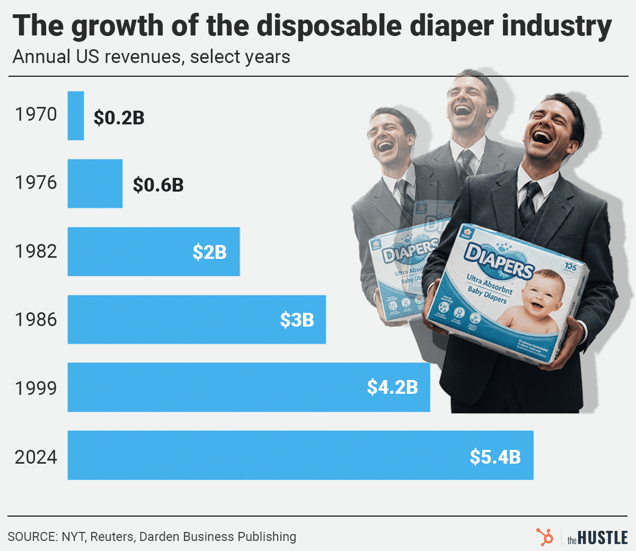
By the early ‘70s, analysts estimated parents bought ~$200m of disposable diapers annually with the market size anticipated to triple in the next few years as remaining holdouts converted from cloth to disposable diapers. P&G had ~80%-90% market share, although Kimberly-Clark, maker of Kimbies and then Huggies, was ratcheting up the competition.
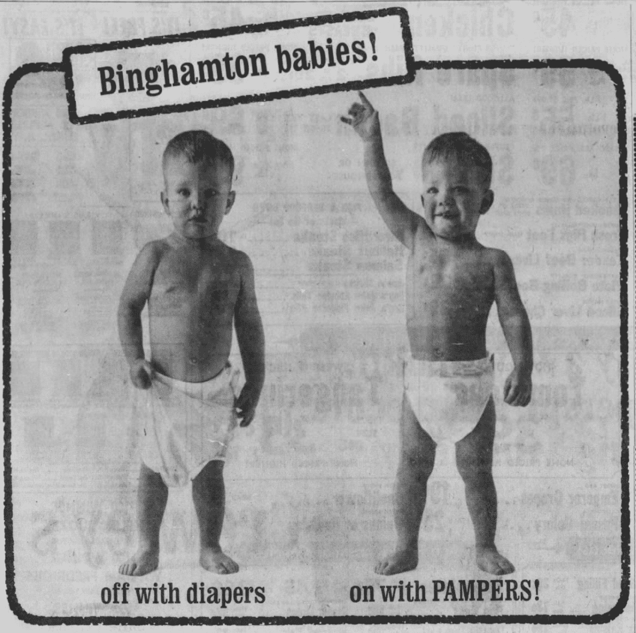
An early Pampers ad from the 1960s. (Newspapers.com)
The disposable diaper was nothing short of revolutionary. “I can’t think of a product that has helped parents more,” noted Judith Butler, the editor of American Baby, in 1988.
Disposables made day-care centers easier to operate, prodded fathers into getting involved, and allowed families to travel with greater ease. They were so convenient, it seemed, that parents didn’t want to stop using them.
The baby whisperer
Even before the dawn of disposables, the age for toilet training was edging upwards:
- In the early 20th century, parents regularly put their children on the toilet when they were just a few weeks old, following the methods of psychologists like John B. Watson, who infamously conditioned a 9-month-old to fear rodents by clanging a metal rod behind his head every time a white rat appeared.
- By the 1940s, the Mayo Clinic program was advising parents to wait longer, in an effort to foster healthier emotional and physical development among children.
In the 1960s, this focus on the child’s readiness coincided with the rise of the modern disposable diaper, perhaps the most significant catalyst in driving up potty training age, and the philosophy of T. Berry Brazelton.
Brazelton, a pediatrician and graduate of Columbia University’s College of Physicians, found the earlier conventional wisdom on infants — essentially that they had little autonomy or feelings and parents should be blamed for how they developed — to be backward and outdated.
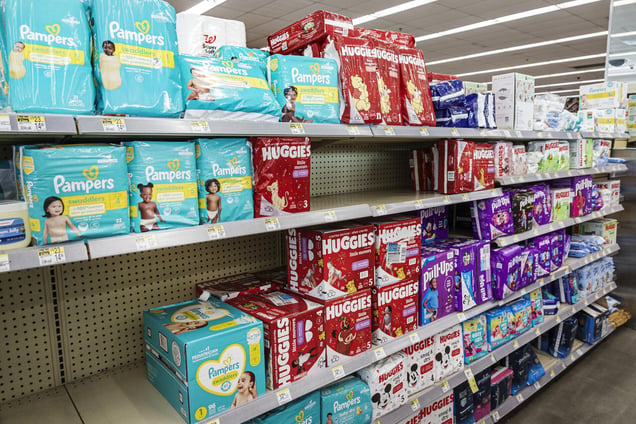
The diaper aisle in a Miami Beach, Florida, Walgreens. (Jeffrey Greenberg/Universal Images Group via Getty Images)
So he founded his own practice in Cambridge, Massachusetts, and observed that babies had their own characteristics separate from parental influence. He went on to advise parents on nearly every step of the child-rearing journey, including toilet training.
In 1962, the journal Pediatrics published a Brazelton study in which he observed ~1k parents and children in the 1950s. They followed his “child-oriented” approach to toilet training, which involved starting training at about two years old. That was after the age when the vast majority of children had previously finished training but when Brazelton believed that most children would only be physically and emotionally ready to start.
The average age for completion of training in his study was 28.5 months.
The results showed that children following his approach were less likely to have bedwetting or constipation problems by the time they turned 5 than those who started earlier. (Subsequent studies have found similar issues in children who train too late.)
He later summarized his view by saying, “Toilet training should be left up to the child. Believe me, he’ll let you know when he’s ready.”
Brazelton became known as the “baby whisperer.” His research underpinned an influential tool called the Brazelton Neonatal Behavioral Assessment Scale, and he achieved fame from his Lifetime television show “What Every Baby Knows.” He grew so famous that on a flight to San Francisco for a book tour in 1987, a flight attendant upgraded Brazelton to first class, offered him “a tub of gin,” and asked him to explain toilet training.
Although Brazelton suggested that children should begin training around 2, he didn’t have any problems with them starting much later. And plenty of parents decided to wait. In 1997, a study of 482 children in suburban Philadelphia indicated that the average age for beginning training was 23 months and just ~60% of children completed training by 36 months.
 The Hustle
Was it necessary to wear diapers for so long? Bruce Taubman, who authored the 1997 study, said at the time that he didn’t think people should coerce their children too early but that Brazelton’s method hadn’t solved every problem.
Environmentalists were also crusading against the landfill impact of disposables, with states like Nebraska passing legislation that required them to be made of material that decomposed quickly. And another author of parenting books, child psychologist John Rosemond, waged a public battle with Brazelton over toilet training, considering it ridiculous that a 3-year-old would still be in diapers.
Americans made comparisons with countries like the Soviet Union, where most babies were still trained by their first birthday. In 1990, one Soviet mother who visited the US wondered why all the toddlers couldn’t use the toilet.
“I got my answer when I walked into the stores and saw all these Pampers,” she said.
The Brazelton commercial
By the late ‘90s, disposable diaper revenues were estimated at $4.2B in the US. Some 95% of parents used them, an increase from 80% in the early ‘80s and 50% in the early ‘70s.
P&G, once the unquestioned leader, slightly trailed Kimberly-Clark in market share. The companies had battled back-and-forth with innovations, from materials that increased absorbency and prevented rashes to velcro tabs and elastic waistbands — all while getting cheaper.
 The Hustle
They’d also started making ever-larger diapers for older toddlers. Kimberly-Clark introduced Pull-Ups in 1989. Ten years later, revenues for training-style diapers were estimated at $545m, with Kimberly-Clark estimating them to double by the early 2000s.
Around this time, Pampers introduced its own tool to sell diapers for older toddlers: Dr. T. Berry Brazelton.
P&G had helped Brazelton fund his own foundation, which he started in 1996. He also served as chairman of the Pampers Parenting Institute.
And in 1998, Brazelton appeared in a Pampers television ad. The brand was introducing the size six diaper, its largest yet. The kid in the commercial stood taller than a bathroom sink and ran through the house wearing khaki pants and a green polo shirt.
“I’m glad there’s finally a bigger diaper for growing toddlers,” Brazelton said in the ad. “What a big help and a terrific idea.”
Brazelton wasn’t just a paid spokesperson for the size six diaper. As The National Post reported at the time, he’d been so concerned about the pressure mounting on parents to train children earlier that he approached P&G with the idea to develop it.
Brazelton said he wasn’t trying to “keep kids in diapers.” He’d formed his beliefs on toilet training long before taking money from P&G.
He added that he worked with Pampers “as a matter of practicality” because they made it easier for kids to start training when they were ready and because they funded some of his work.
The $3B bonus
Today, Pampers has gone beyond the size six. The brand has a size seven diaper, with an upper limit of 50 pounds, a weight that average children don’t reach until they’re ~5. There’s also a size eight that Pampers describes as being for children who weigh up to 65 pounds.
The most cited recent study on toilet training comes from 2004. It showed an average age of training completion of ~37 months for 378 children. About 16% of those babies weren’t trained by 42 months. In Brazelton’s 1950s study, before disposable diapers went mainstream, less than 1% of the babies were trained that late.
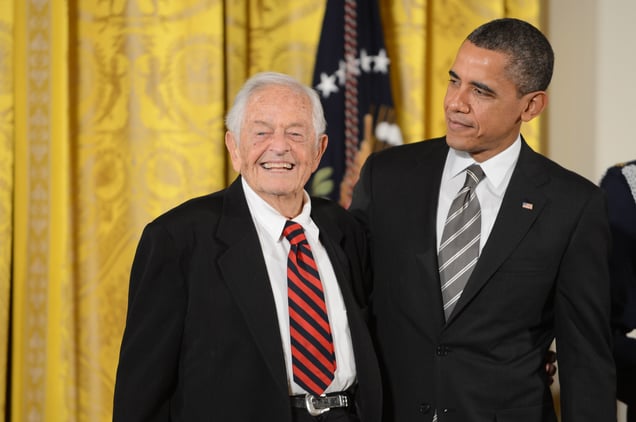
T. Berry Brazelton received the Presidential Citizen’s Medal in 2013. (Christy Bowe/Corbis via Getty Images)
I’m looking at the prospect of toilet training with dread. Should my wife and I stick it to the man, or will we luxuriate in the comforts of Big Disposable Diaper for as long as we can?
The difference in revenues from a country that toilet trains its children at, say, 24 months, compared to one that doesn’t finish until 36 months is striking. If a baby goes through ~50 diapers per week, at a cost of ~33 cents each, the American diaper industry makes ~$858 off every kid during that extra year. With ~3.6m babies born in the US annually, that’s $3.1B every year.
Most parents, for what it’s worth, appear content with the status quo. After Pampers launched the controversial Brazelton ad for the size six diaper, the brand’s GM told reporters the vast majority of phone calls commenting on the new product were positive.
Occasionally, though, Pampers heard dissent. The message from those parents was loud and clear: “Shame on you for doing this.”
consumer products