Five experts weigh in.

The mania had started with something real. The safety bicycle: equal wheels, pneumatic tires, a chain drive. The first bicycle model where the rider’s feet could actually touch the road if they needed to stop.
Too bad speculators didn’t keep their feet on solid ground.
“Suddenly, everyone wants to own a bicycle,” says Will Quinn, associate professor of finance at Queen’s University Belfast and co-author of Boom and Bust: A Global History of Financial Bubbles.
The year was 1897 and the bicycle boom had hit Birmingham hard. Tradesmen north of the city bent and brazed steel into frames. When the owner of Dunlop Tires, Ernest Terah Hooley, saw the surge, he jumped. He bribed journalists, packed company boards with noblemen and bought companies for cheap and sold them to the public at a markup.

Ernest Hooley, one of the British entrepreneurs behind the Birmingham bicycle boom. He’d go on to declare bankruptcy four times. (Photo by the Print Collector/Getty Images)
People began daytrading bicycle shares. Nearly every small bicycle company in Birmingham, ~400, went public; there was a rush on the London Stock Exchange and share prices boomed by 10x.
“About a year after that, three quarters of them have gone bankrupt,” says Quinn, who has studied 300 years of financial bubbles.
At the time, The Economist wrote that investors had subscribed millions “on the assumption that high prices would be maintained, but that delusion has been rudely knocked on the head."
By the end of 1898, the small investors who had bought in late lost the most; the promoters and early insiders had long since cashed out.
But it wasn’t all bad: it created jobs. It left thousands with bicycles. And it laid the foundation for what would become the automotive industry.

The bicycle boom in Birmingham inspired new bike-friendly women’s clothing designs too. (Photo by London Stereoscopic Company/Hulton Archive/Getty Images)
From the bicycle frenzy to the dot-com boom to today’s AI race, financial history is littered with bubbles.
So what happens when they pop?
For Quinn and his co-author, Queen’s University Belfast professor John Turner, the bubble is a poor metaphor. They prefer fire.
The necessary ingredients for this kind of fire, according to Turner:
- Fuel: from low interest rates and freely available credit.
- Marketability: regulatory or technological changes that enable people to buy and sell the bubble asset more easily.
- Speculators: new investors entering the market, and experienced investors unable to short the market.
From there, Turner says, you need a spark: a radical new technology, let’s say, that promises to upend the world.
With the caveat that no one can predict the future (or, as Georgetown University finance professor Jim Angel told The Hustle, “you really only know after the fact, and everybody wakes up with a hangover and goes, ‘what were we thinking?’”), we asked five experts to weigh in on what an AI bubble would mean for the stock market, the job market, and the everyday lives of Americans.
For the stock market
First off, the amount of money being spent on AI is unprecedented. Morgan Stanley predicted hyperscalers will spend a collective $1.4T by 2028. Wells Fargo estimated $1.1T by 2027.
“It’s an extraordinary amount of money,” says Ryan Cummings, chief of staff at the Stanford Institute for Economic Policymaking.
That kind of spend brings behemoth revenue expectations for the companies on the receiving end of the outlay, like Anthropic, OpenAI, and Alphabet.
“If you don’t hit those revenues this year, you need more next year,” he says. “The burden increases over time the longer you go on without hitting those targets.”
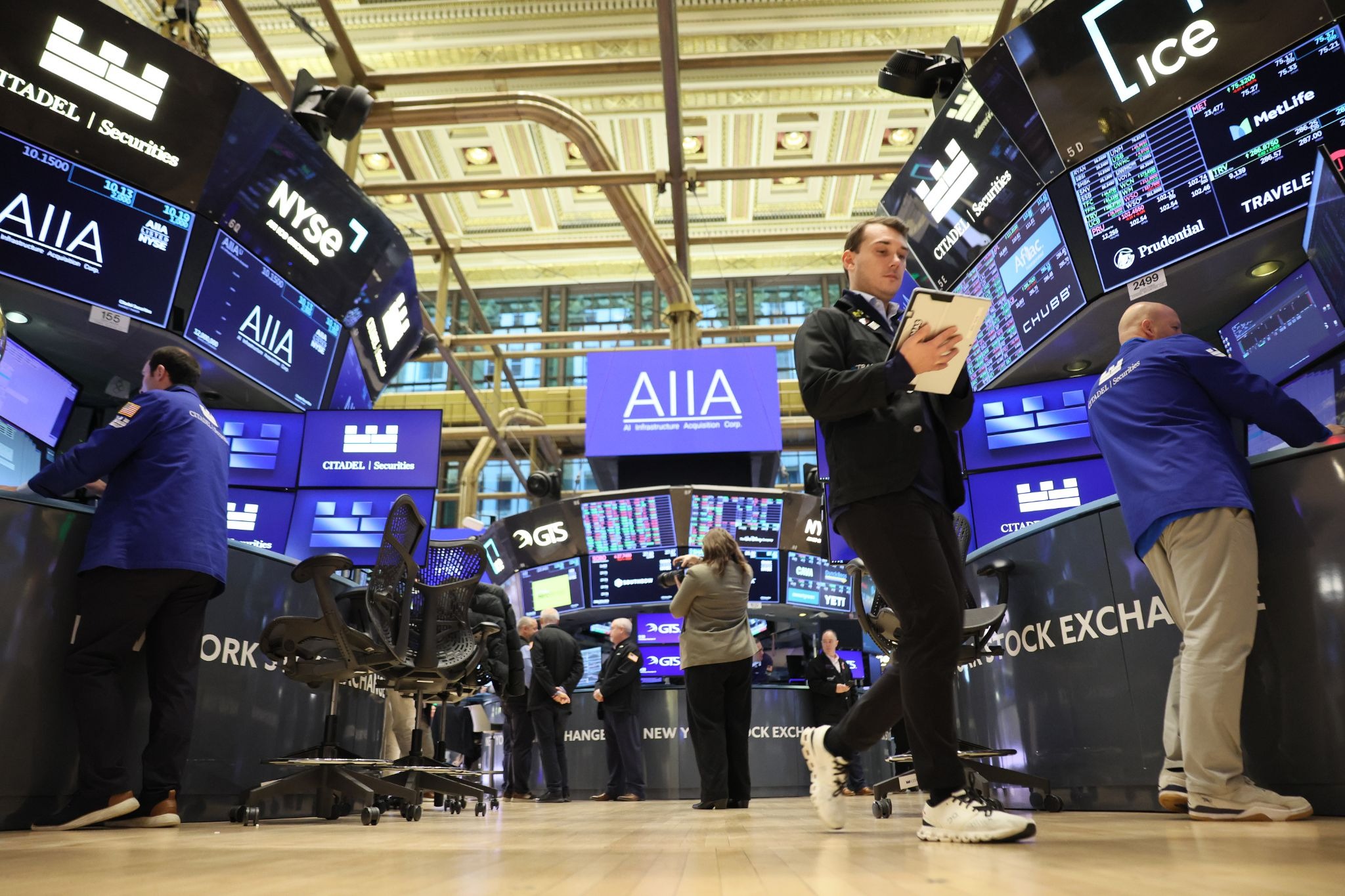
Investors are watching how capital expenditure spending on the AI infrastructure build-out tracks against revenue. (Photo by Michael M. Santiago/Getty Images)
And there’s good reason to be wary of much-touted upcoming IPOs from Anthropic and OpenAI.
“All these firms are receiving these very, very high valuations,” Cummings says. “But they’re all being priced as though they’re all going to be the winner of AI. We know not all firms are going to make it.”
Still, if the bubble does pop, most of the damage will be localized to investors unless major institutions are borrowing money to try to capitalize on the boom.
“You don’t know who’s swimming naked til the tide goes out,” Angel says. “To discover some banks lost their shirts — that can have knock-on effects through the rest of the economy.”
For the job market
Like everything else AI-related, experts are divided on what it will mean for the job market.
“In the short term, there’s a construction boom,” says Azeem Azhar, tech entrepreneur and founder of Exponential Views research group. “From a labor market perspective, that’s a really, really good thing because it creates all sorts of new jobs.”

Azeem Azhar speaks at a conference on “If this is an AI bubble, what comes next?” in November 2025. (Photo by Jordan Peck/Getty Images for Business of Fashion)
Data center infrastructure means construction jobs — one 2025 report funded by Meta estimated 4.7m.
But those jobs are temporary. And data centers themselves require just 50 to 200 people to run them. In the meantime, according to data from Goldman Sachs, AI substitution wiped out roughly 25k jobs per month in the past year, while augmentation added back about 9k.
“The theory that AI will suppress office jobs because it can summarize emails seems to hold up,” he says.
Still, Azhar says, it’s too soon to tell what kinds of jobs AI will create. When the internet was invented, he says, it spawned complementary businesses now worth billions. He predicts AI will cause the same creative surge.
For your retirement fund
If you’re a young person stressing about the AI bubble’s impact on your retirement fund, Cummings has a piece of advice.
“Just look at a picture of the S&P 500,” he says. “I’m just leaving my money in the market.”
More broadly, though, bubbles can trigger something called the wealth effect.
Let’s say you need $2m for retirement, and your 401k shows that you have $2.5m. There’s froth to spend on a nice car or a home renovation. Suddenly, the stock market goes down and your nest egg looks more like $1.5m.
“You’re cancelling that vacation, not getting the new car, not buying the new appliance,” Cummings says. “That puts a decline on the entire economy.”
That possibility is something Cummings is watching warily. “I would be very surprised if we got through 2028 without a recession,” he says.
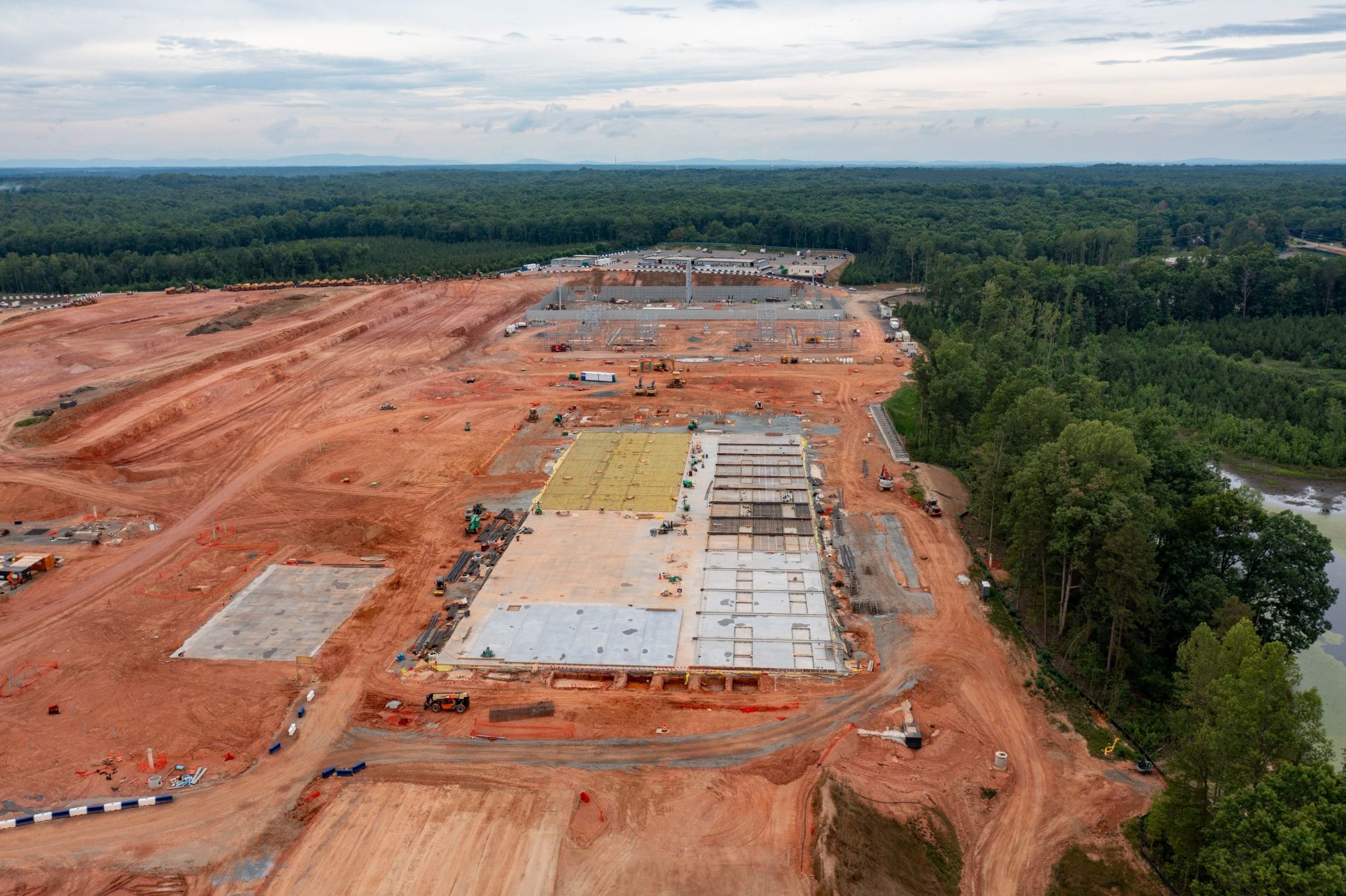
Amazon builds out a massive data center in rural Virginia. (Photo by Jim West/UCG/Universal Images Group via Getty Images)
That could leave GenX facing a retirement crisis. Just 14% of them have a traditional pension, compared to 56% of boomers, according to a report from Alliance’s Retirement Income Institute, making them more reliant on the aftershocks of a stock market bubble.
It took the S&P 500 years to come back from the dot-com bust in 2002: Around five years to get back to its high point, before the 2008 financial crisis wiped it out again. It wasn’t until 2013 that it fully recovered.
Another difference in this bubble, Turner says, is how much the everyday investor might not realize their exposure. In previous bubbles, you could choose whether to invest in the bubble stocks or not. Today, ~$23T is invested in ETFs, which weren’t nearly as prominent back in the dot-com boom.
“If you’ve got an S&P 500 tracker fund, 35% of that tracker is in those big Magnificent Seven stocks, being driven by the AI boom,” he says. “They’re going to be exposed to this in a way that maybe they hadn’t been in previous bubbles.”
For your everyday life
The word bubble gets tossed around a lot. But there’s a critical difference between a potential AI bubble and, say, the housing bubble of 2008.
Like the dot-com bubble before it, the AI bubble is, so far, largely fueled by equity. The housing bubble was propped up by debt, which made its consequences farther reaching.
“There’s an expectation that bubbles are always really bad,” Quinn says. “It’s not a given that the bursting of the bubble will be economically devastating, not at all.”
Whether AI radically changes the world or not, for Cummings, the solution remains the same.
“It’s having a more robust social safety net,” he says. “It’s the same lesson to the dot-com boom, to the financial crisis, to Covid. You find people who lost their job and give them support. They have a roof over their head, food in their bellies, care if they have some sort of medical condition. People talk in lots of complicated ways about what the lesson is. It’s not that complicated.”
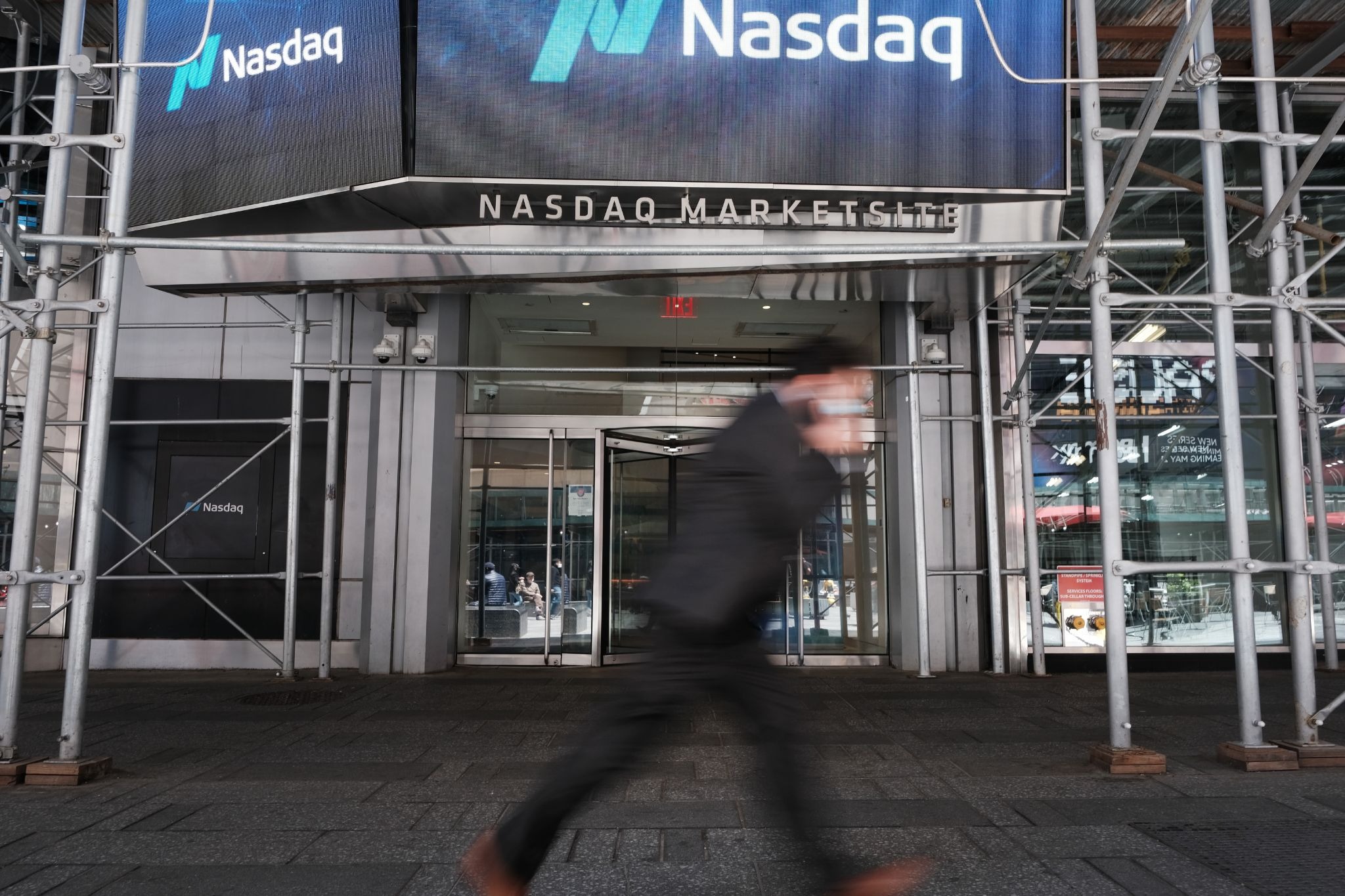
The Nasdaq fell 77% after the dot-com bubble burst. (Photo by Spencer Platt/Getty Images)
Turner returns to his fire metaphor. Fires can have devastating consequences. When the dot-com bubble burst, nearly 5k companies went under and the Nasdaq fell 77%. The year the housing bubble burst, 860k American properties were repossessed.
Still, he says, technology bubbles tend to leave less damage, in part an overvaluation and subsequent crash still leaves behind a real, tangible product we can use.
“Fire can be good for some ecosystems,” he says. “Fire revitalizes. That’s true with a lot of technological bubbles, they actually help revitalize the ecosystem.”
Consider the dot-com boom and bust. It minted millionaires and led to a recession, he says.
“It also gave us the internet. We got this amazing information communications technology infrastructure build-out,” he says. “And, you know, society benefitted from it.”