
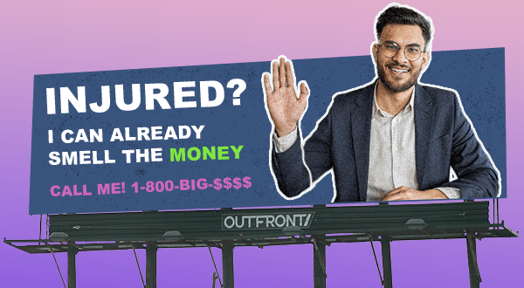
The art and science behind attorney advertising
When San Fernando, California, attorney Arvand Naderi is walking around town, it’s not unusual for random people to greet him enthusiastically. But they don’t say hello. Instead, many shout out the phrase, “Guns n’ dope!”
To which Naderi knowingly responds, “Don’t lose hope!”
The exchange may seem odd to the uninitiated. But alongside a picture of his face, the catchy couplet (“Guns n’ Dope? / Don’t Lose Hope!”) has been plastered on one of his firm’s billboards off the 118 freeway in neighboring Pacoima for seven years, turning him into something of a local celebrity.
Since the criminal defense attorney started advertising on billboards ~10 years ago, he estimates he’s purchased ~50 of them. He says he spends $100k+ on billboard advertising a year.
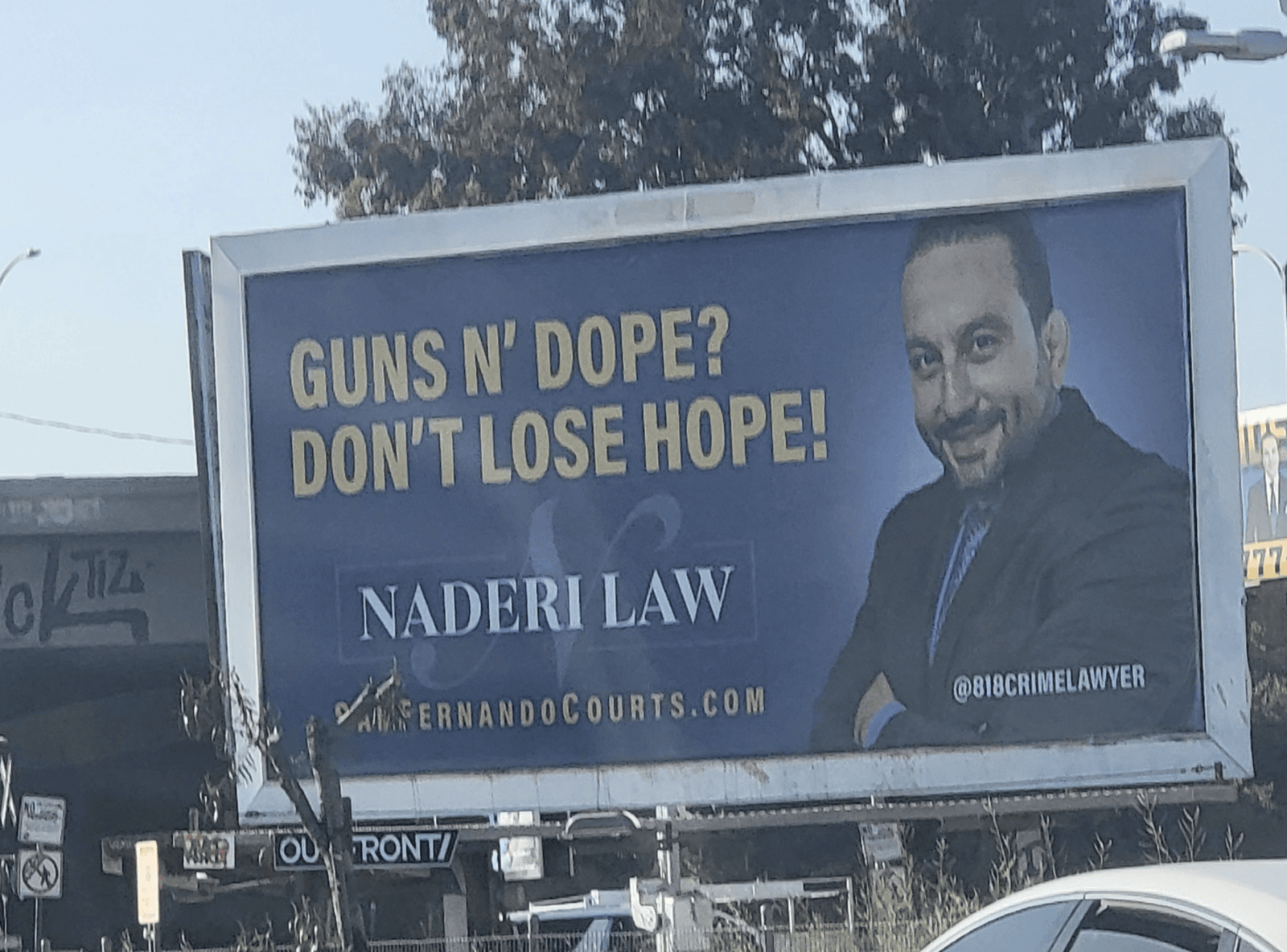
California lawyer Arvand Naderi grins from one of the many billboards that have turned him into a regional star. (Reddit)
Naderi’s ads may be unique, but his reliance on billboard advertising to build his firm is not.
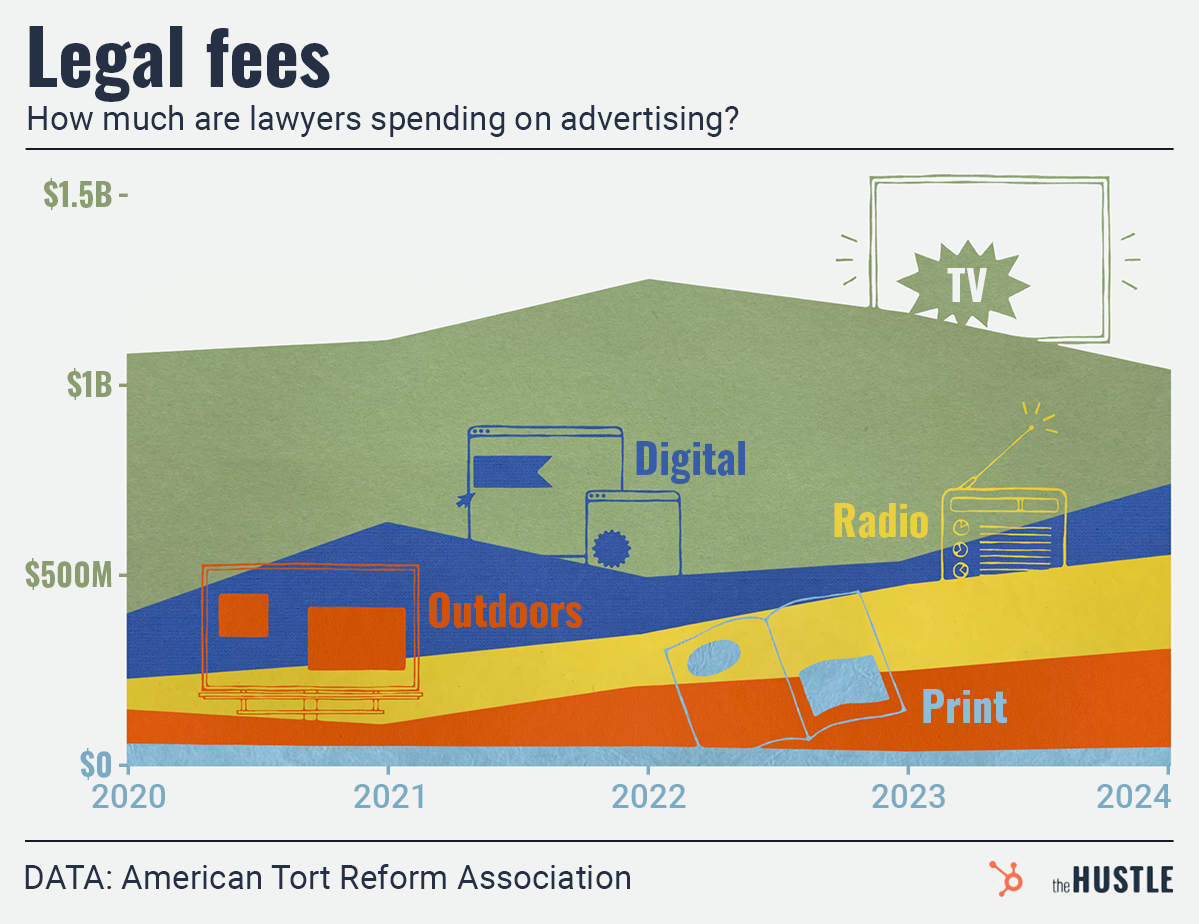
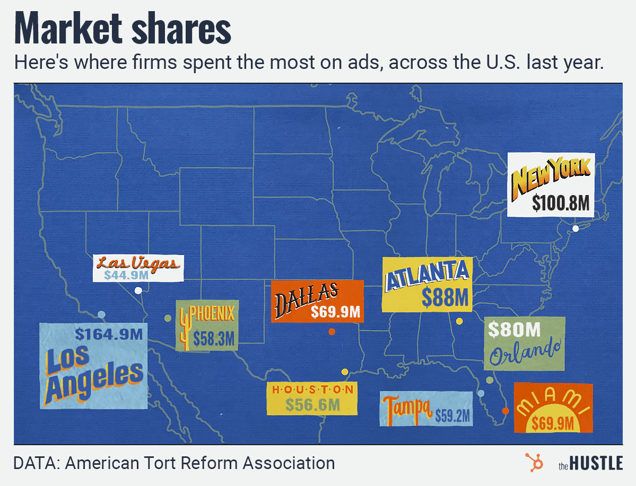
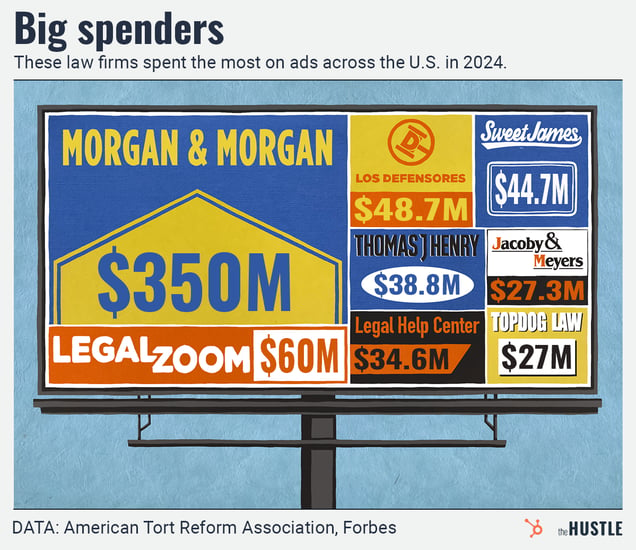
The American Tort Reform Association, a lobbying group that advocates for caps on award damages and changes to current civil liability laws, estimates that in 2024 attorneys spent $541m+ on out-of-home and outdoor ads, a category that includes billboards as well as space on buses, subways, and other public areas. This is an increase of $70m compared to 2023 and nearly $200m from 2022. Morgan & Morgan, the country’s largest personal injury firm, reportedly spends a staggering $350m annually on marketing alone.
So why are so many law firms, from single-attorney practices to firms with thousands of employees, investing so heavily in billboards?
Eat or get eaten
As our world is increasingly lived online, advertising has shifted along with it. The business intelligence firm Research and Markets reports that in 2024 the value of the global digital marketing industry was $410B, and is projected to reach $1.2T by 2033.
Billboards, on the other hand, are stubbornly, laughably low-tech. They’ve barely changed since the first ones appeared in the US in the 1860s. They’re also not cheap. In Los Angeles, for example, billboards range from $5k to $9k a month (and far more in iconic, highly touristed places such as Sunset Boulevard). So what explains their massive appeal today?
The first reason is competition. According to the American Bar Association, in 2024 there were 1.3m practicing attorneys in the United States, a ratio of one attorney to every 260 Americans. While the number peaked in 2019, with 1.352m practicing attorneys, since 2000 this cohort has grown, on average, by 1% a year.
“If you do not advertise, you will get eaten by people like me,” says Brooke Goff, a personal injury attorney in Connecticut.
 Olivia Heller/The Hustle
Goff has certainly put her money where her mouth is. Her ads, a mix of clever puns and pictures of her cutting it up with celebrities including Vanilla Ice (“Slip and fall on ice ice baby? Call Goff Law”), Flavor Flav, Mike Tyson, Chevy Chase, and Detroit Lions quarterback Jared Goff (no relation), dot all of the state’s major highways.
While the billboards are playful — they’re highlighted regularly in the r/Connecticut subreddit, no small honor — Goff takes them extremely seriously. To ensure her name and face stay in the minds of the hundreds of thousands of people who drive past her ads daily, she tries to change them every eight weeks. While she wouldn’t go into specifics, she says she spends $1m+ annually on her campaigns.
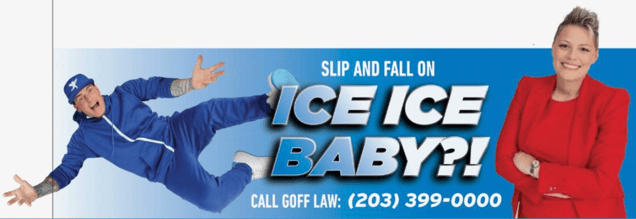 Connecticut lawyer Brooke Goff comes up with her playful billboard ideas in-house. (Facebook)
If this sounds like a lot of work, it is. Goff, whose firm has eight locations, says she now spends far more time on marketing and operations than litigating. “Any good business owner, especially a good lawyer, realizes that at one point, when your firm gets big enough, you have to make a decision whether you're going to litigate the bigger files and run the business, or you're going to just litigate everything and there's going to be nobody that runs the business and you're just going to hope it all works out.”
“Everybody wants that truck wreck”
And a booming business it is. For lawsuit winners, the payoffs can be huge. Plaintiff damages collectively add up to $10B+ every year. And data suggests this figure has been rising steadily.
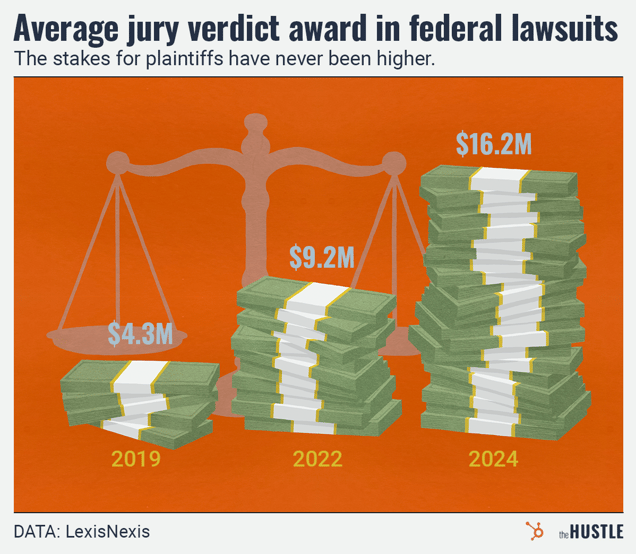
In a recent LexisNexis analysis of 73k federal court cases over the past few years, the legal research and analytics company found that in 2024 the average amount of damages awarded by a jury verdict was $16.2m — nearly double the $9.2m awarded on average in 2022.
Investors have taken notice. In just the past few months, both the Wall Street Journal and Financial Times reported on private equity’s newfound interest in rolling up US law firms. Burford Capital, a litigation financing firm founded in 2009, listed on the NYSE in 2020 and now boasts a portfolio worth $7B. And while their primary focus is on commercial matters such as B2B contract disputes, patent issues, and antitrust cases — not the types of cases that attract plaintiffs via billboard advertising — their valuation illustrates just how hot the litigation finance market has become.
 Olivia Heller/The Hustle
So for better or worse — we’ll get to this debate in a bit — there’s a huge potential pot of award money. But if firms want to access it, they have to find a plaintiff with a strong case — and before their competition. That’s where billboards come in.
“Everybody wants that truck wreck,” says Bobby Steinbach, founding partner at MeanPug Digital, an attorney marketing agency in Brooklyn. “Because PI [personal injury] is direct-to-consumer, it can affect anybody. It's not like estate planning, where you're targeting a very potentially small set of folks: people that have high net worth or a lot of assets. [PI ads] can really be relevant to anyone and everyone.”
And if you want to target “everyone,” there’s no substitute for hanging a huge rectangular advertisement on the side of a busy roadway.
This realization is what motivated Naderi to start advertising ten years ago. “One day I was sitting at a light and I'm like, ‘Goddamn, people really read these.’ Because I read every single one.”
The science and art of a successful billboard
Still, just because a lawyer has a billboard doesn't guarantee success. In such a crowded field, you have to stand out if you want to build a memorable brand.
Some types of law, like criminal defense, more easily lend themselves to a provocative (i.e., stickier) message. Another one of Naderi’s greatest hits is a billboard with the line "Cops knocking? I'll do the talking.” With the help of one of his employees, he even came up with a hard-hitting rhyme for a Spanish-language advertisement: “Cuetes y cocaína? Llame a mi oficina!” (The less-melodic English translation: “Guns and cocaine? Call my office!”)
On the tamer side, there are attorneys like Chandler Mason, aka My Bald Lawyer™ (tagline: “Injured? Don’t pull your hair out!”). The Atlanta-based personal injury attorney is one of several follicularly challenged attorneys around the country who lean into their appearance. Others include, but are surely not limited to:
- The Bald Divorce Lawyer
- Bald Guy Legal
- Kalikhman & Rayz, aka “Philly’s Brightest (and Baldest) Injury attorneys”
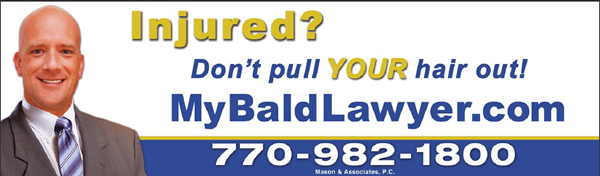
Atlanta lawyer Chandler Mason uses his appearance to his punny advantage. (Courtesy of Chandler Mason)
Regardless of a billboard’s theme, Steinbach, of MeanPug Digital, says there are certain golden rules all successful ones follow. He would know; before he founded MeanPug in 2020, he was a director of engineering at personal injury colossus Morgan & Morgan.
The first is that the attorney’s phone number should be big and visible. “There [are] two reasons for it. Number one is obvious: you want people to know how to contact you. The little thing that’s less obvious is you don't want to have to pay the ‘Google tax,’” or the fees companies pay to ensure they show up high in Google Search results.
The second is that the billboard should be highly readable with a strong color contrast.
Those are just the basics. For an attorney’s brand to really stand out in the marketplace, their billboard has to go beyond old cliches. “Most want to do the boring, arms-crossed, ‘I'm such a pitbull and I'll fight for you,’” says Naderi. “And it's so stupid. That's like 1990s advertising.”
 Olivia Heller/The Hustle
Mason believes being self-deprecating helps potential clients connect to him. “[It shows] you're not talking to some high priest of the law,” he says. “You're talking to someone who you know is relatable.”
Steinbach agrees that humor can be a key differentiator. He says a clever billboard can punch above its weight, potentially anchoring a much larger strategy. “If you can create highly memorable messaging… you're kind of putting everything else you do on steroids.” Today’s funny billboard tagline can become tomorrow’s radio jingle or TV ad.
Measuring success
So, if American attorneys are collectively spending hundreds of millions of dollars on billboards, how do they know if theirs is working or not?
“At the end of the day, it's all kind of guesswork,” says Steinbach. Unlike in digital marketing, which offers tetrabytes of data on PPCs and clickthrough rates, it’s difficult to pinpoint the conversion rate of a sign that sits on a roadway for months on end.
Goff, the Connecticut attorney, says she takes a broader view of success. “What tells the story is, are we growing year over year? And is that growth in line with people reporting that they're seeing us on billboards?”
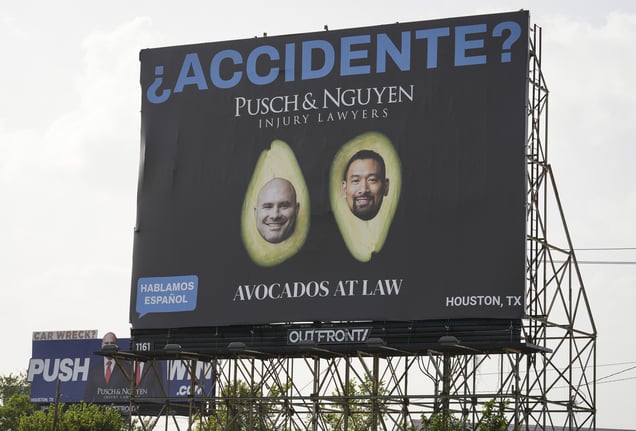 When Houston lawyers George Pusch and Hieu Nguyen split, it caused a wave of messy litigation and rebranding from billboards like this one. (Yi-Chin Lee/Houston Chronicle via Getty Images)
“Most if not all of the clients that reach out to us, they'll never say ‘Hey, we saw your billboard, and that's why we're calling you,’” says Mason. Like Goff, he views his billboards as a way to consistently promote his brand message.
“We don't know when someone's going to need an attorney,” he says. But if they do, and they live in the Atlanta area, ideally their first thought will wander to the bald guy whose friendly face has been smiling back at them for years.
Objection, Your Honor
As billboards and monetary damages have grown, so has opposition to them. Critics such as the ATRA argue that the settlements being awarded to plaintiffs are unreasonably large and hurt consumers, driving up the costs of insurance that businesses and medical service providers must purchase.
Another tort reform organization, Protecting American Consumers Together (PACT), launched this past January. In one of their first press releases, they announced they would be committing $10m this year to “targeting the exploitative practices of the predatory personal injury system—commonly known as billboard attorneys.” Some of PACT’s major funders include Waffle House, Uber, and the Owner–Operator Independent Drivers Association, a trade association for independent truck owner-operators.
Lauren Zelt, the executive director of PACT, says the organization is already having an impact. In April, the Georgia General Assembly passed two tort reform laws PACT supported. One more tightly regulates how damages can be awarded (though it doesn't mandate a cap), while the other places restrictions on litigation financing, including a requirement for investors to register with the state.
One of PACT’s next targets is the federal government. They’ve been lobbying Congress to pass the Tackling Predatory Litigation Funding Act, which, among other changes, would tax litigation financing at 41%.
 Olivia Heller/The Hustle
Georgia isn’t the only state that has been responding to the current landscape. In October, the California state legislature passed a bill meant to strengthen enforcement against false or misleading legal advertising and prohibiting advertising in certain locations.
Many longtime consumer advocates, however, are skeptical. In their telling, the tort reform movement is a smokescreen for corporations to avoid paying out fair settlements or instituting proper consumer safety protections.
Joanne Doroshow is the founder and executive director of the Center for Justice & Democracy, a consumer advocacy organization affiliated with New York Law school. She says she puts the term “tort reform” in quotes.
“The word ‘reform’ suggests to most people that this would be a positive development. But the way we look at these laws that get passed, they basically are about either stripping everyday people of their legal rights to keep them from going to court or taking away the power and authority of civil juries to award compensation to people who have been harmed,” she says.
“So we don't consider that reform in any sort of positive way.”
She also says it’s hypocritical for pharmaceutical companies and insurers to oppose attorney advertising given how much they spend on their own. (Last year, for instance, Progressive, Allstate, Geico and State Farm spent a combined $7.5B on advertising.)
This is all high-level stuff. But for the armies of enterprising attorneys scrapping to get your attention, concerns are more immediate.
“You have to have that ‘go big or go home’ mentality,” says Goff.
Naderi agrees. “[People] are either gonna be like, ‘God, that guy's a fucking idiot,’ or, ‘Damn, that guy has massive nuts – he must be really good at what he does.’ I'm willing to take that risk.”
advertising