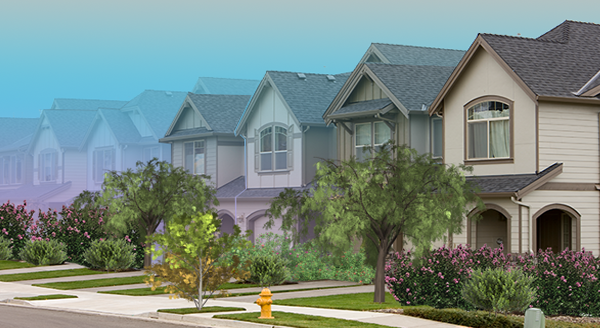
Places like Fulshear and Buckeye are more popular lately than New York City and Boston.
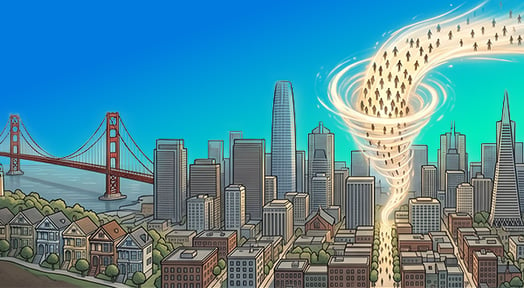
If you’re in your 30s or 40s and having conversations with friends about where to buy homes, you might be hearing some strange names discussed.
- Buckeye, Arizona
- Fulshear, Texas
- Port Chester, New York
- Moncks Corner, South Carolina
- Centralia, Washington
They sound like they’re in the middle of nowhere. But they’re actually adding more residents than Los Angeles and New York City.
In May, the US Census Bureau released new data that highlighted the rapid growth of formerly sleepy towns and struggles for many big cities.
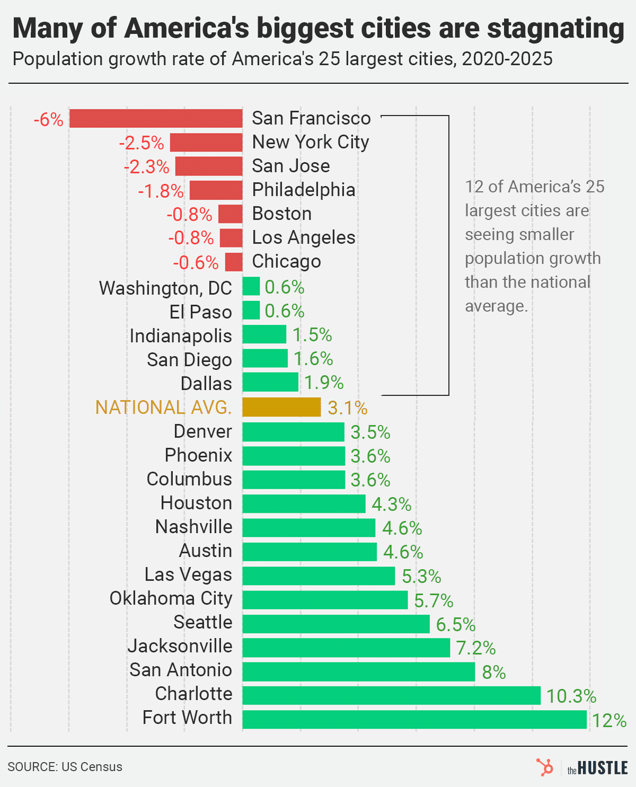
From 2020 to 2025, the 25 largest cities in the US grew by 1.3%, compared to 3.1% for the country as a whole.
Although about half of those cities saw average or above-average growth rates, many glamour cities, like New York City, Boston, and Los Angeles, declined in population. Dallas and Washington, DC, were basically flat.
The Hustle
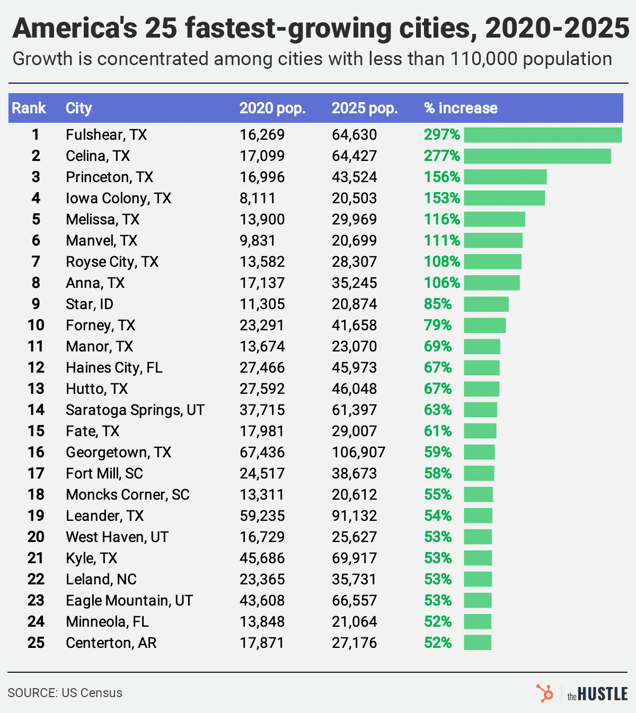
Meanwhile, in the same time period, the 25 fastest-growing cities with at least 20k population were nearly all exurbs on the fringes of metro areas that have seen cornfields and pastures turn into subdivisions and shopping centers.
And this isn’t just a case of smaller places naturally seeing a higher percentage growth over larger places given their size. Over the last year, exurbs like Fulshear and Celina, Texas, saw more numeric population growth than all but five of the 25 largest cities.
The Hustle
Until a decade or two ago, many of these places had populations of just a few thousand. They’re located as far as 50 miles from a city center.
How did so many Americans end up practically in the middle of nowhere? And how far outside of cities are they willing to go?
The 15-minute city vs the one-minute city
The simplest answer for this shift starts back in March 2020, at the onset of the COVID pandemic.
Basement interest rates, coupled with remote work offering the ability to spread out, triggered one of the wildest seller’s markets in recent history. The median home sales price in the US shot up by 35% from late 2019 to late 2022. (They’ve declined slightly since then.)
Before the pandemic, a city like Boston was already unaffordable for middle class residents. But with a median sales price at ~$661k, homes weren’t insurmountable for the upper middle class.
That’s no longer the case. Median home sales prices checked in at $849.6k this spring, according to Redfin, or $764 per square foot. Typical Boston houses are out of reach for all but a small number of residents, even in one of the wealthiest areas of the country.
Price relief comes farther out of the city. Worcester County, an hour’s drive west of Boston, featuring towns like Shrewsbury, has attracted would-be Boston residents. 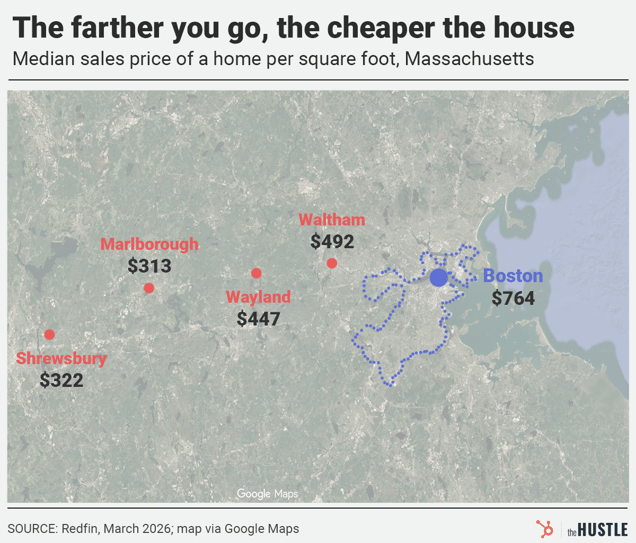
The Hustle
But the shift to exurbs is also about a preference in lifestyle. Many Americans want larger homes than they can get in big cities.
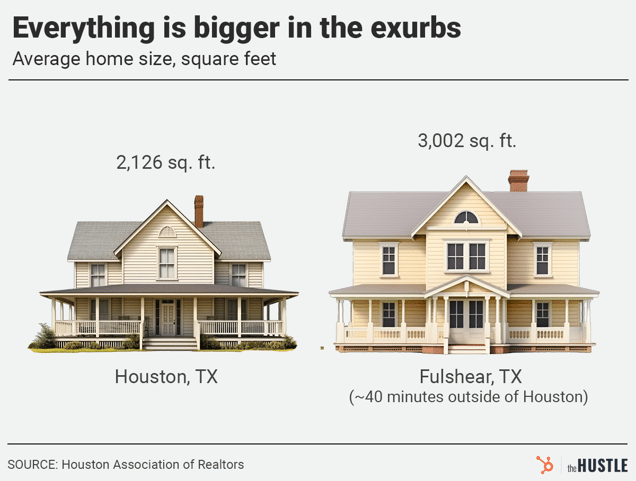
Take Fulshear, Texas, for example. The city, ~40 minutes west of Houston, grew by nearly 300% from 2020 to 2025, from a population of 16.3k to 64.6k.
Houston has plenty of space and sprawl but still doesn’t compare to Fulshear, where the average house size is ~50% larger.
The Hustle

Richard Florida, a prominent urbanist and visiting distinguished professor at Vanderbilt University, has described the urban-to-exurban shift as a preference between a 15-minute city and a one-minute city.
- The 15-minute city, a well-known concept among planners, involves living in a dense area where groceries, parks, restaurants, jobs, and schools are within 15 minutes by walking or public transit.
- The one-minute city is more about loading up on amenities at your house. As Florida explains, it involves living somewhere far-flung with “a gymnasium, a home theater, two offices, play spaces for my kids, a big backyard with outdoor space and a play structure, and maybe a pool.”
Many exurbs have master-planned communities featuring multiple pools, walking trails, soccer fields, and fitness centers, giving them the spirit of a one-minute city.
There might not be a better example for portraying all these shifts than Dallas.
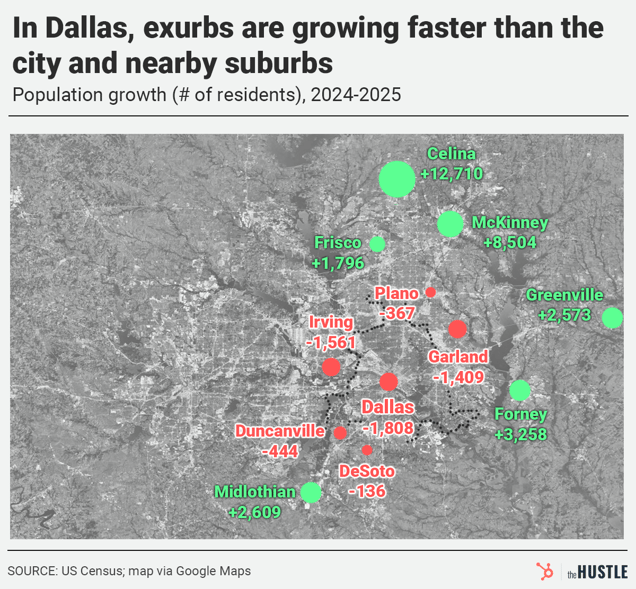
The city lost population from 2024 to 2025 and saw modest growth going back to 2020. The same was true with Dallas’s suburbs. But its exurbs, with more bang for the buck and open space, exploded in population, both from Texans seeking a change and out-of-state newcomers moving in.
The Hustle
Celina, way up north of Dallas, added 12.7k residents from 2024 to 2025. It was also the fastest-growing city in the country (for cities with at least 20k pop.) by percent change in that timeframe. Nearby Princeton, Melissa, Anna, Forney, and Greenville were in the top 15.
How long can this last?
There’s one big problem with America’s exurban boom: these cities might already be too popular.
Many exurbs aren’t particularly cheap anymore. Celina, even with a recent dip, has a median home sales price of ~$488k, more than 5x the Dallas-Fort Worth metro area median income. And traffic, construction, and city services have become major problems for exurbs as they rapidly grow.
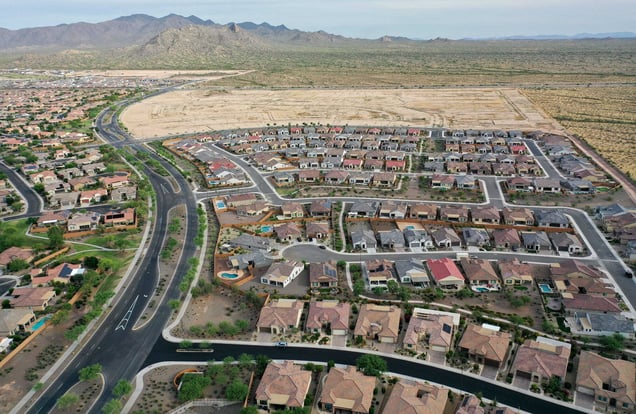
Buckeye, Arizona, one of many fast-growing exurbs outside Phoenix. (Mario Tama/Getty Images)
People who want entry-level homes and open space might have to branch out farther. And given that popular exurbs are already 30-to-50 miles from city centers, is that even possible?
In the 1990s, an Italian physicist named Cesare Marchetti theorized that throughout history and throughout the world people have been willing to spend no more than 30 minutes for a one-way commute, regardless of the mode of transit. His idea is known as Marchetti’s Constant.
Two things have allowed exurban transplants to stay within the confines of Marchetti’s Constant even as they live 45 minutes or more from city centers: remote work and corporate relocations.
- Although the work-from-home rate has fallen far from its pandemic high of ~62% of all days worked, ~25% of all days worked in the US are from home, according to FRED.
- Many businesses are downsizing or leaving downtown headquarters and opening multiple offices in suburbs, as part of what CBRE calls a “hub-and-spoke” strategy.
Developers are betting on these trends to continue.
In Texas, for instance, builders David Craig and Mehrdad Moayedi have announced a $7B investment in an area near the Texas-Oklahoma border, ~75 miles north of downtown Dallas. They envision thousands of homes.
The middle of nowhere just keeps getting closer and closer.
housing and real estate