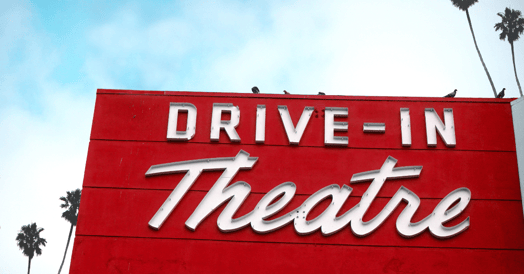
Drive-in movie theaters had fallen to the wayside until the pandemic brought them back as a socially distant way to enjoy the big screen.
- From late March to mid-August of 2020, drive-ins accounted for 85% of US box office revenue, far more than the 2.9% they generated during the same period in 2019.
Today, with pandemic restrictions over and a rally at the traditional box office, CNN Business reports that drive-ins still reflect a “small but meaningful boost” for the movie industry.
A little history
Though versions of drive-in theaters date back to the 1910s, the first was patented by Richard Hollingshead in New Jersey in 1933 as a way for people who couldn’t comfortably fit in traditional seats and families with noisy kids to enjoy a film. They reached peak popularity in the ‘50s and ‘60s, with 4k+ US locations in 1958.
In the ‘70s, after consumers began purchasing smaller cars to save on gas, drive-ins shifted to show less family-friendly content and more horror and exploitation, per the New York Film Academy, before being crushed by the at-home convenience of VHS. In the 2010s, the conversion from film to digital posed additional financial hurdles.
In 2014, Indiana-based US Drive-Ins announced a partnership with Johnny Rockets to open 200 US theaters by 2018. That never happened, and it wasn’t until the pandemic that the medium saw a real resurgence.
Today…
… drive-ins are somewhat rare, with just ~283 across the US in 2024.
Most are independently operated, some by people who’ve reopened shuttered drive-ins as a labor of love. They offer cheaper tickets than traditional theaters and rely on concessions to stay afloat, but people still go:
- Photographer Janie Osborne visited three theaters in Montana, Wyoming, and Idaho for The New York Times, finding audiences across demographics who enjoyed drive-ins’ accessibility. Some didn’t even drive, but biked or walked.
- Theater owners told CNN that nostalgia helps, with audiences turning out for retro screenings of classic faves.
There are also new spins on the format. For example, Swimply, a platform for homeowners to rent out their pools, partnered with Disney+ on immersive “dive-in” screenings in LA, where guests could watch films like Alien in a pool.