


👋 Good morning. We hope all of our marketing friends out there are having an especially good one. To make sure of it, we’ve got something to help you get through the rest of the week: Our newly rebranded sister newsletter, Marketing Against the Grain, delivers proven tactics straight from experts who know a lot more than we do. If you’re a marketer tired of boring marketing advice, take a look.
STARTING UP

Ad-supported period products are here
❌ The problem: While free toilet paper is a mainstay in public bathrooms, period products are usually nowhere to be found.
💡 The pitch: Australian startup On the House doesn’t want to leave women hanging. The startup makes wall-mounted units that dispense free, organic, biodegradable period products. Each dispenser has a 32-inch digital screen that displays advertisements, turning bathrooms into a “social out-of-home” ad channel and generating the money to pay for the supplies inside.
🚀 The outlook: On the House has already partnered with nine brands for its pilot advertisements and its digital dispensers are gracing the bathrooms of entertainment venues and stadiums, with plans to expand nationally to universities, workplaces, gyms, and shopping areas. Article Link
NEWS FLASH
-
Not your average interview: Anduril, Palmer Luckey’s defense startup, is hosting the AI Grand Prix, a drone-flying competition in which contestants see who can write the best autonomous drone-flying software. In addition to a $500k pot, prizes include jobs at Anduril.
-
Faster fillings: Swedish startup Dentio raised $2.3m to expand its AI-powered software, which streamlines admin work in dental offices, to other Nordic countries before a broader European launch. A survey of 50 dentists found Dentio’s software saved 5-7 minutes per patient visit.
-
Barnwell Bio is working to detect potential outbreaks and offer health insights in the poultry industry. It collects foot swabs from barns to examine birds’ fecal matter to both detect pathogens and track gut bacteria levels.
-
Forget your ski jacket? Rotation, a fashion rental startup, partnered with Uber to deliver ski apparel across the UK in 60 minutes or less. Rotation founder Eshita Kabra-Davies called it part of the “emergency economy,” in which 25% of rentals occur within 48 hours of an event.
FROM OUR FRIENDS AT MINDSTREAM

AI is tackling healthcare’s paperwork problem
New York–based Tandem just hit a $1B valuation after raising $100m in funding to automate the slow, frustrating process of getting prescriptions approved and filled.
The tech automates tasks like prior authorizations and follow-up calls and, interestingly, it doesn’t cost healthcare providers or patients a dime.
How’s that possible?
👉 Read more on Mindstream
THE BIG IDEA
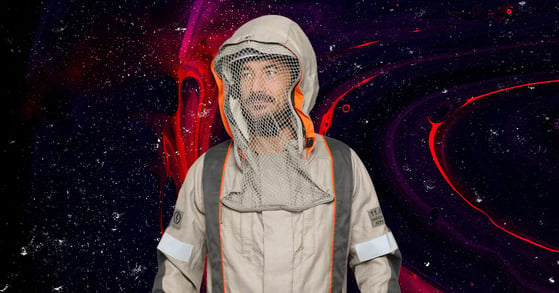
The suit that protects workers from dangerous electricity
Some of our favorite startup innovations are those that make workers safer: for example, the robot that tamps down grain in silos, or the one that paints lines on roads. They offer a practical solution to some of the most dangerous, yet necessary work humans perform.
Power-line work is one of those risky jobs. Though the industry adheres to practices meant to safeguard workers from dangerous currents, fatal accidents can still occur.
One of the biggest hazards is induction:
- That’s when a worker comes into contact with a line or piece of equipment that isn’t supposed to be energized but has become so due to nearby electric or magnetic fields, resulting in shocks, injury, or death.
- There were 81 induction accidents in the US between 1985 and 2021, resulting in 60 deaths, per US Bureau of Labor Statistics data.
But Eduardo Ramirez Bettoni, who helped develop a suit that protects workers and who now works for a power-distribution equipment firm, told IEEE Spectrum that he believes there are hundreds of induction contacts every year in the US alone.
He also suspects incidents are increasing as grid operators attempt to boost capacity.
About this suit…
It comes from Electrostatics, a Budapest startup that makes jumpsuits (complete with gloves and socks) to protect workers.
How they work:
- The suits are made with conductive materials, but also have low-resistance conductive straps through which current can flow out.
- They’re flame retardant and insulated to protect against heat.
- They keep exposure below the “let-go” threshold — when a current is so strong, it causes the muscles to seize involuntarily and prevents someone from releasing themselves.
Electrostatics began selling the suits in 2023, and now provides them to transmission operators across the US, Europe, Canada, and elsewhere. In the US, they cost ~$5.2k per suit.
A small price to pay for safety — and not as expensive as other protective gear. A firefighter’s full outfit, for example, can run between $12.8k and $18.6k.
HIGHLY RECOMMENDED
Gather round to hear the story of Demis Hassabis, the most important entrepreneur you’ve never heard of.
NEWSWORTHY NUMBER

YouTube followers amassed by Bruce, an Australian plumber who has captivated viewers with his on-the-job antics. In each video on his “Drain Cleaning Australia” channel, Bruce assesses a blockage and goes to town, occasionally encountering spiders, snakes, and other very Australian problems while sometimes getting sprayed in the face with sewage.
Why do people want to watch this? Well, Bruce seems to have a delightful number of catchphrases and perhaps it’s interesting to watch a man do a dirty job that he sincerely refers to as “the dream.” Yet as Ars Technica notes, plumbing is actually a popular YouTube subgenre, and Bruce is far from the only one unclogging drains for views.
Given how many people watch pimple-popping videos, maybe we’re just satisfied watching anything become unburdened in these stressful times?
AROUND THE WEB
📆 On this day: In 1929, The Seeing Eye — the first school to train dogs as service animals for blind people — opened in Nashville. Founder Frank Morris had been inspired by a newspaper article he’d read about German Shepherds that helped blind WWI vets.
😮💨 That’s interesting: When it’s actually good to give up.
🐦⬛ That’s cool: A crowd-controlled wildlife cam.
🏷️ Useful: A free label maker.
👋 Aww: Greetings.
SHOWER THOUGHT
You might have spent the same $1 bill a few times and you'd never know it. SOURCE
Today's email was brought to you by Juliet Bennett Rylah and Singdhi Sokpo.
Editing by: Sara "Nothing shocks me" Friedman.
Was this email forwarded to you? Sign up here.
Working on something big?
We've got a whole library of business-building resources for you.
Subscribe to our other newsletters
Stay up-to-date on AI: Mindstream | Expert insights: Marketing Against the Grain | Sell better: The Science of Scaling
