Livestock on the loose? Call this guy
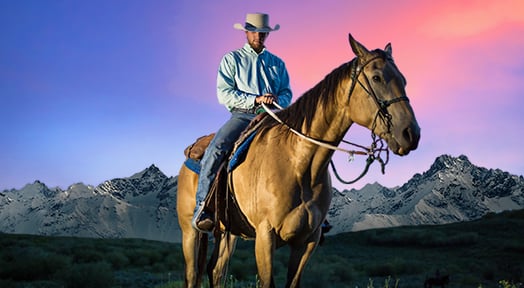
One summer, early on in his career, Illinois cattle catcher Wesley Bush got a call from down in Tennessee. He’d just taken over the business full-time from an old hand cattle herder, and he was still finding his own footing.
The guy explained that, eight years ago, he’d bought a piece of property knowing it came with a herd of cattle that roamed wild. But now he wanted to sell, and the prospective buyer had a stipulation: he needed to deal with the runaway cattle problem. He’d hired several other people to come round them up, but no one could get the job done.
Bush loaded up his Dodge Ram one-ton pickup and hit the road. He traveled alone, just him, his dogs, and his horse behind him in a trailer. “Buddy, this ain’t Illinois. These are the mountains in Tennessee,” his client told him.
“I called up a friend in Kentucky, he met me there,” Bush says. “We were done by 1 o’clock.”
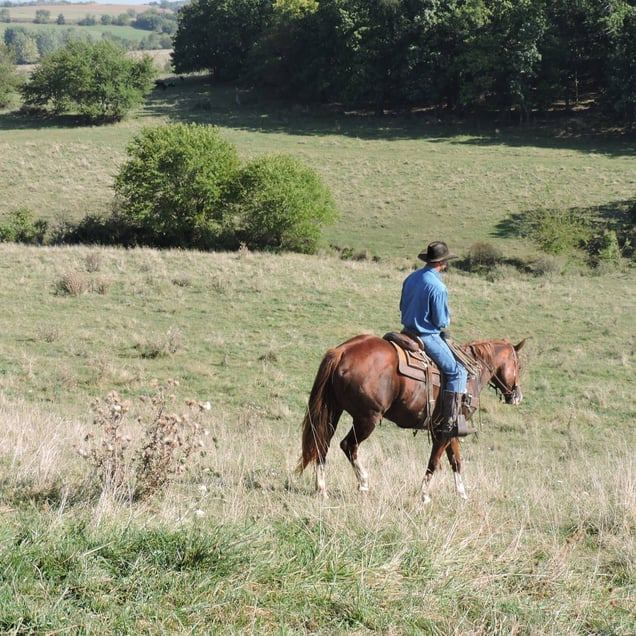 Wesley Bush on assignment. (Facebook)
Bush is one of America’s few remaining on-call cowboys. He’s traveled as far south as Tennessee, across Ohio and Kentucky, and north to Minnesota and Michigan, all in the name of catching cattle. He’s on call 24 hours a day, seven days a week.
Horsing around
Born and raised in Morrison, Illinois, Bush always imagined he’d work with horses. At 13, he expressed interest in learning to rope. He spent a few years training his roping arm and competing in the rodeo.
“I could catch cattle for friends and neighbors who needed help, as long as they were visible, in pasture,” he says. “During the summer, if they were in the corn, I wasn’t any help.”
If the job required figuring out where the cattle had gone, they had to call Chet Peugh, a local man in the next town over running a second-generation cattle-catching business.
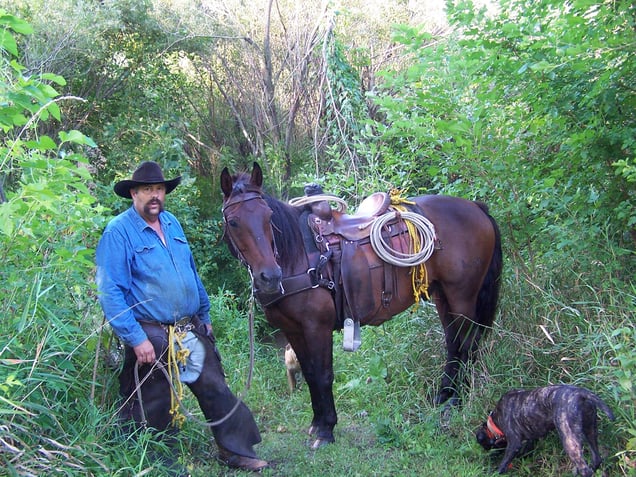 Chet Peugh, a second-generation cattle wrangler, sold Bush his business and has since (mostly) retired. (Facebook)
Bush, in the meantime, heeded his family’s advice and went off to get a college degree. He tried, but it didn’t stick and he dropped out. He worked for horse trainers for a while, then on feedlots and sale barns.
Twelve years later, he moved home to Morrison and happened to run into Peugh, the very guy he knew as a cattle-catcher.
He asked if he needed some help. “Where’s your horse?” Peugh asked him.
Turns out it was five miles away, and Peugh told him to go get it. That chance encounter changed the course of Bush’s career. Together, the pair worked to round up rogue steeds for five years, until Peugh was assured Bush was qualified to run the business on his own.
When he bought the business from Peugh, it came with a couple of crucial items.
“I got his phone number, which is the same phone number that his dad had. Anyone who needed cattle caught 50 years ago might have tried the phone number hoping he’d still answer, and he didn’t but I would,” Bush says.
“Keep that number and you’ll be taken care of,” Peugh would tell his customers.
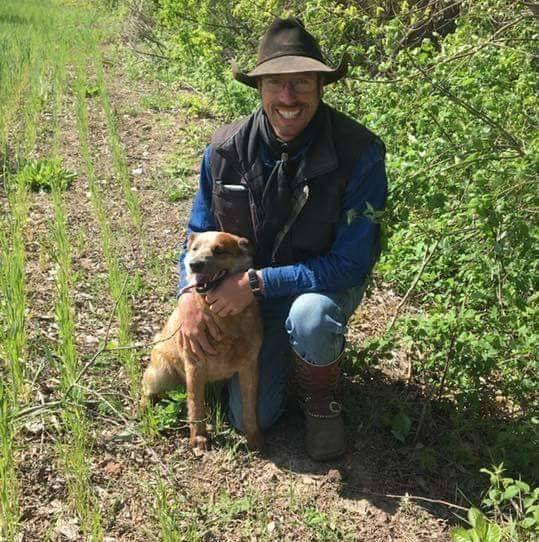 Bush travels with a team of between three and six dogs who track the cattle by scent. (Facebook)
The second was a team of dogs trained to track and find cattle, thicket of corn stalks be damned. (The job comes with a special kind of R&D: Bush now breeds his own dogs – part catahoula, terrier, and hound – to ensure he’s working with an expert team of trackers.)
The dogs join Bush on his cattle calls, and if they can catch a fresh scent, they point him in the right direction. From there, it’s a matter of rounding them up. Usually, he says, a drove on the run will split into groups of 15 or less.
Cost per head
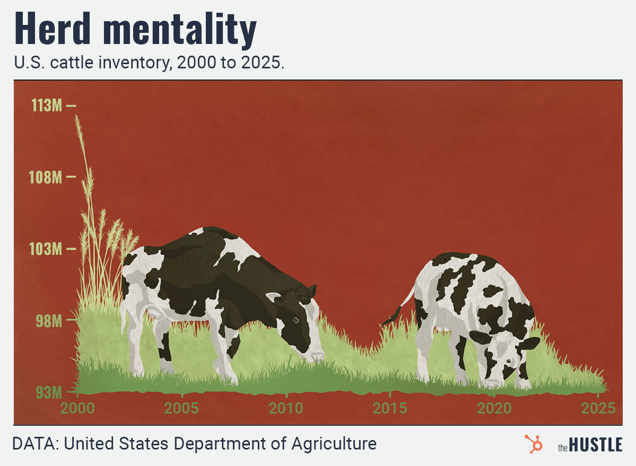
Cattle ranchers and farmers in the US aren’t having the best time. For one, the herd size is constricting: last year, it hit its lowest point since 1951. Production costs are up, reaching record highs, and tariffs have squeezed supplies like fertilizer, pesticides, and tractors and other self-propelled machinery.
Dairy farmers are even testing out new revenue streams, like cow cuddling, to boost a year where prices and demand for dairy have fallen. (Surprised? Bookings for the experience at one Washington County, Penn., farm went from ~500 to 2.5k+ last year.)
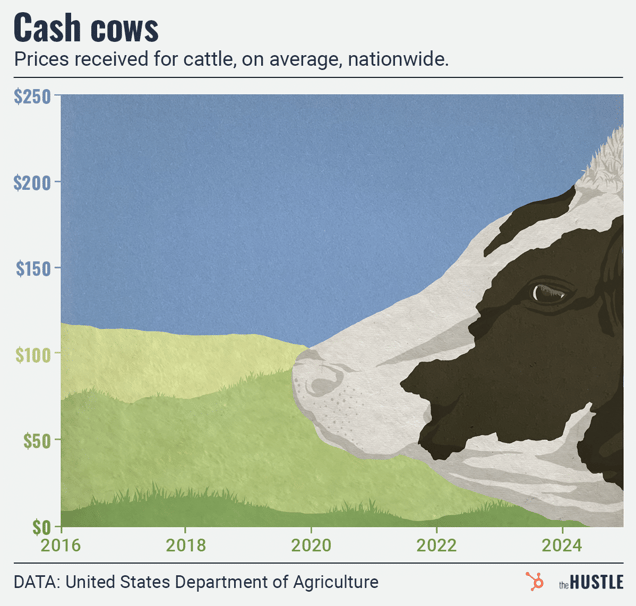
Bush’s pricing follows the market. He quotes his clients a standard fee – by the head – and a mileage fee to account for his travel.
“During Covid, cattle prices dropped drastically and I dropped my prices,” he says. “I currently get about $400 a head on them.”
 Olivia Heller/The Hustle
Still, there are always exceptions. One recent job was 96 head (or cattle) and he had it done in a day, so he cut the guy a deal.
“People say I don’t charge enough,” he says. “I’m amazed at how many people give me a substantial tip.”
Click of the gate
Bush shares ten acres outside of Morrison, Illinois, with his wife and their six-year-old son, plus eight dogs, a few cattle, and a handful of horses. He estimates 90% of his business comes from the phone number he inherited from Peugh, and the rest from his connections across the Midwestern rodeo scene and a smattering of Facebook advertising. His competitive advantage? He’s always on call.
In the winter, on average Bush gets a call once every week or two. When the cattle get out, there aren’t many places to hide or food to scrounge up. Most of the creeks are frozen over. So the owners can usually round them up themselves.
But during the summer, when the crops come up, Bush is taking on two to three jobs a day, only breaking midday to give the dogs a rest from the punishing heat. “I’ll go anywhere the phone rings from,” he says.
Calls come in at all hours, from hobby farmers and ranching conglomerates alike, and within 30 minutes Bush can be out the door and on his way, prioritizing jobs that see cattle meeting highways or putting people or themselves in danger. He likes to get where he’s going by daybreak – 5am in the summer – which can mean a 1am wake-up after getting home at 9pm or 10pm the night before.
“During the summer, there’s a lot of short nights,” he says.
 Olivia Heller/The Hustle
And while the job itself comes with some risks (Bush’s list of injuries starts with a broken leg and ends with a shattered shoulder blade), he says there’s nothing quite like hearing that satisfying click of the gate and helping someone out of a stressful situation.
“When somebody’s cattle are out, it’s a huge liability for them, a very stressful time,” he says.
“The best part of the job is when you can get the job done for somebody and they can relax.”